Stylos is the blog of Jeff Riddle, a Reformed Baptist Pastor in North Garden, Virginia. The title "Stylos" is the Greek word for pillar. In 1 Timothy 3:15 Paul urges his readers to consider "how thou oughtest to behave thyself in the house of God, which is the church of the living God, the pillar (stylos) and ground of the truth." Image (left side): Decorative urn with title for the book of Acts in Codex Alexandrinus.
Monday, February 19, 2007
Hymn Singing, Cyberhymnal, and Family Worship

Saturday, February 17, 2007
Wilberforce on Unitarianism
In his book "Real Christianity," Wilberforce also addressed the rise of Unitarianism in Britain [which was at the time much more "Protestant" than is its contemporary manifestation]:
The Unitarian teachers by no means claim to absolve their followers from the unbending strictness of Christian morality. They prescribe love for God that dominates all life and a habitual spirit of devotion. However, people who seek a refuge in this form of faith seem to go there because they want a watered-down sort of faith; they want the joys of Christianity without the difficult doctrines. In particular, most of them seem to want to escape the Bible’s command to be separate from the world, a unique and special people. They prefer to remain at one with the world’s philosophies….
Christianity has not gone to the same efforts to promote its arguments that the Unitarians have. If they were attacked as they have attacked orthodoxy, and asked to defend their tenets, I doubt they would be able to keep their ground so well. In short, we can find no watered-down alternative to Christianity that can be rationally supported. If we have abandoned Christianity, then we must logically abandon all its forms. We must abandon any hope we have of finding the comfort of faith without its demands.
(As quoted in Lon Fendall, William Wilberforce: Abolitionist, Politician, Writer [Barbour, 2002]: 193-95).
Wilberforce, "Amazing Grace," and the end of slavery

What do you say to a Unitarian?
JPBC February 14, 2007
Jeff Riddle
I. Definitions: What is Unitarianism?
II. Historical Backgrounds:
- Monarchianism.
- Arianism.
- Michael Servetus (1511-53).
- Faustus Socinus (1539-1604).
- John Biddle (1615-62).
- American Unitarian Association formed in 1825.
- In 1961 they merged with the Universalist Association of America to form the Unitarian-Universalist Association.
III. Beliefs:
1. Reason and conscience as authority, vis-à-vis the Bible.
2. Complete religious toleration.
3. The innate goodness of man.
4. Universal salvation.
5. Liberal social agenda. Examples: Pro homosexual behavior/marriage; anti-war, etc.
IV. What do you say to a Unitarian?
1. What does the Bible teach about God?
The Bible teaches the Trinity.
Examples: (1) Baptism of Jesus in Matthew 3; (2) Great Commission in Matthew 28:19-20; (3) Acts 2:32-33; (4) Romans 1:2-3; (4) 2 Corinthians 13:14.
Does the Unitarian view do justice to Jesus’ own self-understanding?
Compare the claims Jesus made for himself. See:
John 10:30: "I and My Father are one."
John 14:6: "I am the way, the truth, and the life."
Luke 5:17-26: "Who can forgive sins but God alone?" (v. 21).
Does the Unitarian view do justice to the early Christian view of Jesus?
See "Jesus is Lord" (Rom 10:9; 1 Cor 12:3).
See the warning against those who do not preach Jesus properly: 1 John 4:1-3; 5:1, 9-13.
2. Does it make sense to say that all religions deserve equal toleration and consideration?
3. If men are innately good, then why is there so much human evil in the world?
4. If all men meet the same eternal destiny what does this say about the justice of God?
5. Can we ever hope to solve all the world’s problems apart from God’s complete and final intervention?
Tuesday, February 13, 2007
Book Recommendation: Pinocchio
At the end of Lorenzi’s story, the wayward Pinocchio learns to obey his elders, to keep his word, to work hard, and to think of others above himself. As he drifts off to sleep, the Blue Fairy appears to him in a dream and says:
Brave Pinocchio! In return for your good heart I forgive you all your past misdeeds. Children who love their parents, and help them when they are sick and poor, are worthy of praise and love, even if they are not models of obedience and good behavior. Be good in the future, and you will be happy.
When he awakes in the morning, Pinocchio finds he is a real boy and exclaims, "How ridiculous I was when I was a puppet! And how happy I am to have become a real boy!"
What a great book for a child (or adult) to read!
JTR
Tuesday, February 06, 2007
Winter Reflections

"You have set all the borders of the earth; You have made summer and winter" (Psalm 74:17).
"If we are faithless, He remains faithful; He cannot deny Himself" (2 Timothy 2:13).
As I write we are in the midst of a cold snap. All the complaining about warm winters is over. It is keep-your-pets-indoors, wear-layers-of-clothing, see-your-breath-in-a-fog-before-your-face COLD!
When Noah and his family emerged from the ark after the flood, the Lord made a promise to mankind: "I will never again curse the ground for man’s sake, although the imagination of man’s heart is evil from his youth; nor will I again destroy every living thing as I have done" (Gen 8:21). Then, as a reminder of this, the Lord promised the constancy of the seasons. As long as there is seedtime and harvest, cold and heat, winter and summer, day and night, we know that there is a covenant God.
This account reminds me of Paul’s words in 1 Timothy 2:13: "If we are faithless, He remains faithful; He cannot deny Himself." Just as the preservation of the earth does not depend on God’s approval of human conduct, so our salvation does not depend on God’s approval of our human efforts at faithfulness. If we are saved and persevere in the faith, all the glory goes to God alone. "If [read "when"] we are faithless, He remains faithful." Now this is not to make any excuses for slackness in our behavior. The redeemed man will strive to live a godly life. This word humbles us and it gives us hope.
So, when it gets cold outside or the snow starts to fall, consider for a moment a faithful Creator God who has entered into a covenant with unfaithful men whose hearts are evil from youth. Remember also that the same God who is faithful to give us winter and summer is also faithful to keep those who are saved in Christ.
Grace and peace, Pastor Jeff Riddle
Michael Haykin coming to JPBC in October 2007
Winter 2007 Evangelical Forum Newsletter
Monday, February 05, 2007
Great Post-Super Bowl Quote
Wednesday, January 31, 2007
Happy Birthday Stylos!
The Patience of the Saints
"Here is the patience of the saints" (Revelation 14:12).
In reading again through Revelation, the last book of the Christian canon, I was reminded of the comfort and assurance God gives to those who follow the Lamb. Though Revelation describes many evil things, both things present and still to come, things like the wickedness of the beast and his false prophet, it also reminds us that God will ultimately triumph in the end. Good will defeat evil; Christ will overcome Satan; death will be swallowed up with life.
At several points, John points to "the patience and faith of the saints." The believer is given patience—rooted in his faith in Jesus Christ—for enduring trials. What trials are you facing? Have you been sick? Do you fear death? Just last week I got an email from a Pastor in South Carolina who has been a close family friend. The email told me how he had just received word that his 33 year old son had died suddenly leaving behind a wife and infant child. Truly, no man knows his time (Ecclesiastes 9:12). Are you frightened by the world’s wars and rumors of war? Are you worried that you might not be able to get your bills paid this month? Do you fear for the waywardness of a son or daughter? Have you lost fellowship with a Christian friend? Are there moments of bewilderment and even despair?
Christian, hear the comfort of Scripture. God’s hands are firmly on the steering wheel of the universe. God will triumph over evil in the end. Nothing can take you out of his hands (John 10:29). Look at how God takes care of birds and plants, and "Are you not of more value than they?" (Matthew 6:26).
"Here is the patience and faith of the saints."
Grace and peace, Pastor Jeff Riddle
Wednesday, January 24, 2007
In Zeus They Trust

An AP story the other day reported that a group of modern pagans reinstituted worship of Zeus in Athens for the first time since the 4th century AD.
The comments of these neo-pagans sound more like those of politically correct moderns than what you might read from Zeus' faithful in Homer.
Reading suggestion: The Swiss Family Robinson
Looking for a good book to read on Christian family or an entertaining book to recommend to an older child? Check out Johann Wyss’ classic, The Swiss Family Robinson (make sure you get hold of an unabridged version!). The Disney movie, only loosely based on the book, of course, eliminated all the spiritual and explicitly Christian elements. Wyss’ tale of a Swiss family (father, mother, and four sons) shipwrecked on a deserted island is really a story about Christian family. The father (a pastor) is a wise spiritual leader who defends the family, teaches his young sons to be resourceful and good, and frequently leads his family in prayer and devotions.
After ten years on the island, the father reflects on their circumstances:
The shade of sadness cast on my mind by retrospect of this kind was dispelled by thoughts full of gratitude to God, for the welfare and happiness of my beloved family during so long a period. I had cause especially to rejoice in seeing our sons to manhood, strengthened by early training for lives of usefulness and activity wherever their lot might fall.
And my great wish is that young people who read this record of our lives and adventures should learn from it how admirably suited is the peaceful, industrious, and pious life of a cheerful, united family to the formation of strong, pure, and manly character.
The Spiritual Discipline of Reading
Let me take this opportunity to urge our church body to take up the discipline of reading through the Bible over the course of the next twelve months. It is not too late to take up this resolution. Begin reading three chapters a day. Or, read five chapters per day at least five of seven days in a week. Bible intake is essential to our growth in Christ.
If reading the whole Bible seems daunting, make it your personal goal to read at least through the entire New Testament. Begin in Matthew and read through to the end of Revelation. Put a book mark in your Bible and register your progress.
Our first priority in reading is the Word of God. There is no substitute for this. In addition (as a supplement and not a replacement!) begin the discipline of reading good Christian literature. In an 1863 sermon on Paul’s exhortation to Timothy to "bring the books, but especially the parchments" (2 Tim 4:13), famed London preacher Charles Spurgeon urged believers to pursue the discipline of reading:
You need to read. Renounce as much as you will all light literature, but study as much as possible sound theological works, especially the Puritanic writers, and expositions of the Bible. We are quite persuaded that the very best way to be spending your leisure is to be either reading or praying. You may get much instruction from books which afterwards you may use as a true weapon in your Lord and Master’s service. Paul cries, "Bring the books"—join in the cry.
Beware of just picking up any book off the shelf at the Christian bookstore. In general, avoid works on the current Christian bestsellers. We have some good books for sale at JPBC by the side entrance. We have also set up a table with various Christian tracts and booklets in the sanctuary offered at no cost. These include evangelistic tracts, devotional, doctrinal, and family works. Next time you are at church, pick up something to read that will feed and grow you in Christ.
Grace and peace, Pastor Jeff Riddle
Thursday, January 18, 2007
Christian meets Ignorance
As Christian leaves the Delectable Mountains on the highway towards the city, he meets with "a brisk lad" whose name is Ignorance. Ignorance is a man who strives to be religious and live a good life, but who is ignorant of the fact that one is only saved through Christ alone (Solus Christus).
Christian learns that Ignorance is heading for the Celestial City, but this man has not begun his journey by passing through the "Wicket-gate."
Christian asks how Ignorance hopes to enter the gates of the Celestial City without the parchment given those who pass through the Wicket-gate:
Christian: "But how do you think to get in at the gate, for you may find some difficulty there?"
Ignorance: "As other good people do."
Christian: "But what have you to show at the gate, that may cause that the gate should be opened to you?"
Ignorance: "I know my Lord’s will, and I have been a good liver; I pay every man his own; I pray, fast, pay tithes, and given alms, and have left my own country for whither I am going."
Christian: "But thou camest not in at the Wicket-gate that is at the head of this way; thou camest in hither through that same crooked lane, and therefore, I fear, however thou mayest think of thyself, when the reckoning day shall come, thou wilt have laid to thy charge that thou art a thief and a robber, instead of getting admittance to that city."
Ignorance: "Gentlemen, ye be utter strangers to me; I know you not: be content to follow the religion of your country and I will follow the religion of mine. I hope all will be well. And as for the gate you talk of, all the world knows that that is a long way off of our country. I cannot think that any man in all our parts doth so much as know the way to it; nor need they matter whether they do or no, since we have, as you see, a fine pleasant green lane, that comes down from our country the next way into the way."
Seeing that Ignorance is "wise in his own conceit" Christian and Hopeful discuss how they are to respond. Hopeful concludes with this verse:
"Let Ignorance a little while now muse
On what is said, and let him not refuse
Good counsel to embrace, lest he remain
Still ignorant of what’s the chiefest gain
God saith, Those that no understanding have,
(Although he made them) them he will not save."
Wednesday, January 17, 2007
Racism is Sin
The passing of another Martin Luther King, Jr. Holiday brings reflection on the Biblical view of the relationship between people of different ethnic groups. The Bible speaks of a person’s nation (ethnos) rather than "race."
When Paul preached on the Areopagus (Mar’s Hill) in ancient Athens, he reminded the cultured Gentiles that the God of the Bible is the God of the nations: "And he has made from one blood every nation (ethnos) of men to dwell on all the face of the earth…."
In his letter to the Galatians, Paul says that for those who have put on Christ, "There is neither Jew nor Greek, there is neither slave nor free, there is neither male nor female; for you are all one in Christ Jesus" (3:28).
What matters is not the ethnos to which you belong in the flesh but whether or not you have been made part of the "holy nation (ethnos)" composed of those called "out of darkness into His marvelous light" (1 Peter 2:9). Have you by grace through faith come to know Christ? This is what matters.
When Southern Baptists revised our confession, the Baptist Faith and Message, in 2000, an article was added that addressed "The Christian and the Social Order." Included was this line: "In the spirit of Christ, Christians should oppose racism, every form of greed, selfishness, and vice, and all forms of sexual immorality, including adultery, homosexuality, and pornography."
Though in this age there remain differences among men in language, cultures, and customs, what matters now is whether or not we are in Christ. Let us put racism behind us and preach the gospel to all nations!
Grace and peace, Pastor Jeff Riddle
Monday, January 15, 2007
Answering a Friendly Challenge: What Do I Have in Common with a Neo-Pagan?
Okay... so we disagree. That's not exactly unexpected. Where do we go from here? Or do we simply abandon dialogue altogether? You've suggested some books, and I might have some suggested books as well, that I'd wish you to read. Knowing how busy I suspect both of us are, I sincerely doubt we have the time to get through each other’s reading lists. I did however go back and reread the Bible verses that you referenced (and I concede that the "rocky ground" metaphor might possibly apply, since I was but a youth when exposed to Christianity). So... instead I offer a friendly challenge. I would ask that you write an entire blog entry about only the points we seem to agree upon. I will then do the same (although I don't currently have a blog, I can make one, or find an appropriate community forum). If this is successful, then maybe we can take things a step further. I have little power over our group (being non-hierarchical and all) but I am willing to take this dialogue further if that's of interest to you. If not, then I wish you well.
Lonnie, I do appreciate and respect the tone in which you have entered this dialogue. I also very much appreciate the fact that you were willing to read the Biblical texts I suggested to you for interpreting your previous spiritual experiences.
So, the challenge is for me to post "the points we seem to agree upon."
From a worldview perspective, I think it will be hard to find things we agree upon. I am a conservative, evangelical Christian who believes in the full authority (inerrancy) of Scripture. You are a self-described Neo-pagan. We do not agree on epistemology (how do we know what is true), theology (who God is), anthropology (who man is), Christology (who Christ is), soteriology (salvation), or ethics (what is just, right, and good).
I would sum up our agreement, however, in this: We both believe that no one should force another person to engage in a religious practice or belief against his or her conscience. I would not, for example, attempt to make you a "Christian" at the point of a sword and hope that you would not attempt to make me a neo-pagan by the same means.
Now, I do believe there is much that we have in common (though perhaps we would not agree about this). Here are the things I believe we have in common:
1. We are both human beings made in the image of God and, therefore, have a God-given dignity and value, merely by virtue of our humanity (see Genesis 1:27).
2. We are both sinners. As Paul put it: "All sin and fall short of the glory of God" (Romans 3:23). We have sinned against a holy and righteous God. We inherited our sin nature from our first parents, Adam and Eve. We are sinners from the moment of conception, even before we commit actual transgressions (see Genesis 3; Psalm 51;3; Psalms 58:3). "We are not sinners because we sin; we sin because we are sinners."
3. Sin has badly tarnished or wounded the image of God in us. On the spiritual level our ability to seek God has been deeply damaged to the point that aside from the grace of God we will not seek the God of the Bible. As Paul put it: "There is none righteous, no, not one. There is none who understands. There is none who seeks after God" (Romans 3:11-12). This is not to say that men are irreligious. We love to create gods and religions that meet our needs. When the Apostle Paul went into ancient Athens, he told the inhabitants, "I perceive that in all things you are very religious" (Acts 17:22). Paul even noted that the Athenians had an idol to "the unknown God," and then declared, "the One whom you worship without knowing, Him I proclaim to you" (v. 23).
4. Despite the impact of sin, all human beings are still capable of doing some good things and some things that are pleasing to God. Christians call this "common grace."
5. No matter how "good" we are in this life, we will both receive the just wrath of God for our sin for all eternity, until and unless, God, by his sovereign grace, saves us and brings us to believe in Jesus alone: "He who believes in the Son has everlasting life; and he who does not believe the Son shall not see life, but the wrath of God abides on him" (John 3:36).
Lonnie, please understand that Christians do not feel that we are superior spiritually or ethically to other people (including people who are neo-pagan). Faith in Christ, rightly understood, should fill one with awe and humility at the grace of God.
One of my favorite passages in the Bible is 1 Corinthians 6:9-11. First Paul describes all those who will not be able to enter into the kingdom of God because of their sin in vv. 9-10:
9 Do you not know that the unrighteous will not inherit the kingdom of God? Do not be deceived. Neither fornicators, nor idolaters, nor adulterers, nor homosexuals, nor sodomites,
10 nor thieves, nor covetous, nor drunkards, nor revilers, nor extortioners will inherit the kingdom of God.
He then adds this final note to the Christians at Corinth in v. 11:
And such were some of you. But you were washed, but you were sanctified, but you were justified in the name of the Lord Jesus and by the Spirit of our God.
Christians know we deserve God’s wrath as much as anyone else. We are not inherently more spiritual than other men, or more kind, or more good. Any good we do we must attribute to God’s grace and given Him glory for all things.
JTR
Wednesday, January 10, 2007
Paul Washer is Coming to JPBC (Again!)
Tuesday, January 09, 2007
Christian meets Atheist
Now after a while they perceived afar off, one coming softly and alone all along the highway to meet them. Then said Christian to his fellow, "Yonder is a man with his back toward Zion, and he is coming to meet us."
HOPEFUL: "I see him; let us take heed to ourselves now lest he should prove a Flatterer also." So he drew nearer and nearer, and at last came up unto them. His name was Atheist, and he asked them wither they were going.
CHRISTIAN: "We are going to Mount Zion."
The Atheist then fell into a very great laughter.
CHRISTIAN: "What is the meaning of your laughter?"
ATHEIST: "I laugh to see what ignorant persons you are, to take upon you so tedious a journey; and yet are like to have nothing for your travel but pains."
CHRISTIAN: "Why, man? Do you think we shall not be received?"
ATHEIST: "Received! There is no such place as you dream of in all the world."
CHRISTIAN: "But there is in the world to come."
ATHEIST: "When I was at home in mine own country, I heard as you now affirm, and, from that hearing went out to see, and have been seeking this city this twenty years: But find no more of it, than I did the first day I set out."
CHRISTIAN: "We have both heard and believe that there is such a place to be found."
ATHEIST: "Had not I, when at home, believed, I had not come thus far to seek: But finding none (and yet I should, had there been such a place to be found, for I have gone to seek it further than you), I am going back again, and will seek to refresh myself with the things that I then cast away, for hopes of which I now see is not."
Then said Christian to Hopeful his fellow, "Is it true which this man hath said?"
HOPEFUL: "Take heed, he is one of the Flatterers; remember what it hath cost us once already for our hearkening to such kind of fellows. What! No Mount Zion! Did we not see from the Delectable Mountains the gate of the city? Also, are we not now to walk by faith? Let us go on, said Hopeful, lest the man with the whip overtake us again. You should have taught me that lesson, which I will round you in the ears withal: ‘Cease, my son, to hear the instruction that causeth to err from words of knowledge.’ I say, my brother, cease to hear him, and let us believe to the saving of the soul."
CHRISTIAN: "My brother, I did not put the question to thee for that I doubted the truth of our belief myself, but to prove thee, and to fetch from thee a fruit of the honesty of the thy heart. As for this man, I know that he is blinded by the god of this world. Let thee and I go on, knowing that we have belief of the truth, and ‘no lie is of the truth.’"
HOPEFUL: "Now do I rejoice in hope of the glory of God." So they turned away from the man; and he, laughing at them, went his way.
JTR
Christian at the cave of Pope and Pagan
In the light therefore he came to the end of the valley. Now I saw in my dream, that at the end of the valley lay blood, bones, ashes and the mangled bodies of men, even of pilgrims who had gone this way formerly: And while I was musing what should be the reason, I espied a little before me a cave where two giants, Pope and Pagan, dwelt in old time, by whose power and tyranny the men whose bones, blood, ashes, etc., lay there, were cruelly put to death. But by this place Christian went without much danger, whereat I somewhat wondered; but I have learnt since, that Pagan has been dead many a day; and as for the other, though he be yet alive, he is, by reason of age, and also of the many shrewd brushes that he met with in his younger days, grown so crazy, and stiff in his joints, that he can now do little more than sit in his cave’s mouth grinning at pilgrims as they go by, and biting his nails, because he cannot come at them.
Sadly, it seems that Christian’s intelligence that Pagan "has been dead many a day" was in error. Apparently, he was only slumbering and has now awakened in these postmodern days. Likewise, his twin Pope does not now seem to be so "stiff in the joints." Many pilgrims passing by their cave are mangled by these brutes and their bones, blood, and ashes added to the pile before they can pass by to the Celestial City. Pilgrims, beware.
JTR
Wednesday, January 03, 2007
Spiritual Inventory for a New Year
Survey minutely your inclinations and thoughts, your words and actions, even from your earliest years. Put to yourself seriously questions such as these: What have I been intending and pursuing all my days? What has been the rule of my conduct? The maxims of men or the Word of God? The customs of the world, or the example of Christ? What has the supreme love of my heart been fixed on? Have I given to Christ, or to the world, my strongest desires and warmest attachments? Has it been my habitual intention to please God, or to please myself? Has it been His glory that I have aimed at in every pursuit, or my own gratification, wealth or honor? Is it in heaven or upon earth that I have been chiefly aiming, to lay up treasures for myself? Has God in Christ been the delightful subject of my frequent meditation and conversation? Or have I regarded religious thoughts and converse as insipid and wearisome? Have I been out of my element when employed in the delightful work of prayer and praise, of reading and hearing the glorious Gospel? And have I found more pleasure in licentious mirth and trifling conversation? Have I kept the Sabbath, and with holy reverence frequented the sanctuary of the Lord? Or have I profaned His Sabbath, and poured contempt on His ordinances? And have I relied for all my right to eternal life on the surety-righteousness of Jesus Christ, and trusted cordially in Him for all His salvation? Or have I relied for a title to life partly on my own works, and trusted in Him for a part only of His salvation? Propose with impartiality these questions to yourself, and suffer conscience to return a faithful answer, in order that you may so discern your self-deformity, as to abhor yourself, and repent in dust and ashes.
Grace and peace in the New Year, Jeff Riddle
Tuesday, January 02, 2007
High housing costs in C-ville and rootlessness
JTR
Wednesday, December 27, 2006
Stark on Slavery: Part 2: What about Pagans and Humanists?
He notes that no philosopher of Sumer, Babylon, or Assyria "ever protested against slavery" or expressed any sympathy for its victims.
Plato saw slaves as "lacking the mental capacity for virtue and culture" p. 326). At his death, Plato’s estate included five slaves.
Aristotle justified slavery since slaves were "more akin to brute beasts than to free men" (p. 327). "Upon his death, Aristotle’s personal property included fourteen slaves" (p. 327).
Opposition to slavery developed only among Jews (the Essene and the Therapeutae sects) and Christians.
What about men of the Enlightenment? Surely these noble humanists opposed slavery! Think again, Stark says (see p. 359-60). Stark notes that "a virtual Who’s Who of ‘Enlightenment figures fully accepted slavery" (p. 359). These included Thomas Hobbes, John Locke (he invested in the African slave trade), and Voltair (who supported the slave trade and believed in the inferiority of Africans). We can add to our list of humanist slavery supporters Baron Montesquieu, Compte de Mirabeau, and Edmund Burke (he saw abolitionists as "religious fanatics").
Stark concludes: "It was not philosophers or secular humanists who assembled the moral indictment of slavery, but the very people they held in such contempt: men and women having intense Christian faith, who opposed slavery because it was sin" (p. 360).
The end of slavery in the West did not come through the efforts of humanists but from Quakers in North America, the preaching of the aged John Wesley, and the efforts of evangelical churchmen like William Wilberforce and the "Clapham Sect" in Great Britain.
Stark on Slavery: Christianity contrasted with Islam
Stark notes, on the contrary, that of all the world’s religions, "only in Christianity did the idea develop that slavery was sinful and must be abolished" (p. 291).
Further, Stark notes that when slavery was introduced in the New World by Europeans, its eventual abolition, "was initiated and achieved by Christian activists" (p. 291).
According to Stark, "the excesses of political correctness have all but erased awareness that slavery was once nearly universal to all societies that could afford it, and that only in the West did significant moral opposition ever arise and lead to abolition" (p. 291).
Stark attempts to "put the record straight" by sketching how "Christian theology was unique in eventually developing the abolitionist perspective" (p. 292).
For those enamoured with pre-Christian and pagan societies and religions, they should note the common practice of human slavery in the ancient world.
Those who see no differences in religions should compare the Christian view of slavery with that of Islam. Stark notes that slavery was not abolished in Saudi Arabia until 1962 and not in Mauritania until 1981 (p. 303)!
Stark also asks those who argue that slavery was less abusive in Islamic areas than in the New World to simply note "how few people of black ancestry one observes in Islamic nations, compared with the New World" (p. 304). Given that there were approximately the same number of African slaves who went to both destinations, Stark says that Islamic nations "ought to have very substantial black populations" (p. 303). Why don’t they? Stark says the answer is not infertility or castration "but because infanticide was routinely practiced on infants having black ancestry" in Islamic dominated areas (p. 304).
Why didn’t an abolition movement develop among the theologians of Islam? Stark notes that "the fundamental problem facing Muslim theologians vis-à-vis the morality of slavery is that Muhammed bought, sold, captured, and owned slaved" (p. 338).
Notes from Rodney Stark's "For the Glory of God"
This book is a refutation of Emil Durkheim’s social scientific theory that religion has merely to do with "rites and rituals" and not with what those religions actually believe about who God is. Stark corrects Durkheim by arguing that there are moral implications directly related to what one believe about who God is.
He draws two conclusions: "First, the effects of religiousness on individual morality are contingent on image of Gods as conscious, morally concerned beings; religiousness based on impersonal or amoral Gods will not influence moral choices. Second, participation in religious rites and rituals will have little or no independent effect on morality" (p. 374).
Contrary to the views of many secularists, Stark argues that it was the monotheism of Christianity that gave rise to science, limited the abuses of witch-hunts, and ended slavery (in the West). He concludes:
"Moreover, it was not the ‘wisdom of the East’ that gave rise to science, nor did Zen meditation turn people’s hearts against slavery. By the same token, science was not the work of Western secularists or even deists; it was entirely the work of devout believers in an active, conscious, creator God. And it was faith in the goodness of this same God and in the mission of Jesus that led other devout Christians to end slavery, first in medieval Europe and then again in the new world" (p. 376).
Saturday, December 23, 2006
A Call to Counter-Cultural Christianity
Waldron notes that although Calvinists (and Calvinistic Baptists, in particular) promoted and encouraged religious liberty in America, the rise of the American democratic spirit, in turn, led to the decline of Calvinism in American Churches (Baptists included).
In his closing call for contemporary Reformed Baptist churches to be "counter-cultural" Waldron notes the exposure of "a fundamental tension between the spirit of American democracy and the spirit of Biblical Calvinism" (see pp. 41-43).
He continues:
"Together with much that was good, sound, and even Biblical, there was mixed the little ‘leaven’ of a political philosophy fundamentally the same as that which spawned the French Revolution. Though long restrained and moderated by the vigorously Christian environment, in which it was planted, it blossomed in an increasingly general hostility to biblical Calvinism. Now its fruit is ripening in an America largely dominated by secular humanism and its radical separation of church and state."
Reformed Baptists must face the fact that "they are a counter-culture." Any insistence "on the electing grace and authoritative law of an absolutely sovereign God must seem un-American to their neighbors! In a certain sense it will be!" He adds, "Only sovereign grace can make a 20th century American a Christian."
Waldron concludes:
"Any church, therefore, determined to preach and practice the whole counsel of God in American today must be ready for war. It must be ready to be called many things by those who believe in autonomous freedom and worship at the shrine of individual liberty! Even those who should know better may be alienated by the spirit of the age. Yet the war is not un-winnable…. The secret of winning the war is not compromise with the spirit of this age. It is uncompromising obedience to God which holds the promise of his blessing."
Review: Baptist Roots in America
The booklet has three primary chapters and a conclusion:
I. The Rise of Particular Baptists in America.
His basic thesis is that the early Baptists (pre-1900) were Calvinistic (Reformed), coming out of the English Particular Baptists movement and the Great Awakening. Their guiding confession of faith was the Second London Baptist Confession (1689), a Baptistic revision of the Westminster Confession and the Savoy Declaration. This Confession was adopted (along with two extra articles) by Baptists in America in the influential Philadelphia Baptist Confession of 1742.
II. The Decline of Particular Baptists in America.
Next, Waldron asks, "What happened?" (p. 9). How did early Calvinistic Baptist churches become so doctrinally shallow and Arminian? Waldron traces seven major factors:
1. The American, Democratic Ethos.
"There was something in the political philosophy associated with the American Revolution which was profoundly antithetical to Calvinism. There was something in the Baptist alliance with the likes of Thomas Jefferson which did not bode well for the future" (p. 10).
2. Revivalism.
3. Methodism.
4. Inclusivism.
By this Waldron means an effort to downplay the doctrinal divide between Arminian ("free will") and Reformed Baptists.
5. Hyper-Calvinism.
The "Hard-shell" views of men like Daniel Parker (1781-1844) led to "passivism in the Christian life and the rejection of evangelistic effort" (p. 22), placing the doctrines of grace in a distorted light.
6. Modernism.
Liberalism began to creep in after the Civil War, and by the 20th century "it was a flood of heresy among Baptists" (p. 25).
7. The Fundamentalist movement.
Waldron notes three harmful tendencies here: (1) dangerous reduction of focus to a few "fundamentals" that downplayed doctrines of grace; (2) domination of Dispensational Premillenialism; (3) Kewick focus on "higher life," a modification of Wesleyan perfectionism rooted in "a Pelagianizing view of sin."
Some of the ill byproducts here included "Easy-believism" and the teaching of "Carnal Christian Theory" (p. 28).
III. The Rise of Reformed Baptists in America.
Waldron cites the popularity of the writings of C. H. Spurgeon and A. W. Pink; the founding of Westminster Seminary; and the Banner of Truth’s reprinting of Puritan literature as influences that have led to the contemporary reclamation of the Particular Baptist tradition in America.
IV. Concluding Observations.
Waldron closes by describing "the counter-cultural character of the Reformed Baptist movement in America" (p. 41).
He urges Baptists to beware the dangers of "anti-creedalism" which "opened the door to Arminianism and made it impossible to shut the door against Modernism" (p. 43).
He also warns against falling into "hyper-Calvinism": "The cult of five-pointism must be avoided" (p. 45).
Closing Reflection:
Waldron has given us some keen insights on understanding not just the state of Baptists in America but of evangelicalism in general. Every Virginia Baptist, in particular, should read this booklet. True to Waldron’s thesis, Calvinistic Virginia Baptists (born of the merger of Regular and Separate Baptists in the early 19th century) loosened their doctrinal convictions in the post Civil War era. One can clearly trace this if he goes back and reads the articles in the Religious Herald, the newspaper of Virginia Baptists. J. B. Jeter was the last Calvinistic editor of the Religious Herald. With the transition to R. H. Pitt a period of doctrinal decline was hastened. Pitt used the pages of the Herald, for example, to speak out against the adoption of the Baptist Faith and Message in 1925 (the SBC answer to the fundamentalist-modernist controversy). "Freedom" became more important than "purity." "Anti-creedalism" has led to liberalism.
Thursday, December 21, 2006
Jefferson, Calvinism, and the Roots of American Religious Liberty


Some more thoughts churned up by the comments posted on Pagan Evangelism. In that conversation, I made the following comment: "By the way, how do we think our nation arrived at this position where there is freedom of religious expression? It came through the influence of Christians in the nation's founding." I immediately received a number of reprimands. Here are a few:
- In fact, it has always been my understanding, from my US History studies, that the establishment clause of the 1st amendment was influenced most by the Deistic members of the Continental Congress. Men like Ethan Allen, Thomas Paine, James Madison, and Thomas Jefferson, among others. Okay, it's debatable as to whether Jefferson was really a Deist, but he did coin the term "separation of church and state."
- Sorry, but this statement is contradicted by historical fact. Deists such as Jefferson, Madison, Washington, et al., saw so much violence and intolerance engendered by the various Christian sects in Europe that they realized that a secular nation was the only form in which this country could endure.
- While the majority of individuals in our nation are Christians, this nation wasn't founded upon Christianity, but upon the Enlightenment, which included an explicit rejection of the idea that certain religions should be given special consideration by the government.This is the nation you are living in. It is a secular one, and has been since day one. Much like your hypothetical Christian in India, you are a stranger in a strange land (you just have a rather large expat community here with you.)
- The singular mistake you continue to make is that the founding law of this country was based on Christian principles, bound by Christian law, and answerable to the Christian God -- and this is entirely wrong. The Founders instituted freedom of religion not in the least to ensure freedom from religion, and to ensure that the bloody internecine warfare of the 16th and 17th century did not repeat itself in the New World.
- To say Christianity was behind this is a pretty wild distortion.
- Now, return to the question at hand. It is not "What influenced the Founders?" It's "What's responsible for religious toleration in the US?" And I'll eat my hat if the answer "Christianity is responsible for religious toleration in the US" is anything but a half-truth at best and a lie at worst.I fully grant that early America was super-religious and super-Christian. Now, if you want to show that religious toleration comes from Christianity, from the hyper-Calvinists and Anglicans and Methodists, then go ahead. I'll admit William Penn as a religious defender of toleration, but you can't exactly chalk up the radical social doctrines of Quakers to Christianity. I'll stand by my claim of religious toleration coming from highly unorthodox Christians and Christianity-denying Enlightenment figures.
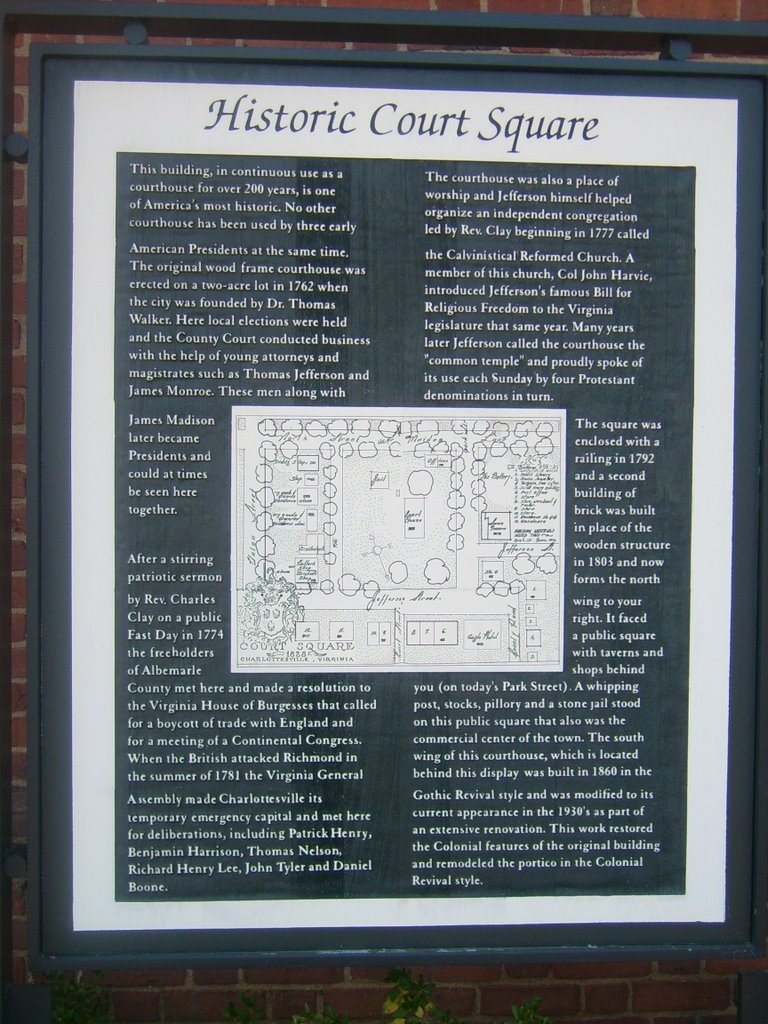
Those who live in Charlottesville might appreciate taking a stroll through Court Square and reading the historic marker there which notes Thomas Jefferson’s role in the 1777 organization of a "Calvinistical Reformed Church" led by Rev. Charles Clay and meeting in the County Courthouse. Notice also that it was a member of this Calvinistic congregation, Col. John Harvie, who introduced Jefferson’s Bill for Religious Freedom in the Virginia Legislature in 1777. Note also how Jefferson referred to the Courthouse as a "common temple" and was proud of its use each Sunday by no less than four Protestant churches in turn.
Why did religious freedom arise in America? Was it because of free-thinking Deists or was it because of committed, Scripture saturated Christians?
For more photos from Charlottesville’s Court Square, check out this photo album.
JTR
Wednesday, December 20, 2006
If there is no God why be good?
The Excellency of Christ

And though his infinite condescension thus appeared in the manner of his incarnation, yet his divine dignity also appeared in it; for though he was conceived in the womb of a poor virgin, yet he was conceived there by the power of the Holy Ghost. And his divine dignity also appeared in the holiness of his conception and birth. Though he was conceived in the womb of one of the corrupt race of mankind, yet he was conceived and born without sin; as the angel said to the blessed Virgin, Luke 1:35. "The Holy Ghost shall come upon thee, and the power of the Highest shall overshadow thee, therefore also that holy thing which shall be born of thee, shall be called the Son of God."
His infinite condescension marvelously appeared in the manner of his birth. He was brought forth in a stable because there was no room for them in the inn. The inn was taken up by others, that were looked upon as persons of greater account. The Blessed Virgin, being poor and despised, was turned or shut out. Though she was in such necessitous circumstances, yet those that counted themselves her betters would not give place to her; and therefore, in the time of her travail, she was forced to betake herself to a stable; and when the child was born, it was wrapped in swaddling clothes, and laid in a manger. There Christ lay a little infant, and there he eminently appeared as a lamb.
But yet this feeble infant, born thus in a stable, and laid in a manger, was born to conquer and triumph over Satan, that roaring lion. He came to subdue the mighty powers of darkness, and make a show of them openly, and so to restore peace on earth, and to manifest God's good-will towards men, and to bring glory to God in the highest, according as the end of his birth was declared by the joyful songs of the glorious hosts of angels appearing to the shepherds at the same time that the infant lay in the manger; whereby his divine dignity was manifested.
Merry Christmas!
In the Lamb, Pastor Jeff Riddle
Tuesday, December 19, 2006
Sunday, December 17, 2006
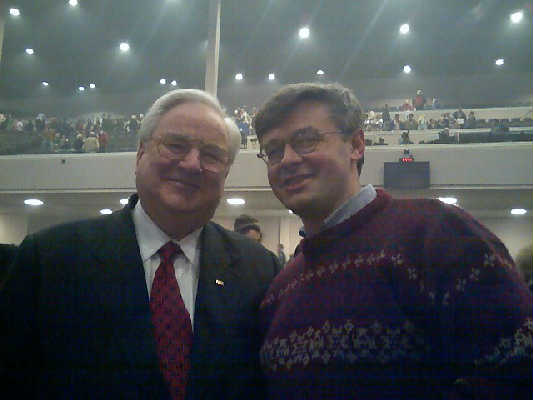
Hanging Out With Jerry

Saturday, December 16, 2006
A Half Dozen or More Responses to an Atheist
By all means, do abandon the public school system to only those tolerant of the beliefs or lack thereof of others. :)
Not long after reading this post, I was struck by Brooke Gladstone's NPR report last Friday on the "new atheist offensive" (listen here). See also Al Mohler’s recent blog post on "The New Atheism?"
Here’s a reply to "Lewis":
To C. Lewis (Not to be confused with C. S. Lewis whom one hopes C. Lewis might read someday),
So, there is no God. Christianity (and other forms of theism, for that matter) are just examples of mass psychological delusion. Our God is just an "imaginary" friend.
Here are a half dozen or more responses to consider:
1. An analogy.
Suppose you came to a village where the inhabitants claim that a certain virus has infiltrated the village. The reports indicate that once a person contracts this virus it completely changes his behavior and life. He begins to speak, act, and even think differently. The virus seems to spread from person to person, though some seem never to get it. You also learn that if a person who has the virus travels to another village that many people in that village will also begin to develop the same virus. In fact you learn that the spread of the virus is a global phenomenon, crossing all boundaries of race, culture, and language.
One day a person in the village, who considers himself to be very enlightened and who does not have the virus, makes an announcement in the town square. "Listen people," he smugly states, "there is no virus." He continues, "This is just a figment of your imagination. You are just fooling yourself. I know you all claim to have these symptoms, but since I myself do not have them, it is plainly obvious that no one has them. Wake up people! The virus is a myth!"
Those who have the virus look at each other puzzled and then go about their business. "If he ever gets the virus, he’ll know the truth. But for now he’s in the dark."
2. Another analogy.
John was born blind. His sighted parents, family, and friends were constantly describing to him all the things they saw. They tried to convey to him the greenness of grass, the yellow of corn, the red of a sunset. One day, John called his family and friends together and announced, "I have come to the conclusion that all of you are fools! There is no such thing as color. That much is as plain as the nose on my face. If there were such a thing as color then I could see it or you could at least explain it to me in a way I could understand."
3. Have you ever considered the teleological argument for the existence of God?
4. Have you ever considered the ontological argument for the existence of God?
5. Have you ever considered the cosomological argument for the existence of God? Of course, none of these rational arguments for theism is ultimately satisfying for a Christian, who must move on to belief in God as Trinity.
6. Have you ever considered Pascal’s Wager? This is not my favorite argument but it’s worth considering.
It goes like this: If I say the God of the Bible is true and you say there is no such thing, we have two possibilities. Either you are right and I am wrong, or you are wrong and I am right.
Possibility one: If you are right, and I am wrong, then you and I come to the end of our lives, we die, and pass into the oblivion of non-existence. At the least, I can claim that my life has been more rich and fulfilling by following a Biblical lifestyle of loving God and loving my neighbor as myself.
Possibility two: If you are wrong, and I am right, then you and I come to the end of our lives, we die, and we pass into the presence of the God of the Bible. At the end of the ages, we receive our resurrection bodies and stand before a righteous and holy God. Our lives on earth are evaluated by one standard: Did we come to believe in Jesus Christ alone for our salvation from God’s wrath for our sin? (see Matthew 10:32-33). You pass into hell where you will experience eternal conscious suffering for your sin under the just wrath of God, and I pass into heaven where my eternal vocation will be enjoying God and giving him glory, because of the saving work of Christ.
Do you want to bet your eternity that you are right and I am wrong?
9. Consider also Psalm 14:1: "The fool has said in his heart, there is no God" (cf. also Psalm 53:1).
Might your situation of spiritual blindness be like that described by Paul in 2 Corinthians 4:3-4?:
"But even if our gospel is veiled, it is veiled to those who are perishing, whose minds the god of this age has blinded, who do not believe, lest the light of the gospel of the glory of Christ, who is the image of God, should shine on them."
JTR
Thursday, December 14, 2006
Ten Ways in Which a Christian Woman Treats Her Husband
1. She follows his lead and responds to his initiative. When he offers leadership in the family, she does not resist or belittle his efforts but intelligently follows. This does not mean that she blindly follows him into sin.
2. She offers him respect and admiration. She knows that most men have a deep need to be looked up to by their families and especially by their wives. She finds qualities in him that are praiseworthy and focuses on those.
3. Her words build him up. She does not put him down with her words. She does not nag him.
4. She puts his needs above her own.
5. She honors and respects him as a man.
6. She is willing to forgive him when he makes mistakes. She does not keep a record of his past wrongs and periodically remind him of them.
7. She prefers him above all other men.
8. She does not resent her role in the family.
9. She compliments him and expresses gratitude for the things he does.
10. She does not let the sun go down on her anger.
Wednesday, December 13, 2006
Ten Ways in Which a Christian Man Treats His Wife
2. He takes the initiative. He does not sit back and wait for his wife to take charge. For example, if a problem arises, he readily admits when he has made a mistake and asks for forgiveness.
4. He puts her needs above his own and those of others. He does not think first of what is best for himself. He thinks first of what is best for his family. He spends time with her. He does not insist in having things done his way.
6. He respects her and treats her as a woman. If he is sitting, he gets up when she walks into the room. He opens doors for her. He lifts heavy things for her. When they go somewhere in a car, he usually drives.
7. He leads the family in spiritual things. He leads the family in prayer and Bible reading. He makes sure the family attends church meetings.
8. He prefers her above other women. He is careful not to pay undue attention to other women. He does not compare her to other women. He does not have close friendships or long, private conversations with other women. She knows he only has eyes for her.
9. He compliments her and expresses gratitude to her for the things she does.
10. He does not let the sun go down on his anger. He never goes to bed at night with a conflict unsettled or leaves the home in anger.
Tuesday, December 12, 2006
A Masterpiece of the Holy Spirit
We have seen some of his works in creation. But there was one particular instance of creation in which the Holy Spirit was more especially concerned; viz., the formation of the body of our Lord Jesus Christ. Though our Lord Jesus Christ was born of a woman, and made in the likeness of sinful flesh, yet, the power that begat him was entirely in God the Holy Spirit—as the Scriptures express it, "The Holy One of Israel shall overshadow thee." He was begotten, as the Apostles' Creed says, begotten of the Holy Ghost. "That holy thing which is born of thee shall be called the Son of the Highest." The corporeal frame of the Lord Jesus Christ was a masterpiece of the Holy Spirit. I suppose his body to have excelled all others in beauty; to have been like that of the first man, the very pattern of what the body is to be in heaven, when it shall shine forth in all its glory. That fabric, in all its beauty and perfection, was modeled by the Spirit. "In his book were all the members written, when as yet there were none of them." He fashioned and formed him; and here again we have another instance of the creative energy of the Spirit.
Let’s not forget that December 25 is not the birthdate of Jesus. If a Christian is to discover any meaning in the holiday madness, it will come in quiet contemplation of the mysterious goodness and power of God in the Word becoming flesh and dwelling among us.
Grace and peace, Pastor Jeff Riddle
An Ancient Witness to the Brutality of Paganism
Christian missionaries, pastors, and laymen preaching the gospel and teaching the Bible brought an end to the inhumane suffering of men and beasts in the Roman gladiatorial games, the aborting and abandoning of children in ancient garbage dumps, the binding of women’s feet in China, the burning of widows on the funeral pyres of their husbands in India, and the end of man’s enslavement of man in the Western world (Slavery still happens in some Muslim dominated areas—but there is little outcry by enlightened liberals against the "religion of peace" for this.).
Look at Julius Caesar’s description of the Druids in Gaul in 54 B. C.:
As a nation the Gauls are extremely superstitious; and so persons suffering from serious diseases, as well as those who are exposed to the perils of battle, offer, or vow to offer, human sacrifices, for the performance of which they employ Druids. They believe that the only way of saving a man’s life is to propitiate the gods' wrath by rendering another life in its place, and they have regular state sacrifices of the same kind. Some tribes have colossal images made of wickerwork, the limbs of which they fill with living men; they are then set on fire, and the victims burnt to death. They think that the gods prefer the execution of men taken in the act of theft or brigandage, or guilty of some offence; but when they run short of criminals, they do not hesitate to make up with innocent men (source: Jon E. Lewis, Ed., Mammoth Book of Eyewitness Ancient Rome, pp. 90-91).
Is this one of the "pagan rituals" we want to teach our children?
For a keen reflection on the "salt and light" influence of Christianity and the blessing it has been to humanity throughout history, see also the sermon by Scottish preacher David P. Murray, "What made Great Britain Great?" This message is also a tremendous warning to our nation and perhaps a prophecy of what lies ahead for American evangelicals.
JTR
Thursday, December 07, 2006
Knox on Deborah
Back in October, I preached on the presentation of Deborah in Judges 4, rejecting the naïve interpretation of Deborah as a proto-feminist (listen to the sermon, Deborah: Feminist Icon or Reluctant Leader?).
In the days after the message, I read the great Scottish Reformer John Knox’s "The First Blast of the Trumpet Against the Monstrous Regiment of Women" (read it here) in which he rejects women as rulers in home, church, or, state. His polemic was aimed at his nemesis, Queen Mary ("that cursed Jezebel").
"The First Blast" was part one of an intended three part series that was never completed. Knox presented part one as an anonymous work fearing arrest for treason, but he intended to reveal his name after publication of the third blast.
This work is certainly no favorite of feminists.
At the close, Knox anticipates objections to his argument, noting that his opponents will be quick to raise the example of Deborah as a woman in civil leadership in Scripture.
How does Knox respond? First, he notes that the story of Deborah (and also Huldah) is really about the sovereignty of God. The Deborah account does not establish a "common law" but, "The causes were known to God alone, why he took the spirit of wisdom and force from all men of those ages; and did mightily assist women against nature, and against his ordinary course…. With these women, I say, did God work potently and miraculously; yea to them he gave most singular grace and privilege."
He continues, "For God (being free) may, for such causes are approved by his inscrutable wisdom, dispense with the rigors of his law, and may use his creatures at his pleasure. But the same power is not permitted to man…."
According to Knox God raised up Deborah to expose the spiritual weakness of Israel’s men: He did so partly "to advance and notify the power of his majesty" and "partly he did it to confound and shame all men of that age, because they had for the most part declined from his true obedience. And therefore was the spirit of courage, regiment, and boldness taken from them for a time to their confusion and further humiliation."
He further notes the humility of Deborah’s leadership, that "she usurps to herself neither power nor authority…. No she spoils herself of no power to command, attributing that authority to God."
JTR
Wednesday, December 06, 2006
Foundations for Christian Family: Part 1
Part 1: Family in the Bible
Family is God’s idea. It is not man-made. It is the first institution created by God, and it was created before sin (Gen 3).
1. Family in the Old Testament:
God created mankind as male and female (Gen 1:27).
God created marriage as one man and one woman living together in a covenant commitment lasting a lifetime (see Gen 2:24).
God blessed the family with children (see Gen 1:28 and the command to be fruitful and multiply). In this way we mirror the creativity of God (see Gen 5:1-3).
Sin damaged God’s ideal for marriage and family. Mankind was cursed (see Gen 3:16-19). Brothers fought against each other (see Gen 4:9). Men took more than one wife (see Gen 16:1-3). Sexual perversion increased (see the homosexual lust in Sodom in Gen 19:4-5; the incest of Lot and his daughters in Gen 19:31-32; the adultery of David in 2 Sam 11:2-5).
Still God preserved the original goodness of marriage and family as a place where people can grow in godliness and in knowledge of the Lord (see Deut 6:4-9; Ecc 4:9-12).
At close of OT we have a vision for the restoration of family in Malachi 4:5-6.
2. Family in the New Testament:
Jesus was born into a family with a mother, (step) father, and (later) brothers and sisters (see Mark 6:3).
Jesus also said that he must have first place. Our commitment to him is above our commitment to family (see Matt 10:34-39; Mark 3:31-35).
But Jesus affirmed marriage (see Matthew 19:1-6).
Note in the early church that whole households came to faith in Christ (see Acts 16:15, 32-33).
See also the "household codes" of the NT (Ephesians 5:22-6:9; Col 3:18-4:1).
Note, however, that marriage is not for everyone (see 1 Cor 7:1-2, 7). Some have the gift of celibacy; others never find one to whom it is proper to be yoked. Better to be single and wish to be married than married and wish to be single. Jesus was single and singleness will be our eternal state.
3. Family and Discipleship.
Family is a workshop or laboratory of discipleship. It is where we learn about servant leadership, sacrifice, self-denial, and loving enemies.
Family is there to protect us from sin. It provides an environment for the next generation of believers to be raised up. Satan hates the family and will try to corrupt it. See C. J. Mahaney’s sermon "Cravings and Conflicts" on James 4:1-6 at SBTS chapel (10/26/06).
Pulpit Guardian: Sermon Filter System
Tuesday, December 05, 2006
Former JPBCer clerking at Supreme Court
Monday, December 04, 2006
Tips from Beeke on Time Management
The Striving book is based on lectures Beeke gave in 2004 at the Metropolitan Tabernacle Church in London. I have already read that one and was greatly encouraged by it.
We had thought of inviting Beeke to speak at the Evangelical Forum. I discovered that our best chance of getting him was 2010. He noted that 2009 will be the 500th anniversary of Calvin’s birth and that lots of events will take place around that time, so his dance card is getting full.
I am impressed at how productive this man is. He is a pastor, a seminary President, author, editor and speaker. I asked him how he is able to do so much.
His answer: First, he said he had a good wife who supported him. Second, he said he does not watch television. Third, he does not surf the internet.
JTR
Saturday, December 02, 2006
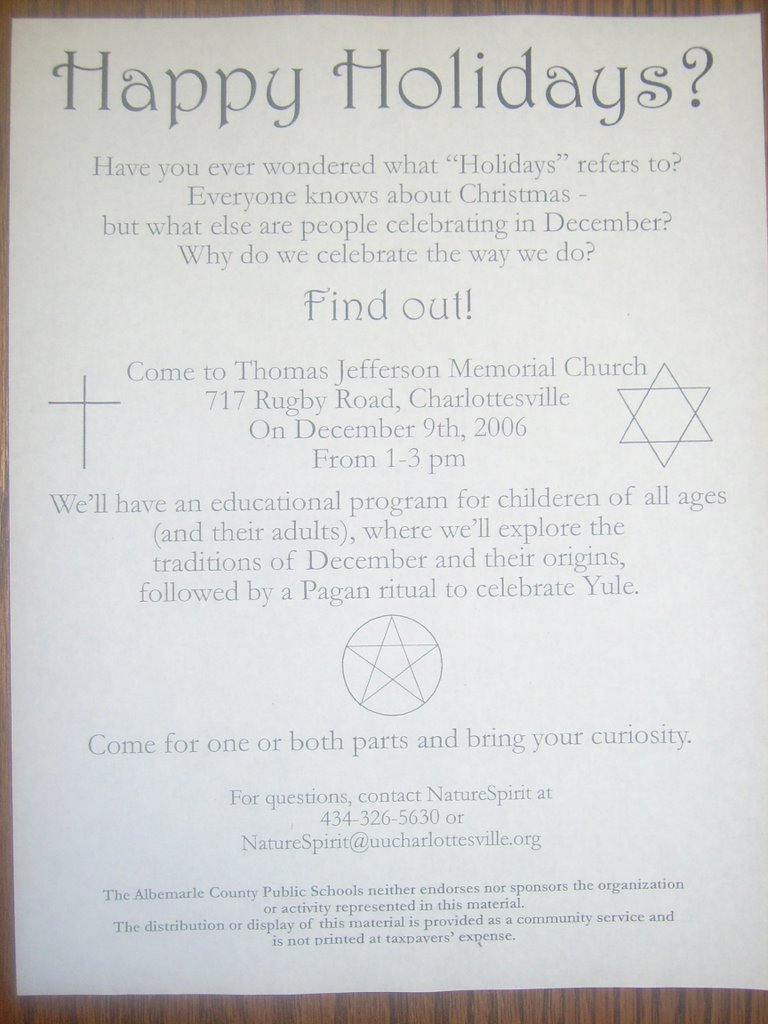
Happy Holidays? Pagan Evangelism

A JPBC member showed me this flyer that was sent home this week with students from a local elementary school in Albemarle County, Virginia.