JTR

Note: Devotional taken from last Sunday's sermon on Genesis 3:15-24.
“cursed is the ground for thy sake” (Genesis 3:17)
“and a flaming sword which turned every way, to keep the way of
the tree of life” (Genesis 3:24).
“and on either side of the river, was there the tree of life”
(Revelation 22:2).
“and there shall be no more curse” (Revelation 22:3).
Genesis 3:14-24 details the “curse” that comes upon all
creation due to the fall of our first parents. Here are some gleanings we might
take from this passage:
Sin has consequences. There were consequences for Adam’s sin
that we bear in our bodies and minds to this very day. We need also remember
there will be consequences for our actual transgressions as well.
The good and beautiful design that God made for man and woman
in the institution of marriage has been damaged and tarnished by sin.
We need to examine ourselves: What sinful tendencies have I
demonstrated and how, by God’s grace, might I fight this corruption so as to
live in such a way as is fitting of a follower of Christ?
When Christ was asked by the Pharisees why Moses allowed a “writing
of divorcement” (Matthew 19:7), Christ responded by saying he only did this
because of the hardness of their hearts. He then added, “but from the beginning
it was not so” (Matthew 19:8). The standard for Christians is not Genesis 3,
but Genesis 1-2.
By the grace of God and the love of Christ, let us stive to
restore what has been tarnished.
Because of Adam’s sin we all know our mortality. The way to
the tree of life has been blocked. Yet Christ promised life, abundant life,
which begins in the here-and-now for all who trust in him, and extends beyond
this life to eternal life (John 10:10, 28). See the classic declaration in John 3:16, “For God so loved the world, that he gave his only
begotten Son, that whosoever believeth in him should not perish, but have
everlasting life.”
Through Christ, the second Adam, a new way of
access has been made to the tree of life. By the tree of death (the cross), we may
eat of the tree of life.
If we turn from the first book of the Bible
(Genesis) to the last (Revelation) we read of John’s vision of “a pure river of
water of life” which proceeds “out of the throne of God and of the Lamb” (Revelation
22:1). John tells us that on both sides of the river there is “the tree of life”
(v. 2), adding, “And there shall be no more curse” (v. 3).
Because of Christ, there is a land that awaits the saints of God,
where we might eat again of the tree of life, and where there shall be no more
curse.
Grace and peace, Pastor Jeff Riddle

Note: Devotion taken from last Sunday's sermon on Genesis 3:8-15.
And
the LORD God called unto Adam, and said unto him, Where art thou? (Genesis
3:9).
As
we read the account of the LORD God’s confrontation with the first man and the
first woman after they had fallen by sinning against God and by eating the
forbidden fruit, we are meant to sympathize with our first parents. We should
be moved to acknowledge that we too have fallen, that we are naked, exposed
before a holy God, and we have only tried to hide ourselves from him, as did
they.
Yet
the LORD God comes to us even today, even also had come to them, with the voice
of his Word. He seeks us. He confronts us, and he places us under a spiritual investigation
or interrogation. He asks us questions, not because he is ignorant of the
answers, but because he is probing our conscience. So, he asks:
Where art thou? (v. 9).
Hast thou eaten of the tree, whereof I
commanded that thou shouldest not eat? (v. 11).
What is this that thou hast done? (v. 13).
Will
we cast or shift blame, as did the first man and woman, or will we acknowledge
and confess our faults (1 John 1:9)?
Will
we also come to know the one about whom God himself spoke in Genesis 3:15, in
that first prophecy of the Gospel. God himself acting as the Prophet declared
that from the seed of woman shall come one who will crush Satan’s head through
Satan shall bruise his heel (Isaiah 53:5: “he was bruised for our iniquities”).
In
Paul’s letter to the churches of Galatia he will describe the Lord Christ in
this way:
Galatians 4:4 But when the fulness of the time was come, God sent forth his
Son, made of a woman, made under the law,
And in Galatians 3:13 Paul says that the Lord
Jesus Christ “was made a curse for us.” He is the only hope for fallen men.
Grace and peace, Pastor Jeff Riddle

Note: Devotion taken from last Sunday's sermon on Genesis 3:1-7:
Genesis
3:4 And the serpent said unto the woman, Ye shall not surely die: 5 For God
doth know that in the day ye eat thereof, then your eyes shall be opened, and ye
shall be as gods, knowing good and evil.
Satan,
“the great dragon” and “the old serpent” (Revelation 12:9), tempts the first man
and woman to disobey God’s command and to eat the forbidden fruit.
We
learn here of his devises and tactics, which include twisting God’s words, telling
lies (see John 8:44 where Christ called him, “a liar and the father of it”),
making false promises, and appealing to man’s pride.
Satan
here pitches sin as a kind of “enlightenment,” the opening of one’s eyes. This
lie strikes at an ancient weakness in man to desire to throw off the one true
God and make himself to be a god. He wants to rule his own life, to make up his
own rules.
Satan
even pitches sin as some kind of moral achievement. Man can know good and evil.
But man in the state of innocence knew only the good and was not tainted even by
the knowledge of evil. It was not an improvement for man to know evil, as Satan
falsely suggested, but a degradation.
Satan
is like a conman, a snake-oil salesman, a flim-flam artist. He uses the old
bait and switch method:
He promises
enlightenment and gives spiritual blindness.
He promises
freedom and gives bondage.
He promises
wisdom and gives foolishness.
He promises
warmth and gives icy coldness.
He promises
community and gives loneliness (I bet the prodigal had loads of friends in the
far country till the money ran out!).
He promises
satisfaction and gives starvation.
He
promises drink and gives a parched throat.
He
promises wealth and gives poverty.
He promises
life and gives death.
He
promises a party and delivers a funeral.
Grace
and peace, Pastor Jeff Riddle

Note: Devotion taken from last Sunday's sermon on Genesis 2:18-25 in our Genesis series.
Genesis 2:21 And the LORD God caused a deep sleep to fall
upon Adam and he slept: and he took one of his ribs, and closed up the flesh
instead thereof; 22 And the rib, which the LORD God had taken from man, made he
a woman, and brought her to the man.
The LORD God did not leave man in the state of loneliness or incompletion,
determining to make woman as the perfect companion and complement to man.
He does this through an act of what one might call “spiritual
surgery.” He causes the man to fall into a deep sleep, and took from his side a
rib, closing up the flesh (v. 21). Then from this rib he made the first woman
(v. 22a).
There has been much attention given over the years as to the
reasons for the creation of the woman in this way, though it must mostly remain
speculative, since no clear inspired explanations are given.
The Puritan commentator Matthew Henry famously observed,
… woman was made of a rib out of the
side of Adam; not made out of his head to rule over him, nor out of his feet to
be trampled upon by him, but out of his side, to be equal with him, under his
arm to be protected, and near his heart to be beloved.
He later adds a much more allegorical Christ-centered
interpretation, writing:
Adam was a figure of him that was to
come; for out of the side of Christ, the second Adam, his spouse the church was
formed, when he slept the sleep, the deep sleep, of death upon the cross, in
order to which his side was opened, and there came out blood and water, blood
to purchase his church and water to purify it to himself.
Notice then in v. 22b how the LORD God brings the woman to
the man. Here is his presentation of this special gift to Adam.
Maybe as a parent you have sometimes gotten a special gift
for your child, perhaps at a birthday or Christmas. You made or got for him
something you know that he will really love and delight to see and have. You may
have become almost more excited to see him get the gift than he was to receive
it. We can imagine God as like that here.
One commentator notes, “God is like a father who presents his
son with a valuable gift that is bound to please him and be cherished by him.
‘See, he says, what I have prepared for you’” (Currid, Genesis, 112).
Woman was indeed a good gift given to man to complete the
creation of God’s special image bearers.
Grace and peace, Pastor Jeff Riddle

Audio for messages 1-3 and the Q & A:


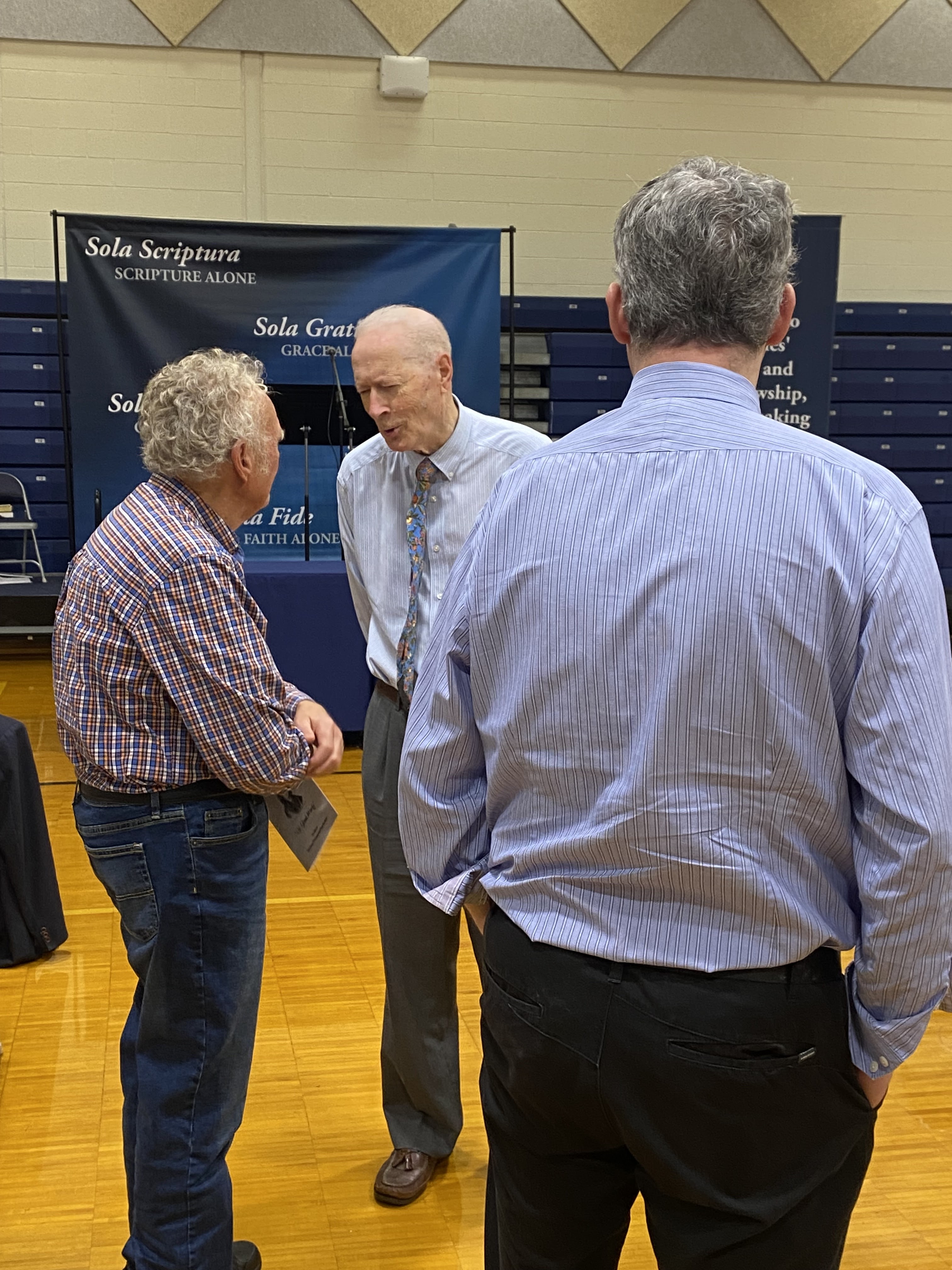

Note: It was my privilege to present an opening "Orientation" to the 2023 Keach Conference, the annual ministry and theology conference hosted by the Reformed Baptist Fellowship of Virginia (RBF-VA) and held last Saturday (9.30.23) in Warrenton:
Dear friends in Christ,
Let me extend a warm welcome to you to the 2023 annual meeting of the Keach Conference. I extend this greeting on behalf of the steering committee of the Reformed Baptist Fellowship of Virginia.
This is now the 22nd consecutive fall (or autumn
for our UK guests) in which we have had a meeting like this one, devoted to
Biblical teaching and Christian fellowship among confessional Reformed Baptists
in the Commonwealth of Virginia, having first met in 2002 in Virginia Beach.
And, yes, we even met in person in 2020 at the height of the Covid pandemic.
Our meeting has changed over the years. It started out as a
small gathering of pastors only and used to be called the Evangelical Forum.
In 2010, in our ninth consecutive annual meeting, reflecting
our desire to be identified with historic confessional Particular Baptists, we
officially changed the name of this gathering to the Keach Conference, in honor
of Benjamin Keach (1640-1704), a diligent pastor and an original signer of our
confession.
In a recent text group conversation among those on the
steering committee, we entertained other possible names (tongue-in-cheek) for
the Conference. These included:
“G-Keach”
“Together for Keach”
“The Keach Coalition”
“The Banner of Keach”
And, in homage to the Acts 29 Network, “Baptists 1690.”
For now, however, we determined it was best that we stick
with the name Keach Conference. Stay tuned for any future updates and
developments.
In 2007, in our sixth
consecutive annual meeting, we began a series through the Second London Baptist
Confession of Faith (1677, 1689), devoting each annual gathering to a
consecutive consideration of one of its 32 chapters.
This is the fourth time since we started that journey through
the confession that we have been blessed to hold our annual meeting here in
Warrenton, hosted by the brethren at Covenant RBC.
In 2011, when we met here our theme was chapter 5 “Of Divine
Providence” and our speakers were Dr. Joel Beeke of Puritan Reformed Seminary
and Pastor Malcolm Watts from Emmanuel Evangelical Church in Salisbury,
England.
In 2014, when we met here again our theme was chapter 8 “Of
Christ the Mediator” and our speakers were Pastor Jim Savastio of the Reformed
BC of Louisville, Kentucky and Pastor Earl Blackburn of Heritage Baptist Church
of Shreveport, Louisiana.
In 2017, when we met here yet again our theme was chapter 26
“Of the Church” and our speaker was Pastor Poh Boon Sing of the Damansara RBC
in Kuala Lampur, Malaysia (going out of order that year based on the expertise
of our speaker).
And this year, in 2023, meeting again in Warrenton, Lord
willing, we will continue this series by examining chapter 16 “Of Good Works.” And we will have
the privilege of listening to two faithful ministers of God’s Word, Ben
Scofield of the West Suffolk Reformed Baptist Church, Suffolk, Virginia and
Geoffrey Thomas, retired pastor after over 50 years of service at the Alfred
Place Baptist Church in Aberystwyth, Wales. As Pastor Thomas put it in his
recent autobiography, reflecting on his retirement, “I never had a call to
another church. Alfred Place was stuck with me!” (In the Shadow of the Rock,
322).
I might note that
though this is Pastor Thomas’s first visit with us at the Keach Conference, we
have already, in fact, in God’s Providence, benefited from his ministry in that
our 2009 speaker, the respected Presbyterian pastor and scholar Derek Thomas (no
family relation), was converted while a university student, attending Alfred
Place, and sitting under Geoff Thomas’s preaching.
Back to our topic “Of Good Works,” for
we Calvinists most of our Bibles fall almost on their own from constant turning
to Ephesians 2:
8 For by grace are ye saved through faith; and that not of
yourselves: it is the gift of God:
9 Not of works, lest any man should boast.
But today we are reminded that we must also proceed to v. 10, “For we are his workmanship, created in Christ
Jesus unto good works, which God hath before ordained that we should walk in
them.”
Calvin himself in his Institutes
wrote about the duplex gratia, or “double grace” of salvation including
both justification and sanctification (3.11.1).
Alister McGrath in his
biography of Calvin suggested that this emphasis manifested itself as a
distinctive component of Reformed theology and practical piety, shaping
everything from assurance of salvation to the Protestant work ethic and the
rise of capitalism. McGrath says of Calvin’s thought,
God’s grace was an unconditional gift, prior to and independent of
any human work or merit. Nevertheless, grace possessed a transformational
dimension, an ability to work within its recipient. To receive grace was to be
renewed by grace… Good works were seen as the outward and visible sign of the
presence and activity of grace within the believer (A Life of John Calvin,
239).
There is much indeed
in this chapter worthy of thoughtful and prayerful consideration.
By taking on chapter
16, this will mark the halfway point through the series. At this rate, God
willing, we will finish just 16 short years from now in 2039.
We trust that by
God’s grace we will profit from the teaching and fellowship today. Let me close
with another brief quotation from Pastor Thomas’ autobiography as he reflected
on his student days at Westminster Seminary while he was sitting under the
teaching of perhaps the most esteemed Protestant seminary faculty ever
assembled (from John Murray to Cornelius Van Til). Thomas writes:
Seminaries are a lot like
conferences. The messages or lectures are the bonus, while the people who
teach, to whom you have personal access, and particularly the men with whom you
study and eat and pray and talk and argue and correspond with for the rest of
your life are the abiding momentum of your consecration and service (147).
Let us find here today just a bit more momentum for our ongoing
consecration and service to the Lord Jesus Christ!
Amen.

Genesis 2 15 And the Lord God took the man, and put him into the garden of Eden to dress it and to keep it.
16 And the Lord God commanded the man, saying, Of every tree of the garden
thou mayest freely eat:
17 But of the tree of the knowledge of good and evil, thou shalt not
eat of it: for in the day that thou eatest thereof thou shalt surely die.
The LORD offers a commandment to the first man in the state
of his innocency that included a most generous provision for him, a most
clear prohibition, and most ominous warning (vv. 16-17).
This is sometimes called the covenant of creation, or the
covenant of life, or the covenant of works.
Calvin called it “a test of obedience” (commentary on Gen
2:16).
First, there is the most generous provision, “Of every tree of the garden thou
mayest freely eat.” What an incredible variety of trees God gave to man in his
innocence to enjoy! You think the fruit of trees in this fallen world taste
good now, imagine what they were like before the fall! And notice they were not
barred from eating from the tree of life. A way was opened unto man to live
forever (see 3:22)!
Second, however, there was the clear prohibition: “But, of the tree of the knowledge
of good and evil, thou shalt not eat it” (v. 17a).
We get a clue here as to how sin operates. We know it from
our fallen selves. God provides for us a vast array of things that we might
pursue that are wholesome, right, good, and soul-satisfying. And what is the
thing we crave? That which he in his wisdom forbids.
The parent says, Don’t touch the stove, and the child thinks,
I wonder what it would feel like to touch the stove! And very often the hand
reaches out to touch the stove and gets burned.
There is finally also the ominous warning: “for in the day that thou eatest
thereof thou shalt surely die” (v. 17b). Man cannot say he was not warned. Paul
will write in Romans 6:23 that the wages of sin is death. God said it first in
the garden. Adam and Eve will not immediately drop down dead, but spiritual
death and eventual physical death will come the moment this commandment is
disobeyed and the covenant is broken.
Grace and peace, Pastor Jeff Riddle

Devotion taken from last Sunday's sermon on Genesis 2:1-3.
Genesis 2:1 declares, “Thus, the heavens and the earth were
finished, and all the host of them.”
The language here echoes that of Genesis 1:1 where the phrase
“heaven and earth” also appears. This is simply a way of saying God made
“everything.”
Moses adds, “and all the host of them.” This is meant to
emphasize the totality and magnitude of the complete, divine work of creation.
One commentator notes that the word “host” “normally only refers to
luminaries” like the sun, moon, and stars (see Deut 4:19; 17:3), but here its
application is extended to all things within the world, everything between and
beyond the heavens and the earth (Currid, Genesis, 90-91).
The immensity of the creation is truly breath-taking. We, as
puny human beings, will never be able to grasp with our finite minds its
enormous scope. I was reading about this last week in a book titled The New
Creationism by a Christian apologist in the UK named Paul Gardner. Gardner
wrote about the stars to illustrate the immensity of the world that God made. He
notes,
Our Sun is one of about 100 billion
stars that make up our galaxy. The Milky Way. Our galaxy is one of about thirty
galaxies in a cluster called the Local Group. This cluster is about ten million
light years across… (34).
He then adds,
One recent estimate suggests that, in
total, there are ten times more stars in the observable universe than all the
grains of sand on the world’s deserts and beaches (34).
Get this also, stars are apparently like snowflakes. “No two
stars are absolutely identical” (34).
With that in mind, consider again the statement in 2:1,
especially its conclusion, “and all the host of them.” The magnitude of
creation staggers the mind. It makes David’s statement in Psalm 8 completely
reasonable, “3 When I consider thy
heavens, the work of thy fingers, the moon and the stars, which thou hast
ordained; 4 What is man, that thou art
mindful of him? and the son of man, that thou visitest him?”
Genesis 2:1 compels us to wonder in worship and awe at the
vast magnitude of the world which God created in the space of six days and all
very good.
Grace and peace, Pastor Jeff Riddle
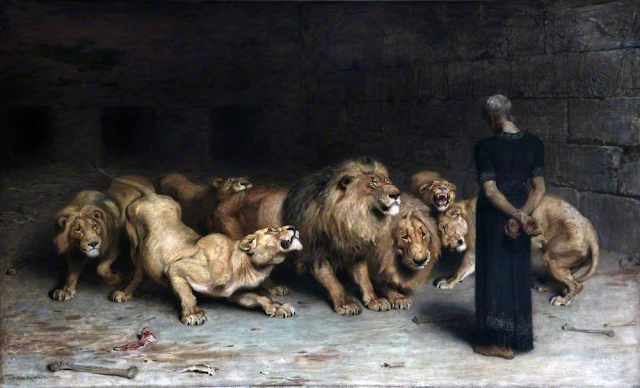
Note: This post taken and expanded from my Twitter/X: @Riddle1689:
Daniel as a type of Christ in Daniel 6:
Enemies plot against a blameless man (vv. 4-5); Arrested after private prayer (v. 10); Cast into a den of death, covered by a stone and sealed (v. 17); An admirer grieves and comes early in the morning (vv. 18-19); Delivered from the den of death by the power of God (v. 23);
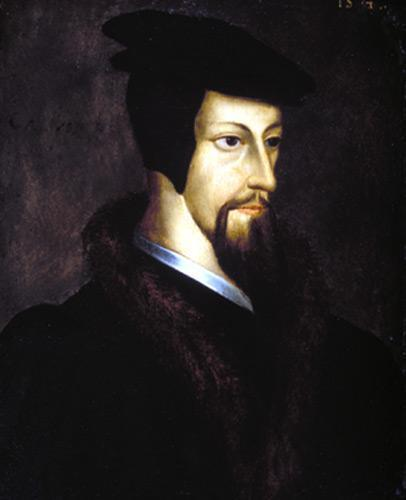
Note: Posts taken from Twitter/X account: @Riddle1689:
Calvin on the preeminence of man in Genesis 1:26:
"Truly there are many things in this corrupted nature which may
induce contempt; but if you rightly weigh all circumstances, man is, among
other creatures, a certain pre-eminent specimen of Divine wisdom, justice, and
goodness, deservedly called by the ancients mikrikosmos, 'a world in
miniature.'"
Calvin on how sin has damaged the imago Dei in his commentary on Genesis
1:26:
"But now, although some obscure lineaments of that image are found
remaining in us; yet are they so vitiated and maimed, that they may truly be
said to be destroyed.”
Calvin on total depravity:
“For besides the deformity which everywhere appears unsightly, this evil
is added, that no part is free from the infection of sin."
Calvin on the imago Christi:
"Since the image of God has been destroyed in us by the fall, we
may judge from its restoration what it originally had been. Paul says we are
transformed into the image of God by the gospel. And according to [Paul],
spiritual regeneration is nothing else than the restoration of the same image.
(Col. iii.10, and Eph. iv.23)."
JTR

Note: Devotion taken from last Sunday's sermon on Genesis 1:26-31.
So God created man in his own image, in the image of God
created he him; male and female created he them (Genesis 1:27).
Back in 2005 the London Zoo made headlines around the world
when for a short time it hired eight persons (three men and five women) to live
in an exhibit under the title “Homo Sapiens.” Other signs described their diet
and typical activities. Another described them as “the most dangerous animal of
all.” Are human beings simply like all the other animals? If not, what exactly
is it that makes us different?
The answer to those questions is given to us in Genesis 1:26-28.
Genesis 1:26 begins, “And God said, Let us make man in our
image, after our likeness.” The Hebrew word for “man” here is adam. It
is also the name of the first man. He is a special creature made in a special
manner and given a special name. He is not listed alongside the other land
creatures in v. 24 (cattle, creeping things, and beast of the earth). He is set
apart. He is unique.
The primary evidence of his uniqueness is that the triune God
purposed to make man “in our image, after our likeness.” Those two statements
are essentially saying the same thing in classic Hebrew parallelism.
The first statement is perhaps best known by the Latin
phrase, “Imago Dei.” Man has an imprint upon him that makes him
different than the rest of the creation. He is not God, but he is made after
the likeness of the thrice Holy God.
Perhaps the key to what this image means is given in the
remainder of v. 26 which begins, “and let them have dominion over the fish of
the sea…” (v. 26b). God who is the King of Kings and the Lord of Lords, the
Master of the whole cosmos gives to man as the crown of his creation a measure
of limited sovereignty. He gives mankind to be his stewards and to rule over
and provide for all the other creatures of firmament, sea, and land, and even
“over all the earth.” This is indeed what David stresses in Psalm 8:4-8, when
he declares that God made man “a little lower than the angels, and hast crowned
him with glory and honour … to have dominion” over the works of his hands.
One more fact about man is provided in v. 27b: “male and female
created he them.” God declares here that human beings are made in two basic
flavors, or in two distinct styles, or in two kinds. God made man to be male
and female, men and women. Human beings are, according to the good design of
God binary. This is why we as Christian say there are only two genders. What
does it say about the state of confusion in our world today when such a basic
claim is somehow controversial?
This was and is God’s original, good design made before man’s fall
into sin. This statement affirms the spiritual equality of men and women. We
are both made in the image of God. We are both image bearers. We are both made
in God’s likeness. We are both made to have dominion over all creatures and all
the earth. Men are not spiritually superior to women; women are not spiritually
superior to men.
This is not to say, however, that we are the same. We are
fundamentally different. Made by an all-good and all-wise God for different
tasks, roles, and functions in this world. We are not interchangeably the same,
and this is good.
Who is man? A special and unique creation by God.
Grace and peace, Pastor Jeff Riddle
