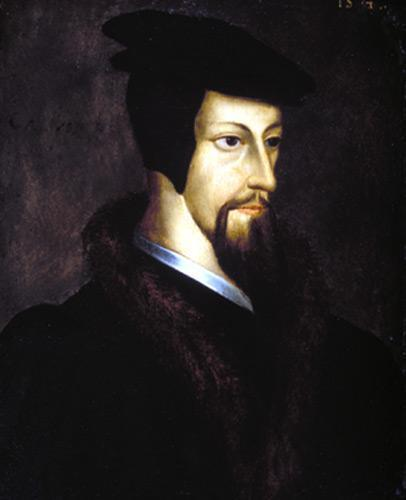
Showing posts with label John Calvin. Show all posts

Tuesday, August 18, 2026

The Vision (8.14.26): Calvin on The Self-Authenticating Nature of Scripture


My sheep hear my voice, and I know them, and they follow me (John 10:27).

In our midweek study through the Belgic Confession, we were looking last Wednesday at this confession’s stress on what is called the self-authenticating (autopistic) nature of the Bible. Why do we believe the Bible’s authority? The Belgic Confession says, the Holy Spirit witnesses to our hearts that the Scriptures are from God, “whereof they carry the evidence in themselves.”

Here is what John Calvin (1509-1564), the great Reformer in Geneva, Switzerland, had to say about Scripture’s testimony to itself:

Let this point therefore stand: that those whom the Holy Spirit has inwardly taught truly rest upon Scripture, and that Scripture indeed is self-authenticated [autopiston]; hence it is not right to subject it to proof and reasoning. And the certainty it deserves with us, it attains by the testimony of the Spirit. For even if it wins reverence for itself by its own majesty, it seriously affects us only when it is sealed upon our hearts through the Spirit. Therefore, illumined by his power, we believe neither by our own nor by anyone else’s judgment that Scripture is from God; but above all human judgment we affirm with utter certainty (just as if we were gazing upon the very majesty of God himself) that it has flowed to us from the very mouth of God by the ministry of men. We seek no proofs, no marks of genuineness upon which our judgment may lean; but we subject our judgment and wit to it as to a thing far beyond any guesswork! This we do, not as persons accustomed to seize upon some unknown thing, which, under closer scrutiny, displeases them, but fully conscious that we hold the unassailable truth! Nor do we do this as those miserable men who habitually bind over their minds to the thralldom of superstition; but we feel that the undoubted power of his divine majesty lives and breathes there. By this power we are drawn and inflamed, knowingly and willingly, to obey him, yet also more vitally and more effectively than by mere human willing or knowing! (Institutes of the Christian Religion, 1.7.5).

May the Spirit continue to affirm the self-authenticating nature of the Holy Scriptures to his people.

Grace and peace, Pastor Jeff Riddle

Wednesday, September 20, 2023

Gleanings from Calvin's Commentary on Genesis on Anthropology


Note: Posts  taken from Twitter/X account: @Riddle1689:

Calvin on the preeminence of man in Genesis 1:26:

"Truly there are many things in this corrupted nature which may induce contempt; but if you rightly weigh all circumstances, man is, among other creatures, a certain pre-eminent specimen of Divine wisdom, justice, and goodness, deservedly called by the ancients mikrikosmos, 'a world in miniature.'"

Calvin on how sin has damaged the imago Dei in his commentary on Genesis 1:26:

"But now, although some obscure lineaments of that image are found remaining in us; yet are they so vitiated and maimed, that they may truly be said to be destroyed.”

Calvin on total depravity:

“For besides the deformity which everywhere appears unsightly, this evil is added, that no part is free from the infection of sin."

Calvin on the imago Christi:

"Since the image of God has been destroyed in us by the fall, we may judge from its restoration what it originally had been. Paul says we are transformed into the image of God by the gospel. And according to [Paul], spiritual regeneration is nothing else than the restoration of the same image. (Col. iii.10, and Eph. iv.23)."

JTR

Friday, September 01, 2023

Calvin on Genesis


Note: Article taken from posts to my Twitter (X): @Riddle1689:

I read the opening “Argument” to Calvin’s Commentary on Genesis (1563) in preparing to begin my sermon series on Genesis. Here are a few quotes. Citations taken from the Calvin Translation Society edition (1847):

“…it is absolutely impossible to unfold the History of the Creation of the World in terms equal to its dignity” (57).

“The intention of Moses, in beginning his Book with the creation of the world, is to render God, as it were, visible to us in his works” (58).

“The Creation of the world, as here described, was already known through the ancient and perpetual tradition of the Fathers. Yet, since nothing is more easy than that the truth of God should be so corrupted by men… it pleased the Lord to commit the history to writing, for the purpose of preserving its purity” (59).

“…let the world become our school if we desire rightly to know God” (60).

Note Calvin’s geocentric cosmology:

“We indeed are not ignorant, that the circuit of the heavens is finite, and that the earth, like a little globe, is placed in the centre” (61).

“For by the Scripture as our guide and teacher, he not only makes those things plain which would otherwise escape our notice, but also compels us to behold them; as if he had assisted our dull sight with spectacles” (62).

“For this is the argument of the Book: After the world had been created, man was placed in it as a theatre, that he, beholding above him and beneath the wonderful works of God, might reverently adore their Author” (64).

“Let us now hearken to Moses” (66).


JTR

Monday, August 28, 2023

McGrath on the Personality of Calvin


Note: This post is taken from my Twitter (X): @Riddle1689:

I've been reading through Alister E. McGrath, A Life of John Calvin (Baker, 1990).

Though McGrath is very much admiring of Calvin's achievement, this work is not hagiography. Here are some of his observations on Calvin's personality:

“… a curious silence resonates through history concerning the personality of Calvin” (14).

“Calvin…. appears to have been reticent to introduce any self-reference in his writings” (16).

“Nevertheless, it is probably fair to suggest that Calvin was not a particularly attractive person, lacking the wit, humour, and warmth which made Luther so entertaining at dinner parties. Calvin’s persona, as it emerges from his writings, is that of a somewhat cold and detached individual, increasingly inclined towards tetchiness and irritability as his health declined, and prone to launch into abusive personal attacks on those with whom he disagreed, rather than dealing primarily with their ideas” (17).

“…it is clear that he was an unhappy man, with whom it is difficult for the modern reader to feel any great bond of sympathy” (17).

“A timid and withdrawn character, he was nonetheless capable of a courage bordering on intransigence, a refusal to compromise, when he believed the will of God to be at stake” (18).

“Calvin was a remarkably private individual…” (18).

“…he emerges as something of a colourless figure, a man whose innermost thoughts, attitudes, and ambitions are largely denied to us” (19).

JTR

Saturday, October 08, 2022

James White Debates Calvin, the Westminster Confession of Faith, and Owen


Here’s a follow up to WM 254 covering the JW vs. PVK debate in which James White mocked prayer and the inward work of the Holy Spirit in recognizing and obeying the authentic text of Scripture. In so doing, he was actually debating classic Protestant Bibliology.

James White said the following (listen here):

You say that this [the Textus Receptus] is what we must follow, and we are asking where does this come from?

And your answer is, We pray about it. Is that how you [answer]? Have you prayed about every variant in the NT?...

So when a Mormon missionary says, I prayed about the Book of Mormon, and the Holy Spirit testified to me that the Book of Mormon is the Word of God, how would you respond, because you just told us that the way we know the Bible is the Word of God is by praying about it….

Are you seriously suggesting that John Calvin taught us to pray over differences in manuscripts? Can you give me a single place in the voluminous writings of the Reformer of Geneva where he taught us to pray to determine when the Greek manuscripts differed from the Latin Vulgate….

In answer to his challenge, see the following:

John Calvin, Institutes (1.7.5) (emphasis added):

Let this point therefore stand: that those whom the Holy Spirit has inwardly taught truly rest upon Scripture, and that Scripture is indeed self-authenticated [autopiston]; hence it is not right to subject it to proof and reasoning. And the certainty it deserves with us, it attains by the testimony of the Spirit. For even if it wins reverence for itself by its own majesty, it seriously affects us only when it is sealed upon our hearts through the Spirit. Therefore, illumined by his power, we believe neither by our own nor by anyone else’s judgement that Scripture is from God; but above human judgment we affirm with utter certainty (just as if we were gazing upon the majesty of God himself) that it has flowed to us from the very mouth of God by the ministry of men. We seek no proofs, no mark of genuineness upon which our judgment may lean; but we subject our judgment and wit to it as a thing far beyond any guesswork! This we do, not as persons accustomed to seize upon some unknown thing, which, under closer scrutiny displeases them, but fully conscious that we hold the infallible truth! Nor do we do this as those miserable men who habitually bind over their minds to the thralldom of superstition: but we feel that the undoubted power of his divine majesty lives and breathes there. By this power we are drawn and inflamed, knowingly and wittingly, to obey him, yet also more vitally and more effectively than mere human knowing!

See also Westminster Confession of Faith, 1:5 (emphasis added):

5. We may be moved and induced by the testimony of the Church to an high and reverent esteem of the holy Scripture;a and the heavenliness of the matter, the efficacy of the doctrine, the majesty of the style, the consent of all the parts, the scope of the whole (which is to give all glory to God), the full discovery it makes of the only way of man’s salvation, the many other incomparable excellencies, and the entire perfection thereof, are arguments whereby it doth abundantly evidence itself to be the Word of God; yet, notwithstanding, our full persuasion and assurance of the infallible truth, and divine authority thereof, is from the inward work of the Holy Spirit, bearing witness by and with the Word in our hearts.b


a.     1 Tim 3:15. • b. Isa 59:21John 16:13-141 Cor 2:10-121 John 2:2027.


See also John Owen, The Reason of Faith (Works, Vol. 4:57) (emphasis added):


The work of the Holy Ghost unto this purpose consists in the saving illumination of the mind; and the effect of it is a supernatural light, whereby the mind is renewed; see Rom. xii.2; Eph. i.18, 19, iii.16-19. It is called a “heart to understand, eyes to see, ears to hear,” Deut. xxix.4; the “opening of the eyes of our understanding,” Eph. 1.18; the “giving of an understanding,” 1 John v.20. Hereby we are enabled to discern the evidences of the divine original and authority of the Scripture that are in itself, as well as assent unto the truth contained in it; and without it we cannot do so, for “the natural man receiveth not the things of the Spirit of God, for they are foolishness unto him, neither can he know them, because they are spiritually discerned,” 1 Cor. ii.14….. That there is a divine and heavenly excellency in the Scripture cannot be denied by any who, on any grounds or motive whatever, do own its divine original…. But these we cannot discern, be they in themselves never so illustrious, without the effectual communication of the light mentioned unto our minds,—that is, without divine, supernatural illumination.


And John Owen, The Reason of Faith (Works, Vol. 4:59) (emphasis added):


But as a pretense herof hath been abused, as we shall see afterward, so the pleading of it is liable to be mistaken; for some are ready to apprehend that this is a retreat unto a Spirit of revelation is but a pretense to discard all rational arguments, and to introduce enthusiasm into their room. Now, although the charge be grievous, yet, because it is groundless, we must not forego what the Scripture plainly affirms and instructs us in, thereby to avoid it. Scripture testimonies may be expounded according to the analogy of faith; but denied or despised, see they never so contrary unto our apprehension of things, they must not be. Some, I confess, seem to disregard both the objective work of the Holy Spirit in this matter (whereof we shall treat afterward) and his subjective work also in our minds, that all things may be reduced unto sense and reason. But we must grant that a “Spirit of wisdom and revelation” to open the eyes of our understanding is needful to enable us to believe the Scripture to be the Word of God in due manner, or forego the gospel; and our duty it is to pray continually for that Spirit, if we intend to be established in the faith thereof.


Conclusion:


James White’s naturalistic approach to Scripture is contrary to the classic Protestant emphasis upon the necessity of the inward work of the Holy Spirit, as emphasized in Calvin, the WCF, and Owen.


JTR

Wednesday, December 09, 2020

WM 184: 1 Cor 3:23: From Paul to Arius to Calvin


Notes for WM 184:

I am currently preaching through Matthew on Sunday pm; the 1689 confession on Sunday pm; and teaching through 1 Cor on Wednesday evenings.

Last week we were looking at 1 Cor 3:18-23 and spent some time discussing 1 Cor 3:23: “And ye are Christ’s and Christ is God’s.”

We discussed how an Arian (follower of Arius, the fourth century heretical teacher from Alexandria might have misused this passage).

Arius taught that Son of God was an exalted creature incarnate in Jesus, but that he was subordinate to the Father.

The controversy over Arian’s teaching is what prompted the Council of Nicaea and the Nicene Creed that was affirmed in it.

What other passages would the Arians have appealed to?

1 Cor 11:3; John 14:26; Mark 13:32; 1 Cor 15:28.

See the letter of Arius to Eusebius of Nicomedia:

Orthodox responses to heterodox interpretations of 1 Cor 3:23:

When Paul says “And ye are Christ’s and Christ is God’s,” he could have been thinking of Christ’s work as the incarnate mediator. Cf. John 1:18: “No man has seen God at any time; the only begotten Son, which is in the bosom of the Father, he hath declared him.”

Other key passage:

On the incarnation: Phil 2:5-11 (esp. vv. 5-6);

On Paul’s declaration that Jesus is Lord: Phil 2:11; Rom 10:9; 1 Cor 12:3; cf. 1 Tim 3:16.

The Gospel declarations that Jesus is equal in essence with God: Mark 2:5-7; John 10:30; John 20:28.

We need “all the counsel of God” (Acts 20:27).

See Calvin’s commentary on 1 Cor 3:23:

Calvin is keenly aware of how this passage might be misused.

He likely is looking back to the Arians, and perhaps also looking around at his own day and the revival of Arianism, or Unitarianism, in some circles. And he, no doubt, was also looking forward to dangers that might arise on the horizon.

Conclusion:

Study of 1 Cor 3:23 demonstrates the need for care in rightly dividing the Word of God (2 Tim 2:15).

JTR

Tuesday, November 19, 2019

Another Challenge to James White on Calvin and Text Criticism


A couple of years ago I wrote an article titled "John Calvin and Text Criticism", which appeared in Puritan Reformed Journal Vol. 9, No. 2 (July 2017): 128-146. You can read the entire article here.

At the beginning of the article I challenged the notion, often put forward by evangelical advocates of the modern critical text, that "the foundational theologians and preachers of the Protestant Reformation era were largely unaware of many of the disputed textual passages in the Greek New Testament” (129).

I used as an example of this the claim made by the popular internet apologist James R. White in his King James Version-Only Controversy book that Calvin and the other Reformers embraced the traditional text of Scripture, as White puts it, “by default, not particular choice” (130). I also point out that White makes this assertion without providing any meaningful evidence to support it.

Here is the section of the article (pp. 129-131) where I engage with White’s position:


My article proceeds to demonstrate that White’s statement is not accurate with regard to Calvin.

White has shown some interest, of late, in some of my academic work relating to the Confessional Text of Scripture. I would look forward to seeing his response to the challenge offered in this article relating to Calvin’s understanding of the text of Scripture.

Update (11.20.19): I have been informed that Mr. White has declined my invitation to offer a scholarly response to my article. Instead he has asked that I listen to his internet podcasts to hear a response to these challenges. Someone has suggested that "Listen to my podcast!" sounds something like "Read my book!" Smiles. If anyone who is a regular listener to the DL can find the specific podcast(s) wherein he responded to my article and provided concrete evidence that Calvin and the other Reformers were ignorant of the major textual variants in the NT and, therefore, embraced the TR "by default, not particular choice" please send me a link and time stamp and I will be glad to listen.

JTR

Saturday, May 25, 2019

Calvin on the 153 fish and unbroken nets of John 21:11: A Rationalizing Trajectory?


Note: I’ve been preaching through John’s Gospel on Lord’s Day mornings over the past two years or so [and am nearing the end of that study]. Along the way, I have been reading the corresponding commentary by Calvin, and I have been struck by Calvin’s usual aversion to mystical or allegorical interpretation, no doubt a reaction to the excesses of the RCC of his own day. The text below is taken from my sermon last Sunday on John 21:1-14 and focuses on v. 11 which includes two details seemingly ripe for spiritual interpretation: the meaning of the 153 fish and the unbroken net. Calvin, as usual resists the allegorical. We happened to have a brother OPC pastor visiting with us last Sunday and over lunch we were discussing Calvin’s interpretation of this passage. I shared with him that while on one hand I greatly appreciate Calvin’s "plain sense" take, on the other I wondered if this rationalizing tendency in Calvin set a trajectory for the rise of the modern historical critical method, especially in Protestant lands, that eventually led to the exclusion nearly altogether of the spiritual, supernatural, and mystical understandings of the text. Here is the excerpt from my sermon manuscript:

John 21:11: Simon Peter went up, and drew the net to land full of great fishes, and hundred and fifty three: and for all there were so many, yet was not the net broken.

In v. 11 we read that Simon Peter went up drew the net to land “full of great fishes.”

There are two intriguing details which are shared here:

First, John says that the number of the fish was one hundred and fifty-three. On one hand, we might take this simply as a vivid detail provided by the inspired evangelist to show the historicity of this event. It really happened and he recalls the exact number of fish caught in that net that day.

Interpreters of this passage, however, have been prone to find spiritual significance in this exact number.

One commentator I read notes, “Some Greek zoologists held that there were 153 kinds of fish, thus this catch fulfilled Ezekiel 47:10” (William E. Hull, John, Broadman Commentary, 373).

Ezekiel 47:10 And it shall come to pass, that the fishers shall stand upon it from Engedi even unto Eneglaim; they shall be a place to spread forth nets; their fish shall be according to their kinds, as the fish of the great sea, exceeding many.

The same commentator adds: “Further 153 represented the sum of the first seventeen numbers (1 + 2 + 3 …. + 17), and so may be represented by an equilateral triangle with 17 units in the base and one each side…. This ideal figure could stand for “the full number of the Gentiles” (Rom 11:25), to be brought in by the apostolic mission.”

Another commentator suggests the passage fulfills Jeremiah 16:16a: “Behold, I will send for many fishers, saith the LORD, and they shall fish for them…” (Orthodox Study Bible).

Augustine apparently managed to take the number 153 as denoting the law and the gospel (so Calvin says).

Calvin offers the sensible conclusion: “As to the number of fishes, we ought not look for any deep mystery in it.” Instead, we ought simply to receive it as an evidence of Christ’s divine power.

The second intriguing detail: “and for all there were so many, yet was not the net broken.” Remember that in the earlier episode recorded in Luke 5, their nets had broken under the load of the great catch (v. 6). But now we have the miracle of the unbroken net.

It is hard not to see this as pointing to the unity that will be shared among genuine disciples of the Lord Jesus Christ. They will come from many times, many nations, many cultures, many languages, and they will have differences among them, but they will have a genuine unity among them that will come from Christ himself.

Think again of Christ’s prayer for us in John 17:21: “That they all may be one….”

Though many, the net will not be broken.

Again, I tend to see in these actual “physical” events a “spiritual” foreshadowing of what will happen in evangelism.

Calvin, however, sees it much more pragmatically. His insights are worth considering.
He says that the spiritual lesson to be gleaned here is the importance of perseverance in laboring for the kingdom even we see little with respect to visible results. The disciples fished all night and caught nothing, but it due time and at Christ’s direction, they received a great and unexpected result.

He observes:

“In the same manner , also, God often tries believers, that he may lead them the more highly to value his blessing. If we were always prosperous , whenever we out our hand to the labor, scarcely any man would attribute to the blessing of God the success of his exertions, all would boast of their industry, and would kiss their hands.”

And:

“Now if we dislike our calling, because the labor which we undertake appears to be unproductive, yet, when the Lord exhorts us to steadiness and perseverance, we ought to take courage; in the end we shall obtain a happy result, but it will be at the proper time.”

This could be applied to many circumstances:

To a parent despairing at not seeing spiritual fruit in a wayward child.

To a believer meeting hostility for Christ’s sake in his workplace.

To one bearing witness that seems fruitless to an unsaved friend or family member.

To a pastor laboring without the outward signs of progress he might earnestly desire.

It may seem you have fished all night but caught nothing. Do not despair, for so did the disciples at the Sea of Tiberias till Christ did intervene and direct.

JTR

Sunday, March 17, 2019

Calvin on the implications of the beloved disciple's care for the mother of Jesus (John 19:27)


Image: The supposed "house of Mary" near the site of ancient Ephesus in Turkey. Tradition says John brought Mary to Ephesus and cared for her there.

I preached this morning a sermon on John 19:23-27, including our Lord’s words from the cross to the beloved disciple, “Behold thy mother!” (v. 27a), entrusting care of his mother to this disciple (John).

I ran out of time, so I did not get the chance to share this intriguing insight from Calvin on v. 27b: “And from that hour that disciple took her unto his own home [eis ta idia]” (v. 27b). Notice “home” is in italic.
Calvin observes:
“Hence it is also evident that the Apostles had their families; for John could not have exercised hospitality towards the mother of Christ, or have taken her into his own home, if he had not a house and a regular way of living. Those men, therefore, are fools who think that the Apostles relinquished their property, and came to Christ naked and empty; but they are worse than fools, who make perfection [maturity] to consist in beggary.”
Again, we see Calvin’s commentary influenced by his contemporary efforts to reform the RC church of his day. His point: You don’t have to take a vow of poverty, renounce the world, and live in a monastery to live a faithful Christian life. This is not what the apostles did. On the contrary, your duty is to live in the world while not being part of it, and to love Christ and love the brethren.
JTR

Monday, February 18, 2019

Calvin, Barabbas, and the RP?


Image: Poster from the Swedish film Barabbas (1953)

I was preaching yesterday on John 18:28-40, including John’s brief (in comparison to the Synoptics) account of the release of Barabbas in vv. 39-40. In my parallel reading of Calvin’s commentary on the passage, I was struck by how Calvin somehow pulls an application from these verses related to the Regulative Principle (RP).

Calvin notes that the custom of releasing a prisoner during the Passover “was done, no doubt, in order the honour the sacredness of the day, but was, in reality, nothing else than a shameful profanation of it.” He cites Proverbs 17:15 as declaring that the guilty are an abomination before God.

Calvin then exhorts:

“Let us learn by this example, that nothing is more ridiculous, than to attempt to serve God by our inventions; for, as soon as men begin to follow their own imaginations, there will be no end till, by falling into some of the most absurd fooleries, they openly insult God. The rule of the worship of God, therefore, ought to be taken from nothing else than from his own appointment.”

This reminds me of the title of the G. K. Beale edited book, The Right Doctrine from theWrong Texts? Though the Barabbas account is related to an extra-biblical Passover tradition, it’s hard to believe that implications for the RP were part of the authorial intent in John 18. I’ve noticed this kind of thing in several other places in Calvin’s commentaries and probably reflects what was often and uppermost in his mind during the course of his reforming ministry.

JTR

Tuesday, January 29, 2019

2 Ephesians?


Image: Ruins of the Roman era Library of Celsus in ancient Ephesus.

I was continuing to read D. B. Hart’s translation of the NT yesterday and in Ephesians  3:3-4 I was struck by Paul’s reference to his previous writings to the recipients. This is a passage I had read before but not given much notice. Paul is discussing his special calling to make known the “mystery” of Christ. Here it is in the KJV:

Ephesians 3:3 How that by revelation he made known unto me the mystery; (as I wrote [from prographō] afore in few words,

4 Whereby, when ye read, ye may understand my knowledge in the mystery of Christ)

The question is what Paul is referring to when he speaks of what he had written before. 

Was he speaking of the previous content found in the opening two chapters? This was Matthew Poole’s deduction: “As I wrote afore; in the two former chapters of this Epistle.”

An alternative possibility is that this refers to an earlier letter. Compare Paul’s reference in 2 Corinthians 2:4 to his previous “painful” letter to the church at Corinth and the various theories of 2 Corinthians being a composite of several letters suggested in the modern period. Consider also the reference in Colossians 4:16 to the "lost" letter to the Laodiceans.

Calvin could say in his time that this was “the general opinion”: “As I wrote a little before. This refers either to a rapid glance at the same subject in the second chapter, or—which appears to be the general opinion—to another Epistle.”

We might well ask what the writing was that Paul mentions in Ephesians 3:3-4? Was it what we might call "1 Ephesians", with what we know as “Ephesians” better considered as “2 Ephesians” [I am leaving aside the whole question about whether “at Ephesus” in Eph 1:1 belongs to the authentic text. I, of course, assume it does.]? Was it a letter or something else? A first-hand account of his conversion and calling? A sermon or doctrinal tract? Theologically speaking, one would assume that this “1 Ephesians”, whatever it was, was uninspired, or it would have been included in the canon. Or, could it refer to another inspired, canonical book, or portion of a book, shared with the Ephesians, in which Paul discussed these matters (Acts 9? Galatians 1-2? etc.)? I’m not sure we’ll ever be able to answer this question in this age.

JTR

Monday, January 28, 2019

Calvin on Cyprian on Christian Unity


I preached Sunday on Christ’s prayer for future disciples as part of his High Priestly prayer (John 17:20-26). A good bit of focus was given to Christ’s prayer for unity: “That they all may be one….” (v. 21). I’ve also been re-reading Calvin’s book IV of the Institutes and had just been looking at Calvin’s defense of the Protestant movement against charges of it being schismatic in chapter 2. Ever since I ran into Dr. Anthony Lane at the Calvin Congress last August I’ve been intrigued by Calvin’s use of the Church Fathers. I had picked out Calvin’s quotation from Cyprian to share in the sermon on Sunday but did not get time to use it, so I thought I’d share it here (from Institutes 4.2.6):
Cyprian, also following Paul, derives the source of concord of the entire church from Christ’s episcopate alone. Afterward he adds:
The church is one, which is spread abroad far and wide into a multitude by an increase of fruitfulness. As there are many rays of the sun but one light, and many branches of a tree but one strong trunk grounded in its tenacious root, and since from one spring flow many streams, although a goodly number seem outpoured from their bounty and superabundance, still at the source unity abides. Take a ray from the body of the sun; its unity undergoes no division. Break a branch from a tree; the severed branch cannot sprout. Cut off a stream from its source; cut off, it dries up. So also the church, bathed in the light of the Lord, extends over the whole earth: yet there is one light diffused everywhere.
Nothing more fitting could be said to express this indivisible connection which all members of Christ have with one another.
JTR

Tuesday, January 15, 2019

Book Note: Calvin's Doctrine of the Knowledge of God


T. H. L. Parker, Calvin’s Doctrine of the Knowledge of God (Eerdmans, 1952; Wipf and Stock reprint, 2015): 128 pp.

This essay consists of two parts. Part One is on “The Knowledge of the Creator” and Part Two on “The Knowledge of the Redeemer.” This reflects the design of the opening two books of the Institutes, since “The first books deals with the knowledge of the Creator; the second with the Knowledge of the Redeemer” (2). For Parker, the Institutes is the “chief source for our understanding Calvin’s doctrine of the Knowledge of God” (3).

Some notes from Part One: The Knowledge of the Creator:


Parker begins by contrasting the beginnings of Calvin’s Institutes and Thomas Aquinas’s Summa Theologica and his famous five proofs for the existence of God.

“Calvin, however, presupposes the existence of God, on the very ground, the validity of which St. Thomas denies, that men have an innate knowledge of the existence of God” (7).

For Calvin all men have a sensus divinitas. “All men, even atheists, the grossly wicked and the complacent bourgeois, know that there is a God” (8). Thus, he does not need to argue for God’s existence.

“The problem of the Knowledge of God is the problem of revelation” (13).

God reveals himself in the opera Dei, the works of God, “by which Calvin means all the creative and providential activity of God” (14).

Parker: “We shall be disappointed if we look for disparagement of man in the pages of Calvin” (16).

“For Calvin the creation has no meaning in itself, apart from the Creator” (17).

“The universe is a mirror in which is to be seen the effigies Dei, the portrait of God…. Thus, in creating the universe God made it a representation of himself” (18).

“For Calvin, history—public and private—is not a confused miscellany of events and actions” (21).

“Man in his created state of purity was capable of the knowledge of God…. But such a soul and mind ceased when Adam fell” (27).

“When the seed of religion is cherished man is not led by it to the true worship of God, but into superstition or idolatry…. In this lies the abuse of the sensus divinitatis” (31).

“Although the universe does show forth God’s glory, man is too blind to see it” (35).

Thus the oracula Dei (as Calvin was fond of calling the Scriptures) are necessary to the understanding of the opera Dei” (39).

“Calvin tells us, on the basis of the Biblical witness, that the faculty of perceiving the Creator in His works is not merely impaired, but lost; that man is not suffering from bad eyesight, but from total blindness” (39).

Parker says Calvin’s “Rational Proofs to Confirm Belief in the Scriptures” (Inst. 1.8) “collectively constitute a blemish on Calvin’s doctrine of the Word of God which has had for its progeny the busyness of fundamentalists to prove the truth of the bible to the neglect of discovering and preaching the Truth of the Bible” (43)!

Parker cites Peter Barth calling the Institutes “Calvin’s forefinger, pointing to the Scriptures” (45).

“Therefore, he regards the Scriptures as a school, the Holy Spirit as a schoolmaster, and believers as the pupils” (46-47).

“The Scripture is a thread, guiding us though the labyrinth, the enigma of the universe in which we live” (48).

“The oracula Dei both confirm the opera Dei and in turn are confirmed by them” (51).

Some notes from Part Two: The Knowledge of the Redeemer:

Parker begins with Calvin’s “perfectly orthodox” view of the Trinity from the first edition of the Institutes (61).

He also notes that “Calvin’s knowledge of patristic theology was not extensive” (61) and that “new quotations from the Fathers” were “being continually added” to succeeding editions of the Institutes (62). The 1536 edition “is not remarkable for its dependence on the past. Only 5 Fathers are directly cited: Ambrose (once), Augustine (ten times), Jerome, Sozomenus and Tertullian (one each)” (62, n. 3).

“The identification of Jesus of Nazareth with the eternal Word of God, made by faith on the authority of the Scriptural witness, means that He is regarded as the valid revelation of God” (70).

“Jesus of Nazareth is the revelation of God” (74).

“For Christ is called the image of God on this ground, that He makes God, in a manner, visible to us” (75).

“Calvin thus regards the death of Christ as the summa, the intensive focal point, of His life, and hence places the emphasis upon it, but comprehending and not excluding the rest of His life and actions” (86).

“We are not saved by contemplating Christ from a distance, but by being united with Him…” (91).

“For Thomism, the knowledge of God is a part of epistemology; i.e., it is a part of our general knowledge and differs from other sorts of knowledge in that its object is different. For Calvin, however, the knowing itself differs from general knowing” (101, n. 3).

“There is, then, according to Calvin, a certain knowledge which precedes and begets faith; which is indeed a praeparatio fidei” (102).

“The knowledge of God cannot be regarded as one of the branches of epistemology, but differs fundamentally from all other forms of knowing” (106).

“Knowing God is a unique activity in man’s experience, having its own categories” (106).

“The fall, for the Thomists (although by making a closer connection between the nature of man and the dona superaddita than the Scotists, they were committed to holding that the loss of the one meant at least the impairing of the other) was not the irreparable cataclysm of human nature that it was for the Reformers. Whatever qualifications are made, the final Thomist word is that man’s soul is wounded, but not dead” (107).

On the debate as to whether Calvin held the analogia entis, see 109 ff.

“…Calvin admits a certain likeness between the mind of man and the mind of God” (109).

“Calvin does not use this likeness between God and man in the way that Thomism and Calvinism do” (110).

Man has not lost his “natural endowments” but his “supernatural endowments” (111).

Finally, the book has an Appendix: a book review of E. A. Downey, The Knowledge of God in Calvin’s Theology (1952).

Parker does not approve of Downey’s view of Calvin on creation and revelation:

“There can be no doubt that Calvin must be cleared of any charge of being a natural theologian, or of having an ‘apologetic’ programme” (125).

JTR