Stylos is the blog of Jeff Riddle, a Reformed Baptist Pastor in North Garden, Virginia. The title "Stylos" is the Greek word for pillar. In 1 Timothy 3:15 Paul urges his readers to consider "how thou oughtest to behave thyself in the house of God, which is the church of the living God, the pillar (stylos) and ground of the truth." Image (left side): Decorative urn with title for the book of Acts in Codex Alexandrinus.
Friday, January 28, 2022
WM 222: Barrett, Modern Translations, & Eternal Generation
Tuesday, January 25, 2022
Augustine, Harmony of the Evangelists.1.24-25: Pagan Toleration & The Works of God
Notes:
1.24: Of the fact that those persons who, reject the God of Israel,
in consequence fail to worship all the gods; and, on the other hand, that those
who worship other gods, fail to worship Him.
Having discussed the fact that the pagans have confused the
God of the Bible with Saturn and Jupiter, Augustine returns to his primary apologetic
point, namely, that pagan continuation of the worship of the gods and rejection
of the worship of Christ is both inconsistent with the tolerant theology of
paganism (in which all gods are worshipped) and with Christian theology
(which dictates that only Christ should be worshipped). He also stresses that
the exclusive worship of Christ was “announced beforehand” through the OT
prophets in their denunciation of idolatry.
1.25: Of the fact that false gods do not forbid others to be
worshipped along with themselves. That the God of Israel is the true God, is
proved by His works, both in prophecy and in fulfillment.
Augustine continues his apologetic against paganism by noting
that none of gods, even if mightier and more virtuous than another god, ever
interdicts the worship of that other god. Jupiter, therefore, does not
interdict the worship of Saturn, and chaste Dianna does not interdict the worship
of the crude Priapus. The God of Israel, however, forbids the worship of any
other gods by images and rites. Thus, the Biblical God shows that the pagan
gods are “false and lying deities,” and he is “the one true and truthful God.”
The pagans have no right to reject the one true God, because God’s
works prove him to be true. Augustine surveys various events from the Bible to
illustrate these works. Rather than point to primordial history (the
translation of Enoch, the flood and Noah’s ark), he begins in Genesis 12 with the
call of Abraham and the promise to bless the nations through his seed (fulfilled
in the birth of Jesus to the virgin Mary). He traces the patriarchs Isaac and Jacob,
and deliverance under Moses. He notes that from Abraham eventually came Judah
(the son of Jacob), and from him the Seed (Jesus) to bless the nations. The
works of God are demonstrated in that now there was a generation of Christians willing
to break apart the idols of their fathers.
Conclusion:
Augustine uses the quality of toleration in the practice of pagan
religion as a tool against that religion. He points to its logical inconsistencies,
arguing that the Biblical concept of one true God is proven by that God’s
actions in history.
JTR
Saturday, January 22, 2022
WM 221: J. K. Elliott, Radical Eclecticism, and Academic Respectability
This episode was prompted by seeing a promotional flyer for an upcoming CSNTM conference in Dallas in which various top scholars in the field of textual criticism will be
presenting papers.
One of the breakout speakers (topic unlisted) is J. K. Elliott,
emeritus professor at the University of Leeds, UK.
This brought to my mind Elliot’s chapter contribution to the
2008 book Perspectives on the Ending of Mark, especially his closing
comments aimed it seems, in particular, at evangelicals or traditional
Christians involved in academic textual criticism.
Elliott represents an approach known as thoroughgoing or radical
eclecticism.
See the description in D. A. Black, NT Textual Criticism
(1994): 37.
There are actually some parallels between this view and the
Confessional Text position in that (1) it is skeptical of reconstruction based
on the external evidence: (2) it affirms the NT text on an alternative basis
(internal evidence; thoroughgoing eclecticism) [cf. the TR, which is also
skeptical of empirical reconstruction of the extant external evidence and affirms
the text based on “providential preservation”].
So, let’s turn and read the conclusion to Elliott’s article: “The
Last Twelve Verses Original or Not? in Perspectives on the Ending of Mark
(80-102).
He rejects the Traditional Ending of Mark (TE) on internal
grounds, concluding that its “content and theology” are “uncharacteristic of
Mark elsewhere” (87). Adding that the TE demonstrates a “significant difference
in the language and style” (87). He later adds, “It is an inferior piece of
writing, plodding and grey, compared with Mark’s racy, simple, and colloquial writing
elsewhere” (91).
Nevertheless, the sees the TE, through secondary, as early
and even suggests it might have been composed as a conclusion to the fourfold Gospel
collection in the Western order (Matt-Luke-John-Mark) (see 92-93).
See, in particular, his conclusion (99-102).
To summarize:
1.
He
misunderstands the meaning of the terms “inerrancy” and “infallibility” as
relating to meticulous transmission of the text without scribal errors. Who
holds this position? He attacks a straw man.
2.
He
rejects the Reformed doctrine of providential preservation. If the original is
there, it is there by “sheer chance” (100).
3.
He
affirms the Ausgangstext calling it “as close as scholarship enables one
to get to the possible original” (99).
4.
He
rejects any notion that canon and the original text are interrelated categories.
For Elliott the canonical text is not the original text. This means there can
be authentic Jesus material not in the canon, and there can be inauthentic
Jesus material within the canon.
Overall reflection:
Elliott’s conclusion reflects the confused state of contemporary
textual criticism. Those evangelicals who choose to engage in this discipline seem
to me to reflect essentially the same worldview and reach the same uncertain conclusions
as Elliott (even though they may reject his radical eclecticism).
Anyone considering the academic study of religion should read
Iain Murray’s book Evangelicalism Divided (Banner of Truth, 2000) and
especially chapter 7, “’Intellectual Respectability’ and the Scripture.” At one
point he writes:
“I turn now to the consequence which always follows a lowered
view of Scripture. It is that biblical truth becomes a matter of possibilities and
probabilities rather than of certainties” (197-198).
Correction note: FYI. In the podcast I assumed the CSNTM conference was formally associated with Dallas Seminary. Looking at the conference info I realize it may not be.
JTR
Friday, January 21, 2022
This Day In Church History: The "White-Ehrman" Joint Appearance (January 21, 2009)
I
received this note today from my friend Felix Doulos, a sometimes contributor
to the blog, and thought I would pass it on to my readers:
This
day in Church History: Thirteen years ago today, January 21, 2009, popular internet
apologist James White participated in a joint appearance ("debate") with UNC
professor and NT textual criticism expert Bart Ehrman in Ft. Lauderdale, Florida.
The topic of discussion: “Does the Bible Misquote Jesus?”
Since
taking place, it has become one of the most talked about events in the subculture of evangelical internet apologetics, discussed frequently on internet
programs (like the Dividing Line) and often put forward (by James White) as
a hallmark example of how to do apologetics in the “real world.” Financial terms
of the joint appearance, including how much Ehrman was paid to take part, have
never been publicly disclosed. Whatever the price, it was well worth it.
Though
White has continued to talk often, if not incessantly, of the joint appearance over
the past thirteen years, Ehrman has been more reticent. When he posted videos
of the debate to his
blog in 2014 he wrote: “I
wasn’t sure whether I should post this debate or not. Frankly, it was not a
good experience. I normally do not have an aversion to the people I debate. But
James White is that kind of fundamentalist who gets under my skin.”
There are many ways in which “White-Ehrman Day”
may be commemorated. One might watch the event again on video and ponder the vast
agreement between the two panelists on textual variants in the NT, or one might
look for those lighthearted moments, as when Ehrman playfully corrected White’s pronunciation
of renowned German textual critic “Kurt Aland.”
As we have recently been reminded with respect
to the commemoration of events like January 6, 2021, these kinds
of significant moments deserve to be remembered (and mentioned again, and again).
Felix Doulos
The Vision (1.21.22): Revealed them unto babes
Note: Devotion taken from last Sunday's sermon on Matthew 11:25-27 (audio not yet posted).
At that time Jesus answered and said, I thank thee, O Father, Lord of heaven and earth, because thou hast hid these things from the wise and prudent, and hast revealed them unto babes (Matthew 11:25).
Here is a record of a spontaneous prayer of Christ. He provides a
model of constant prayer (cf. 1 Thess 5:17). It is a prayer of thanksgiving, addressed
to God the Father. It is a prayer that praises the Father for the wisdom of the
mystery of his plan of salvation:
Why does Christ give thanks to the Father? “Because thou hast hid
these things from the wise and prudent, and hast revealed them unto babes” (v.
25b).
Consider the implications of this statement. There are some people
from whom certain things are hidden (apokrypto, the root for “cryptic”).
They cannot see them, understand them, discern them. The apostle Paul speaks
about the natural man, in distinction from the spiritual man, who cannot discern
spiritual things (1 Corinthians 2:14) and of those from whom the gospel is hid
because of their spiritual blindness (2 Corinthians 4:3-4).
On the other hand, there are those to whom God “hast revealed (apokalypto)”
“these things.” In Ephesians 1:18 Paul makes reference to “the eyes of your
understanding being enlightened.” As John Newton put it in his celebrated hymn,
“I once was blind, but now I see.”
Notice the descriptions of the two groups. First, those to whom
these things are hidden are described as being “wise (sophoi) and
prudent (synetoi: intelligent, wise, with good sense).” There is, no
doubt, irony in Christ’s words. These are not men, who, in fact, are truly
wise, for the fear of the Lord is the beginning of wisdom. But they think
themselves wise or are esteemed as wise and prudent (cf. 1 Corinthians
1:19-20).
Second, there are those to whom God has revealed these things. How
are they described? They are “babes”; they are mere infants. Notice how stark
is the contrast. The wise and prudent on one side and newborn babies on the
other.
Can you think of anyone who is more vulnerable, more dependent,
and less capable of self-care and self-provision than an infant? Literally
everything has to be done for an infant. He has to be fed, given drink, held, changed,
clothed.
Can you imagine a parent saying to an infant?: “Hey, I’m about the
leave the house. Listen, while I’m gone, make up the beds, clean your room, do
the laundry, and have dinner on the table by the time I get back.”
God has revealed the gospel to those who were incapable of
grasping it on their own (cf. 1 Corinthians 1:27-29)!
The point: God in his wisdom revealed his Son to those who were as
incapable of doing this for themselves as infants and hid it from those who
were held to be wise, so that he alone might gain the maximum glory.
Grace and peace, Pastor Jeff Riddle
Tuesday, January 18, 2022
WM 220: Text Note: Luke 2:14: Hixson or Linus?
What is the
issue?
The setting: The angel of the Lord appears
to the shepherds and announces the birth of Christ (vv. 9-12). This angel is
then joined by the heavenly host in praising God (v. 13). The question: What
was the content of that praise (v. 14)?
In the AV:
Luke 2:14 Glory to God in the highest, and on earth peace, good will
toward men.
In some modern version, such as the
ESV:
Luke 2:14 “Glory to God in the highest, and on earth peace among
those with whom he is pleased!”
This not just a difference in wording. It reflects a
difference in text:
TR (Scrivener’s, 1894): δοξα εν υψιστοις θεω και επι γης ειρηνη εν
ανθρωποις ευδοκια
W & H
(1881): δοξα εν υψιστοις θεω και επι γης ειρηνη εν ανθρωποις ευδοκιας
It is a
difference of one word, and one letter in that word. Is it the nominative ευδοκια,
or the genitive ευδοκιας?
External evidence:
Taken from the NA 28:
The
traditional reading is supported by the following: second corrector of Aleph,
second corrector of B, K, L, P, Gamma, Delta, Theta, Xi, Psi, family 1, family
13, 565, 579, 700, 892, 1241, 1424, 2541, Lectionary 844, and the Majority
Text. Among the versions it is the reading of the Syriac Harklean and the
Coptic Boharic. Among the early church writers, it is found in Origin (in
part), Eusebius, and Epiphaneus.
The
modern reading is supported by the original hand of Aleph, A, the original hand
of B, D, and W. Among the versions, the NA28 lists the Stuttgart Vulgate (2007)
and the Sahidic (with some variations). Among the early church writers, it
lists Cyril of Jerusalem.
Note: The
NA 28 also lists a variant in the Old Latin, Clementine Vulgate, and Latin
translation of Irenaeus that is closer to the modern text reading (hominibus
bonae voluntatis).
Note: The
modern text shows its typical favoring of the readings found in Aleph and B.
The
supporting Greek evidence is particularly weak.
Pickering
notes that the traditional text is supported by 99.4% of extant Greek mss., and
the modern critical text only by 0.4%.
If this
was the authentic reading, why was it almost completely ignored (not copied) in
later generations?
Internal evidence:
See
Metzger’s Commentary, which gives the modern text a {B} rating in his
first edition, upgraded to an {A} rating in the second edition.
Meztzger
says the noun in the genitive is the “more difficult reading,” adding, “The
rise of the nominative reading can be explained either as an amelioration of
the sense or as a paleographical oversight…”
If we
assume the nominative is original, however, why could we not just as well see
the genitive as an “amelioration of the sense”?
In
support of the traditional reading is the fact that by placing “good will” in
apposition to “peace” the emphasis might land more on the prepositional phrase
“among men.” It is often noted that Luke, likely a Gentile, stresses Christ as
the universal Savior of all kinds of men. The angel of the Lord, for example,
brings “good tidings of great joy, which shall be to all people” (v. 10).
Metzger
also suggests that the genitive would bring stress on God’s peace “resting on
those whom he had chosen according to his good pleasure” (citing a parallel in
the DSS, as noted by the RC scholar J. A. Fitzmyer!).
The
modern reading, however, is hardly a more “Calvinistic” one, since it could
just as easily be interpreted as implying that the bestowal of God’s peace was
conditioned upon the expression of good will by men.
Conclusion:
The
external evidence overwhelming supports the traditional text. Reasonable internal arguments plausibly explain why a handful of mss. changed the noun
from the nominative to the genitive. The traditional reading was the clear
consensus of Christians throughout the ages and should not be abandoned.
A modern pastor tries to explain his preference for the
modern text:
Elijah
Hixson, Associate Pastor of Fireside Fellowship Church in Kingston, TN in a sermon titled “Glory to God in the Highest” on Luke 2:14 (from December 20,
2020) made an attempt to justify translations based on the modern text.
Though Hixson
never clearly addressed the issues by providing specifics as to why the traditional
text should be abandoned and the modern affirmed, he picks up on the fact that
people will be bothered by the changes being made in modern translations and
attempts preemptively to allay their fears.
In the end, Linus got it right:
The climax of the Charlie Brown Christmas Special (originally released in 1965)
gets it right, by using the traditional translation based on the traditional
text. And no one even needs Mark Ward to explain it to them using modern
words!!!!
JTR
Monday, January 17, 2022
Augustine, Harmony of the Evangelists, 1.22-23: Saturn & Jupiter
This episode
is a continuation of this series after a fairly significant break of c. four months (the last
recorded episode was September 20, 2021). In his introduction to this work, S. F. D. Salmond described the Harmony
as one of Augustine’s “most toilsome” works. After some preliminary information
on the Gospels, much of Book 1 has to do with rather tedious Christian apologetics
against pagan polytheistic religion. Nevertheless, we will continue to persevere
in the series alongside the listener and trust we will be edified in the
process. From this point I am going to do the episodes in an audio-only format
on sermonaudio.com.
1.22: Of the opinion entertained by the Gentiles regarding
our God:
Augustine surveys pagan misunderstandings of the Christian
God. Some associate him with Saturn, and point to the worship of the Jews on
the sabbath (Saturn’s day-Saturday).
The famed Roman scholar Varro, however, associated the God of
the Jews with Jupiter (Greek: Zeus). In Roman mythology, Saturn was the father
of Jupiter. Saturn had eaten all his children at their birth, lest they usurp
him. Jupiter, however, was hidden by his mother and eventually attacked his
father, conquered and expelled him, and freed his divine siblings from Saturn’s
body. Jupiter then became the king of all gods.
Augustine argues that whether pagans think the God of the
Bible is Saturn or Jupiter they have a problem. If they think he is Saturn, how
can the reconcile the fact that Saturn never forbade the worship of other gods?
If they think he is Jupiter, they should remember that, according to Roman
mythology, even after Jupiter dethroned Saturn, he did not forbid worship of
Saturn.
1.23: Of the follies which the pagans have indulged in regarding
Jupiter and Saturn:
In this chapter Augustine pokes holes in the mythology and theology
of paganism. He notes that though popular pagan religion relies on the stories
of the gods as fables, the more sophisticated see deeper meaning. Their
interpretations, however, are not consistent. Some follow a platonic view and
see the Ether (God) as a spirit and not body. Others follow the Stoics and see its
as body (pantheism?).
He cites writers of the past like the Greek Euhemerus and the
Latin Cicero who suggested that the gods were originally men who moved from
heaven to earth, as they did with Romulus and the Caesars.
Nevertheless, Augustine notes that the pagans assert they
worship Jupiter (a vivifying spirit that fills the world) and not a dead man.
Saturn, they say, was also not a man but the equivalent of
the Greek God Chronos (representing time). Augustine offers the jibe
that by making this defense the pagans admit that one of their chief gods is literally
temporal (time).
He notes that the Platonic philosophers have countered the
Christians by arguing that Saturn comes from the names for fulness (satis)
and mind or intellect (nous), so Saturn is “fullness of intellect.” Jupiter
then comes from the “the supreme mind” and is the spirit that serves as “the
soul of the world.”
If this is the case, Augustine retorts, they should tear down
the images and capitol dedicated to Jupiter and erect them to Saturn. Instead,
Saturn is a deity typically maligned as evil by the pagans.
Conclusion:
Augustine continues to deconstruct the mythology and theology
of paganism, pointing to the rational inconsistencies of pagan intellectual
interpretations of the myths of Saturn and Jupiter. His ultimate point will be
to suggest that the God of Christianity is superior to the myths of paganism,
however one might try to interpret them.
Friday, January 14, 2022
The Vision (1.14.22): Warning to Capernaum
Note: Devotion based on last Sunday's sermon on Matthew 11:16-24.
And thou Capernaum, which art exalted unto heaven, shalt be
brought down to hell: for if the mighty works, which have been done in thee,
had been done in Sodom, it would have remained until this day (Matthew 11:23).
Matthew tells us that Christ upbraided the cities where his “mighty
works” had been done “because they repented not” (Matthew 11:20).
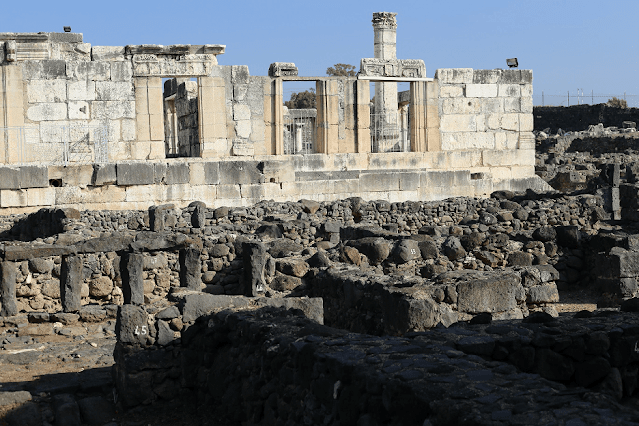
Among those denounced was Capernaum (“the village of Nahum”) mentioned frequently in the Gospels as a chief hub of Christ’s early ministry. In Matthew 4:13 we read how Christ left
Nazareth and settled in Capernaum. In Mark 1:21 it says that Christ
taught on the sabbath days in the synagogue there. It was the site where he healed the servant of the
centurion (see Matthew 8:5).
But even at Capernaum
there were those who rejected Christ.
Christ speaks of the
city as that “which art exalted unto heaven.” Matthew Poole suggests this was “ether
with respect to their trading and outward prosperity, or with respect to the
means of grace they enjoyed in hearing Christ’s sermons and seeing his
miracles.” Nonetheless, Christ continues by adding that this exalted city of privilege
“shalt be brought down to hell” (v. 23).
He contrasts Capernaum’s
lack of receptivity with how wicked Sodom would have responded. This was not
only a pagan city, but one especially known for its immorality. It was indeed destroyed,
alongside Gomorrah, with brimstone and fire in the days of Abraham (see Genesis
18—19). Sodom is a byword in the Scriptures for an evil city. Even degenerate
Sodom, however, if the works of Christ had been done in their midst, would have
repented and “it would have remained until this day” (v. 23b).
Christ’s point is to
emphasize that the “sin of sins” is to reject him. Worse than being a pagan Sodomite
is being one who spurns Christ!
How
might we apply this warning to ourselves?
Consider
the privileges which many of us have been given? Were you raised in a Christian
family, taken to a Christian church? Do you have a Bible on the bookshelf (even
if rarely read), or are you, at the least, the beneficiary of a society deeply touched
by Christ? Still, many given such privileges persist in rejecting him, mocking
him.
Here
is the warning. A day is coming when all wrongs will be made right. It will be
better on that day for Sodom, than for those who, in the end, reject Christ
(Matthew 11:24). Rejection of Christ is indeed the “sin of sins.”
Christ
stands before us, teaching in his word, plaintively warning, toward the end that
we might experience the two great turnings: turning away from our sin in
repentance, and turning toward Christ in faith.
Grace
and peace, Pastor Jeff Riddle
Thursday, January 13, 2022
WM 219: Changing Goals of Modern Text Criticism Revisited
Tuesday, January 11, 2022
Saturday, January 08, 2022
The Vision (1.7.22): The least in the kingdom greater than John
Note: Devotion based on last Sunday's sermon on Matthew 11:7-15 (audio not yet available).
Verily I say to unto you, Among them that are born of women
there hath not risen a greater than John the Baptist: notwithstanding he that
is least in the kingdom of heaven is greater than he (Matthew 11:11).
Our Lord had great praise for John the Baptist. None of the
godly men of the past exceeded John in greatness. John was, spiritually
speaking, the equal of Moses, of David, of Solomon, of Isaiah. He was the last
of the Old Testament prophets and a spiritual Elijah (Matthew 11:13-14). “Notwithstanding,”
our Lord adds, “he that is least in the kingdom of heaven is greater than he”
(v. 11b).
Christ teaches us here that the most immature, undisciplined,
and inconsistent disciple who enters fully into the kingdom of heaven, knowing
that the Lord Jesus Christ is the only begotten Son of God, the Word made
flesh, knowing the fulfillment of Christ’s ministry in his obedience unto death
upon the cross and his glorious resurrection from the dead on the third day,
and who places his fundamental trust in Christ, is greater even than John the
Baptist, and if greater than John greater than all in that great godly line of
Old Testament saints.
This does not mean that the Old Testament saints were not
saved. They were. In Romans 4:3 Paul said, “For what saith the scripture?
Abraham believed God, and it was counted unto him for righteousness.” John the
Baptist was likewise a converted man.
The point is not to denigrate John’s faith or that of the
great saints of the past, but to magnify our understanding of the blessing and
privilege it is to know the Lord Jesus Christ in this age in the fulfillment of
his ministry.
In Ephesians 3:5 Paul spoke of a mystery, which “in other
ages was not made known to the sons of men, as it is now revealed unto his holy
apostles and prophets by the Spirit.”
The apostle Peter, likewise, in 1 Peter 1:12 speaks of the
fact that those who preached the gospel to new covenant believers, with the
help of the Holy Spirit sent down from heaven, revealed “things the angels
desire to look into.”
The least disciple of Christ is greater than John the Baptist.
What privileges have been given to new covenant believers! May we then be good
and faithful stewards of these truths revealed to us and not compromise or
forfeit them.
Grace and peace, Pastor Jeff Riddle
Saturday, January 01, 2022
Personal Reflections: Ten Interesting Reads in 2021
New Year's Day is a good time for looking back and evaluating. I don’t think the intensity of my reading has decreased that
much over the last several years, but I have probably finished fewer books, in
favor of reading selective chapters from works, to mine the desired
information, without completing them from end to end. Here is an eclectic
selection of ten books, however, of at least ten interesting works of various genres that I was able to finish last year:
· Nicholas Wolterstorff, In this World
of Wonders: A Memoir of a Life in Learning (Eerdmans, 2019): 318 pp.
This engaging memoir comes from an influential American
philosopher, shaped by Dutch Reformed and left-leaning evangelical traditions. The
most interesting part was reading about how his study of aesthetics had practical
application in the architectural design of his Grand Rapids home and his
collection of art, from artisan chairs to Japanese ceramics.
· Paul Abidan Shah, Changing the Goalposts
of New Testament Textual Criticism (Wipf & Stock, 2020): 195 pp.
Shah accurately identifies the “radical shift” that has taken
place in 21st century textual criticism (from the old modern goal of
reconstructing the autograph to the new post-modern goal of merely suggesting a
possible “initial text”). Unfortunately, he suggests the answer to this shift is
trying to recapture the old modern goal, rather than abandoning modern reconstruction
altogether. Listen to my review in WM 215.
· Crawford Gribben, Survival and
Resistance in Evangelical America: Christian Reconstruction in the Pacific
Northwest (Oxford, 2021): 210 pp.
This is a fascinating study of conservative Protestant and
Reformed Christian efforts to carve out some version of an enclave of a
distinctively Christian culture in the “American Redoubt” of the Pacific Northwest.
Gribben, of Queen’s University in Belfast, explains how Doug Wilson is not your
father’s Rushdoony. Listen to my interview with the author in WM 199.
· William H. Willimon, Stories (Abingdon
Press, 2020): 251 pp.
Willimon is a mainline Methodist Barthian ecclesiocrat with a
Southerner’s gift for telling an engaging story (even if you can’t agree with
him theologically). These “stories” are drawn from his many books and articles
written over a long career.
· Hilarion Alfeyev, The Sermon on the
Mount, Jesus Christ: His Life & Teaching, Volume 2 (SVSP, 2019): 432
pp.
This is the second in a projected six-part series on the life
and teaching of Jesus. It focuses on an extensive exposition of Matthew 5—7 from
an Eastern Orthodox perspective. Listen to
my review of Volume 1 in this series here.
· E. M. Cioran, The New Gods,
trans. by Richard Howard (Quadrangle, NY Times Book Co., 1969): 120 pp.
I picked this used volume off the shelf at the Blue Whale
Books in Charlottesville after having read the author’s The Trouble of Being
Born a few years back. Cioran is a Romanian-born philosopher, banned under
communism, exiled to France, misanthropic, pessimistic, acerbic, hero of modern
“Anti-Natalists,” and master of aphorism. Not a Christian work, but sometimes
recalls the rants of Qoheleth.
· Matthew Y. Emerson, He Descended
to the Dead: An Evangelical Theology of Holy Saturday (IVP, 2019): 251 pp.
Thought provoking study of the descent clause. Found this
helpful when I preached through the Apostle’s Creed. Listen
to the series here.
· Arthur C. Clarke, 2001 A Space Odyssey
(ACE, 1968, 1999): 297 pp.
I read this sci-fi work, which served as the basis for the classic
film, when I needed a break from reading theology. Predicts the internet, zoom
calls, and space travel.
· John David Punch, The Pericope
Adulterae: Theories of Insertion & Omission: An Academic Essay in Theology
(Doctoral Thesis, Radbound University, Nijmegen, 2010): 417 pp.
I found this book to be very helpful when preparing to teach
and defend John 7:53—8:11.
· James Romm, Ed. Seneca, How To
Keep Your Cool: An Ancient Guide to Anger Management (Princeton University
Press, 2019): 220 pp.
A modern diglot (Latin and English) edition of the Stoic
Master’s De Ira (On Anger), abbreviated to read like a script from a TED
Talk.
JTR
Personal Reflections: A Dozen Memorable Events of 2021
The Lord blessed
me with some very kind providences in 2021. I hope this list is not
taken as “boasting” but as an expression of sincere gratitude for many unexpected and undeserved blessings in 2021. Here is a list of a dozen such things (in
chronological order):
· I taught on text of Scripture at the
Kept Pure Conference at the Five Solas Church in Reedsburg, Wisconsin, and got
to meet and spend time with many friends, including Christian McShaffrey, Bill
Greendyke, and Anne Hills Brown (daughter of E. F. Hills), March 26-27, 2021.
· I watched my two younger sons win
the VACA state championship in baseball for Grace Christian School and saw my son Isaiah given the conference MVP and tournament MVP awards, May 22,
2021.
· Thanks to an anonymous gift from a
church member, I attended for the first time since 2009 the Banner of Truth Ministers’
Conference in Elizabethtown, Pennsylvania, May 25-27, 2021.
· I taught the children of CRBC on the
Life of Joseph (Genesis 37-50) in our annual VBS, June 14-17, 2021.
· I spent a week with my family at
Topsail Island, North Carolina, June 28—July 3, 2021.
· I enjoyed supper at Toscano’s in
Cambridge, Massachusetts with my family and Dr. Jay Rhee, a friend I had not
seen in 18 years, July 7, 2021.
· I contributed an essay to the
festschrift, A Workman Not Ashamed: Essays in Honor of Albert N. Martin
(Free Grace Press, 2021).
· I taught an intensive class on the
Gospels at IRBS Seminary and preached at Heritage RBC, in Mansfield, Texas, August
3-8, 2021.
· I attended the Christ-centered wedding
of Fraser and Lily Jones (who met at the 2019 Text and Conference in Atlanta!)
in Greenfield, Indiana, August 14, 2021.
· I attended and gave the “Orientation”
to the 20th annual Keach Conference, hosted this year at Redeeming
Grace Church, Gloucester, Virginia, September 25, 2021.
· I taught and preached at Metropolitan
Tabernacle Church in London, November 27-29, 2021.
· I attended a performance of Handel’s Messiah
by the Choir of Westminster Abbey and the St. James Baroque with my family
in Westminster Abbey, November 30, 2021.
“my cup
runneth over” (Psalm 23:5).
JTR
Friday, December 31, 2021
The Vision (12.31.21): John's Question to Jesus: Are you the Christ?
Now when John had heard in the prison the works of Christ, he sent
two of his disciples, And said unto him, Art thou he that should come, or do we
look for another? (Matthew 11:2-3).
Given that John had previously declared Jesus to the Lamb of God
and the Son of God (cf. John 1:29, 34, 26), why is he now sending this question
to Jesus by his disciples?
Two responses have been given:
First, some have suggested that the question reflects weaknesses
and doubts in John himself.
John the Baptist was a great man, but he was still only a mere
man. The old adage goes, “The best of men are men at best.”
It raises the question of whether his being cast into prison had
been dispiriting to him. Maybe he had sunk into despair and gloom. He was
perhaps doubting his past experiences, the ministry he had performed, the
truths revealed to him.
Consider the later experience of Peter who would adamantly promise
never to forsake Christ, but then, when the rubber met the road, he denied
three times that he ever knew him (cf. Matthew 26:69-75).
The difficulties of our circumstances can indeed wear us down
spiritually. Spurgeon observed: “Dark thoughts may come to the bravest when
pent up in a narrow cell” (Matt, 131).
Second, others have suggested that John’s question was not for
himself, but for the benefit of his disciples.
According to this view, John wanted Christ himself to affirm his
identity as Messiah directly to his disciples. We know from the record of the
NT that many followers of John would eventually become followers of the Lord
Jesus, but this would require teaching and instruction. The proto-apostle
Andrew had been a disciple of John (John 1:37, 40). Other followers of John who
eventually turned to Jesus include Apollos (cf. Acts 18:24-28) and the twelve
disciples of Ephesus (Acts 19:1-7).
Can you imagine how encouraging this passage recorded by Matthew was
to those who had been disciples of John but then became disciples of the Lord Jesus?
Christ provided a definitive answer to John’s question: “Go and shew
John again those things which ye do hear and see” (Matthew 11:4). He opened blinded
eyes, made the lame walk, cleansed lepers, opened deaf ears, raised the dead,
and preached good news to the poor (v. 5). He is the Messiah, anticipated by
the prophets. “And blessed is he, whosoever shall not be offended in me” (v.
6).
Grace and peace, Pastor Jeff Riddle
Friday, December 24, 2021
The Vision (12.24.21): Receiving Christ
Note: Devotion taken from last Sunday's sermon on Matthew 10:40-42.
He that receiveth you receiveth me, and he that receiveth me
receiveth him that sent me (Matthew 10:40).
The conclusion to Christ’s commissioning of the twelve
apostles in Matthew 10:40-42 really has but one central point with three
thrusts: (1) To receive the faithful messengers of Christ is to receive Christ
himself (v. 40a); (2) To receive Christ is to receive the God who sent him (v.
40b); and (3) The one who does this will be greatly rewarded (vv. 41-42).
It begins in v. 40a: “He that receiveth you receiveth me….”
Christ had already prophesied to his apostles of the mixed
reception that awaited them. First, there will be the “worthy” ones who will
welcome the apostles and extend hospitality to them (see vv. 11-13a). Second,
however, there will be those who will not receive them (see vv. 13b-15). He
sends them as sheep in the midst of wolves (v. 16).
A truly astounding point is being made here. To receive a
faithful message about Christ presented by faithful messengers of Christ is to
receive Christ himself.
What did Christ commission the apostles to do? To proclaim,
“The kingdom of heaven is at hand” (v. 7; cf. Matthew 4:17). This was a
declaration that the rule and reign of God was present, manifest, in the person
and work of the man Jesus of Nazareth.
The person who receives this message through the apostles is
receiving the Lord Jesus himself. Consider the apostle Paul’s words in 2
Corinthians 5:20, “Now then we are ambassadors for Christ, as though
God did beseech you by us: we pray you in Christ's stead, be ye reconciled to
God.”
This is but the first link in a chain. The next
link comes in v. 40b: “and he that receiveth me receiveth him that sent me.”
The one who sent Christ into the world is the God
of the Bible. This requires the doctrine of the Trinity fully to understand. It
is God the Father who sent God the Son to accomplish the redemption of sinful
men (cf. John 3:16-17; 10:36; 17:18; 20:21).
The
apostle Paul thus declared in Galatians 4, “4 But when the fulness of the time was come, God sent forth his Son,
made of a woman, made under the law, 5 To redeem them that were under the law, that we might
receive the adoption of sons.”
This
is a great “Christmas” passage. Paul is teaching the incarnation of Christ. At
just the right time, in the fullness of time, God the Father sent forth God the
Son, to be “made of a woman.” Paul knew the virginal conception and virgin
birth of Christ. To be made under the law. To live in perfect obedience to the
law for our salvation.
So,
the links on the chain in Matthew 10:40 are these: (1) If you receive the
apostles, you receive the Lord Jesus Christ (the eternal Son of God, made
flesh), and (2) if you receive the Lord Jesus Christ, you are receiving God the
Father, the one true God of Scripture.
Grace
and peace, Pastor Jeff Riddle