Showing posts with label church. Show all posts

Friday, July 26, 2024

The Vision: Loyalty to the Local Church (7.26.24)


Last weekend we had our annual Youth Conference at Machen Conference Center in Highland County, Virginia. The topic this year was a study of Peter Master’s book Steps for Guidance in the Journey of Life (Wakeman Trust, 1995, 2008). Masters has served over 50 years as pastor of the Metropolitan Tabernacle Church in London, the same church which Charles Spurgeon once served as minister.

The thesis of this book is that God guides his people in the journey of life, especially at the major turning points, like marriage, vocation, where we will live, and what church we will join.

In the final chapter on the importance of the local church, Masters stresses loyalty to the church. He begins the chapter, “One of the great problems reported in the life of the local church today is the lack of a deep sense of loyalty on the part of many members” (103).

He focuses on Paul’s image in 1 Corinthians 12 of the church as being like a human body: “But now God hath set the members every one of them in the body, as it hath pleased him” (v. 18). Masters asks his readers to consider whether they have a high or a low view of the church. He especially stresses the importance of loyalty to the church, stating, “God insists that his people should feel obligated to their churches in a special way… And they are to be loyal to their church until God himself calls them elsewhere by unmistakable guidance” (106). The church is a living thing. We do not want to hurt it. “How can we bear to see limbs torn out?” (109).

Here are a few other choice exhortations from Masters:

“We must be all for Christ, and for his cause and his church” (113).

“We all need great tenacity, and a deep sense of belonging to our church” (113).

Satan “is constantly tempting God’s people to seek greener pastures elsewhere” (113).

“We are not free agents, and should never be moved by whims” (113).

“High mobility” has been “to the great hurt of churches and individuals” (114).

Masters makes clear, however, that loyalty to any church is not unconditional. Leaving churches that embrace false teachings and false practices is, of course, justified.

Otherwise, Master suggests, “We should regard ourselves as permanent limbs or parts of that body until he moves us….” (118).

May the Lord continue to direct us and give to us a love for and loyalty toward the local church in which he has placed us.

Grace and peace, Pastor Jeff Riddle

Wednesday, May 25, 2022

Four Biblical Bases for Communion Among Churches


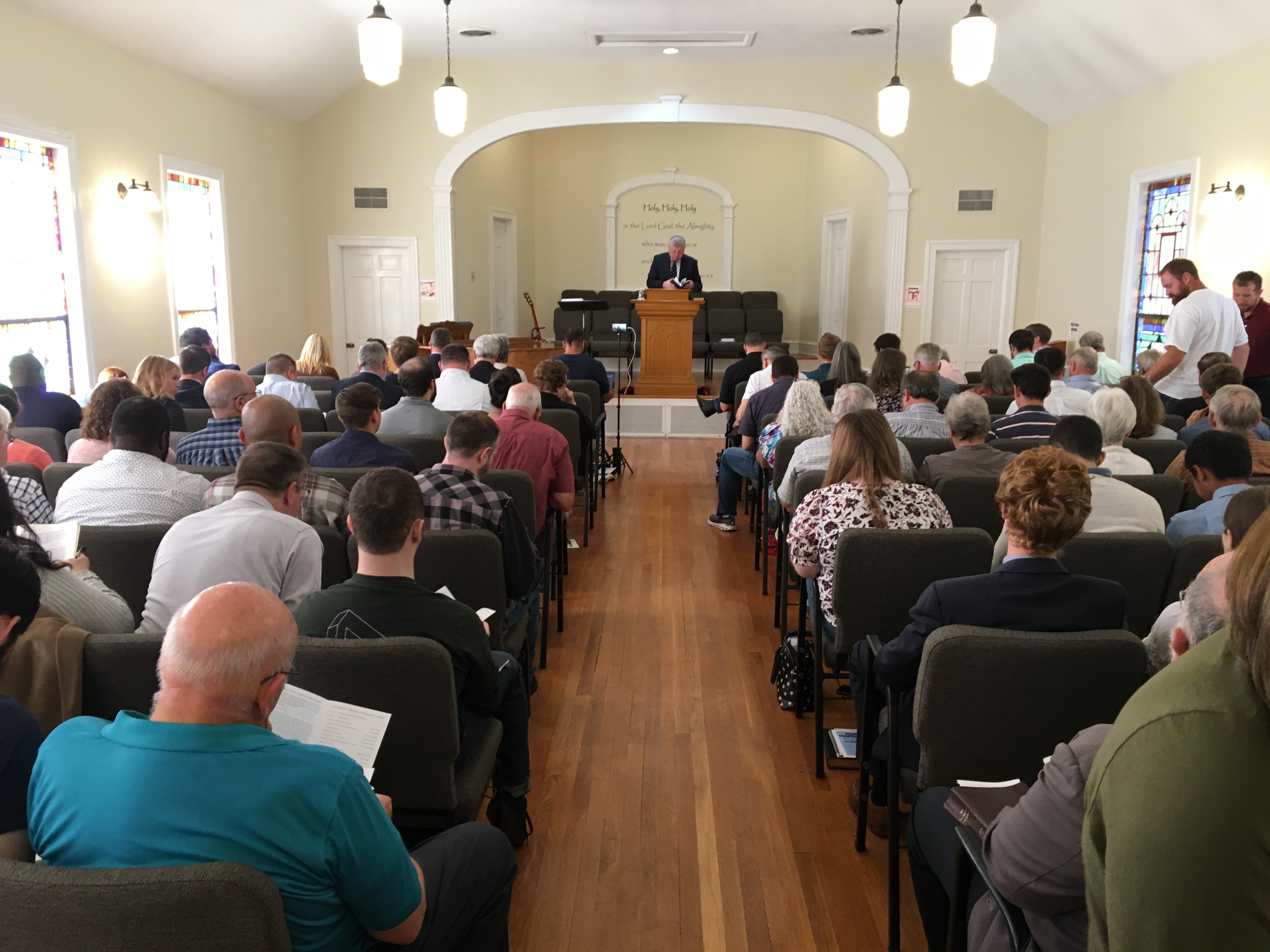
Image: Scene from the 2021 Keach Conference, hosted by the Reformed Baptist Fellowship of Virginia, at Redeeming Grace Baptist Church, Gloucester, Virginia.

The 2LBCF-1689 teaches the necessity and benefits of “communion” among churches (see 26:14-15). Particular Baptist churches have historically realized this through formal associations and assemblies. Last Sunday pm I preached on “The Biblical Basis for Communion Among Churches” and covered these four points (bases):

First: The Jerusalem Council (Acts 15:1-4):

For the background for the church at Antioch, see Acts 11:19-26. Notice that the church at Jerusalem was involved from the very beginning in the planting of the church at Antioch, providing leadership in the form of Barnabas the great son of encouragement.

The church at Antioch then sent out Paul and Barnabas on what we call Paul’s first missionary journey (Acts 13:2-3), and at the end of their journey they returned to Antioch (14:25-28).

Then, there arose a dispute at Antioch over circumcision (Acts 15:1), and the decision was made to send Paul and Barnabas as representatives of the Antioch church to the church at Jerusalem (v. 2). Not only were there living apostles in that church but also elders: “unto the apostles and elders” (v. 6).

This leads to what we call the Jerusalem Council (see vv. 4-6), which resulted in a letter or decree being issued by the council or assembly to the church at Antioch declaring that circumcision was not required. This was delivered not only by Paul and Barnabas but also by Judas and Silas, “chief men among the brethren” (see vv. 22-31).

So, here is perhaps the chief prooftext for the practice of communion among churches.

Second: The tendency of the apostles at times not only to address individual churches, but also to address groups of churches, especially those in the same geographical area.

See the introduction to Galatians (Gal 1:1-2; contrast with Phil 1:1 written to a single church).

See also Paul’s instruction to the church at Colosse and the mention of sister churches in nearby Laodicea and Hierapolis (Col 4:10-16).

See also Peter’s address to the “strangers” (Christians in local churches) in various regions (1 Peter 1:1-2).

And notice the beginning of Revelation as Christ addresses the seven churches of Asia Minor (Rev 1:4, 10-11).

Third: The tendency of the apostles and early churches to commend brethren from one church unto those at another.

See the church at Ephesus’s commendation of Apollos to the church at Corinth (Acts 18:24-28).

See Paul’s commendation of Phoebe in Romans 16:1-2.

There are many more examples of this. See the commendation of Timothy and the affirmation of Epaphroditus in Philippians 2:19-30 (the latter called a “messenger” or apostolos in v. 25).

Fourth, the apostolic assumption of some degree of uniformity of practice among the churches.

See Paul’s comments in 1 Corinthians 4:17; 7:17b; 11:16; 14:33.

This assumes that the early churches strove for unity in faith and practice.

How did they do that? By having communion with one another.

How can we know if we share in this unity of faith and practice unless we have fellowship with other churches? It is the tendency of cults to be isolated and idiosyncratic, but of Biblical churches to be open and accountable unto other churches

JTR

Tuesday, February 09, 2021

Book Review: John Keith Davies, The Local Church: A Living Body


I have posted the audio of my book review of John Keith Davies, The Local Church: A Living Body (Evangelical Press, 2001).

I have also posted my written review which appeared in the Evangelical Forum Newsletter, Vol. 2, No. 1 (2004): 11-12. Read it here on academia.edu.

JTR

Thursday, November 07, 2019

WM 137: Round Table: Are Reformed Baptists "Reformed"?


WM 127: Round Table: Are Reformed Baptists "Reformed"? is posted. Listen here.

This episode was recorded on Wednesday, November 6, 2019 in Sandston, Virginia, following a fraternal meeting of RB pastors. In it, I join with four brothers to discuss the book On Being Reformed: Debates over a Theological Identity (Palgrave Pivot, 2018).

This booklet has four essays written in response to and discussion of R. Scott Clark's Recovering the Reformed Confession: Our Theology, Piety, and Practice (P & R, 2008), especially relating to the question of whether or not modern Reformed Baptists can rightly be labelled as "Reformed."

In favor of Reformed Baptists being Reformed, there are two articles from Baptist scholars:

Chris Caughey and Crawford Gribben, History, Identity, Politics, and the "Recovery of the Reformed Confession"

Matthew C. Bingham, "Reformed Baptists": Anachronistic Oxymoron or Useful Signpost?

And on the opposite side, two articles suggesting that Reformed Baptists are not really Reformed:

D. G. Hart, Baptists are Different

R. Scott Clark, A House of Card? A Response to Bingham, Gribben, and Caughey

Beyond analysis and evaluation of the booklet we also discussed issues like whether a Reformed Baptist church should have the name "Reformed" in its title, how to interpret/explain Reformed theology to those new to our churches or the faith, etc.

Thanks to these brothers for taking part in the discussion!

Image (Left to Right): Clevenger, Jones, Loomis, Davidson

JTR


Friday, February 26, 2016

The Benefits of "Communion" Among Churches


Image: Rose bushes and fountain at Houston Baptist University, Houston, Texas (2.25.16)

Note:  I completed a short series on Churchmanship last Sunday with a message on “Communion Among Churches” (Acts 15).  Here are some notes from the closing application:

There are specific benefits that might come through “communion” or fellowship among churches:

We might appeal to one another for assistance in dealing with difficult doctrinal or other problems that lead to conflict within any church or churches (see the Jerusalem Council in Acts 15).

We might appeal to one another in cases of church discipline (see the 2LBCF-1689 chapter 26, paragraph 15).  Churches can act improperly and unjustly.  They can also act rightly and be accused of acting improperly and unjustly.  In either case it would be good to have a court of appeal.  Compare:

Proverbs 15:22 Without counsel purposes are disappointed: but in the multitude of counsellors they are established.

We might spur one another on toward love and good deeds (cf. how Paul urged the Corinthians to consider the generosity of the Macedonians in 2 Corinthians 8:1-5).


We might assist each other in the ministry.


A church with only one elder might seek the counsel of the elders from other churches.


Sister churches might help a church that is without any elder by supplying preaching and counsel.


A man seeking theological education might seek to study with elders from various churches.

Churches might work together to host camps and conferences.


Churches might work together to plant new churches in places where there are no gospel churches.


We might aid and assist one another in times of distress and persecution.


We might pray for one another.  John Owen:  “There is not a single particular church or a member of any of them that does not have the prayer support of all the churches in the world and all the members of them every day.  Although this fellowship is invisible to the eyes of the flesh, it is glorious to the eyes of faith” (Gospel Church Government, p. 101).


We might hold one another accountable.  This means one church or group of churches might admonish another if it compromises its preaching of the gospel, its holding to the faith, its practice of community, or the purity of its worship and administration of the ordinances.

Last week I did a Bible study on the reaction to modern feminism known as MGTOW (Men Going Their Own Way) and I read Ecclesiastes 4:9-12:

Ecclesiastes 4:9 Two are better than one; because they have a good reward for their labour. 10 For if they fall, the one will lift up his fellow: but woe to him that is alone when he falleth; for he hath not another to help him up. 11 Again, if two lie together, then they have heat: but how can one be warm alone? 12 And if one prevail against him, two shall withstand him; and a threefold cord is not quickly broken.


I was struck in preparing this message on communion among churches, how these principles might be applied here as well.  Churches need communion with other churches, lest they become CHiGTOWS:  Churches going their own way.


Indeed, this might well be one of the questions you ask of any church you might consider joining to evaluate its health.  Is it connected and accountable to other churches?


As we seek to be faithful in other areas of our life as a church let us also seek to be faithful in this area of communion among churches.

Grace and peace, Pastor Jeff Riddle

Wednesday, February 05, 2014

When is a church a cult?


In the review article I did on the Go Stand Speak video and the street preaching movement in the last RBT, I made reference to one of the featured speakers in the video and controversy over The Church at Wells, Texas.  Texas Monthly magazine did an extended feature article in its February 2014 issue on this church, asking “When is a church a cult?”  A message board has also been set up with various locals, family members, and others weighing in (sometimes unhelpfully) on the situation.

It is a fascinating religio-sociological study.

The members of the Church of Wells are generally well educated young adults (the core leaders met at Baylor University) who come from middle class to upper middle class backgrounds, and who mostly grew up in mainstream evangelical churches.  This reminded me of Rodney Stark’s study of early Christianity in The Rise of Early Christianity and his observation that most new religious movements do not begin among the poor and under-educated but among the more privileged and well-educated.

The leaders became heavily involved in the street preaching movement and their theology has been influenced by soteriological Calvinism and their reading of Spurgeon and the Puritans, as well as revivalistic preachers like Leonard Ravenhill and Rolphe Barnard.  Where the group appears to have run into trouble is with its communal living and communal ownership of businesses, intense conflict with family and friends of members, isolation, and confrontations with local residents in the community.

 Theologically, the church’s practices appear to raise questions in the following areas:

·        It seems to stress the requirement of some kind of heightened spiritual experience to prove that one has been converted (salvation is not something given until diligently sought).  R. Scott Clark would call this QIRE (the quest for an illegitimate religious experience).  I have heard Paul Washer, who has had a significant influence on these young folk and others like them, for example, stress this sort of thing.

·        Related to its views on regeneration, it seems the church does not hold to the classical Reformed understanding of the perseverance of the saints.  Part of this comes as a reaction against easy-believism evangelism, false assurance, and “carnal Christianity,” typical of the mainstream evangelicalism in which they were raised and now vehemently attacked by the street preacher movement (e.g., the sermons of Paul Washer) by which they have been influenced.

·        Also related to the above, the church seems to stress a distinct view of sanctification that may tend toward perfectionism.  It has, at the least, led toward a self-righteous and judgmental demeanor.

·         It also seems to hold to a non-cessationist viewpoint with regard to spiritual gifts.  Members prayed for a newborn child who died to be “resurrected” (this is the term I’ve seen in the discussion; by this I’m sure they mean “resuscitated”) rather than seeking immediate medical help.  Other anecdotal accounts include references to claiming direct divine communication via internal premonitions and “signs.”

·        The church’s worship meetings are apparently closed to members (and their children) only.  How does this fit with 1 Corinthians 14:23-25 where the “unlearned” and “unbelievers” were included in the church’s meetings?

·        The rightful stress on obedience to Christ over obedience to all other human relationships, including that of families, must be weighed against the equally strong scriptural stream that stresses honor for parents and care for family members (cf. Matt 10:34-39; Exod 20:12; 1 Tim 5:8).  This weighing appears largely to be lacking.

·        The “elders” are three very young (though obviously very earnest and intelligent) men, all under age 30.  One wag labeled it “the church of the hot boys.”  It seems like things have spun out of control in their efforts to create an ideal Christian community.

·        It seems that all opposition has been interpreted as persecution.  I also find this to be typical of the street preaching mentality.  I recently read one “in your face” street preaching advocate refer to it as “riot evangelism.”  Whatever happened, however, to Paul’s admonition to believers to aspire to live quiet and uncontroversial lives (1 Thess 4:11)?   

I know these are sensitive issues, and I am not crazy about discussing a local church’s internal life, but the issues surrounding this church have now become public.  The charge of being a cult is, granted, hard to nail down and, if inaccurate, harmful and wrong.  I once had a man accuse my Reformed views on church eldership, the preservation of Scripture, and the abiding validity of the fourth commandment as being “cultic.”  Like most pastors, in the course of my ministry, I have sometimes been accused of being overbearing and controlling when I have had to confront or address difficult issues.  I am sure many would see any conservative church as being a cult.  Where, however, is the line between being a faithful and disciplined church and being a “cult”?

There are some things that conservative, Reformed churches can learn from Wells.  One, I think, is the value of holding a historic, Reformed confession, as a safeguard against novel beliefs and practices.  Another is the danger of “revivalistic” and experience-driven religion, as opposed to simple reliance on the ordinary means of grace.  A third is the importance of ecclesiological accountability.  How might much of this have been addressed if this church were connected to others that might have privately called a council to examine and confront errors and ill behavior on many sides?
JTR

Friday, April 08, 2011

Holy Churches

Image:  Kafue RBC, Zambia

Most people nowadays seem to think that the only power needed by the Christian Church is the power to attract; but they are wrong. They cannot see the difference between a Gideon’s “three thousand” and a mob. The modern drive after numbers needs reconsideration. Bulk can never be a substitute for power. Growth is never the same as obesity. Some of the biggest bodies are the sickest. The Church needs the power to repel if it is to maintain that holy separation in which alone the Holy Spirit can do His God-glorifying work. Our local churches today need to recover that separateness, that holiness, that overshadowing divine presence which creates God-conscious awe and strikes fear into the insincere. Our churches need again the power to repel. They need again that holy flame which scorches the hypocritical fraternizer; that awesome presence which scares away the “mixed multitude” of compromisers—Satan’s quislings and the world’s plausible Judases.

J. Sidlow Baxter as quoted in the Bible League Quarterly (April-June 2011): pp. 44-45.

Friday, February 04, 2011

NPR covers "National Porn Sunday"


Yesterday's edtion of NPR's "All Things Considered" had a segment titled, "Religious Groups Tackle an X-Rated Secret."  One evangelical group has branded this Sunday (Feb 6) as "National Porn Sunday" (it's also "Super Bowl Sunday"--choose your idol, I suppose).  Somehow I don't think this designation fits with the Regulative Principle.  In its report, NPR must, of course, also cover the topic from the perspective of religious groups other than Christians (Mormons, Jews).  At any rate, the segment is worth a listen.

JTR

Thursday, April 15, 2010

Quality is what counts


Image:  The congregation of Alfred Place Baptist Church in Wales.

In the April-June issue of Bible League Quarterly, J. P. Thackway reflects on a lesson learned from 1 Corinthians 3:12-15:

Largeness of numbers and apparent success are not the criterion.

The Lord will “try every man’s work of what it is”—not “how much it is.” Quality is what counts. Reality is what matters. So many churches justify worldly methods by pointing to increased attendances. As Dinsdale T. Young once pointed out, the only full place of worship recorded in scripture is the temple of Baal (2 Kings 10:21)! Being full of the Lord’s presence and favor counts for infinitely more, now and forever.

JTR

Thursday, September 17, 2009

Dagg on the Minister of the Word's Call (part four)

This is the sixth in this continuing series of excerpts drawn from John Dagg’s chapter on "The Ministry" in A Treatise on Church Order and the fourth from his discussion of the minister’s calling. Here, Dagg addresses the theology of ordination:
The institution of local churches has divine authority, and ought to be respected by every disciple of Christ. It is the duty of every one to become a member of some local church, and walk with the other members in love and Christian obedience. Brethren so connected are bound to exhort one another to diligence in the duties for which they are severally qualified. The obligation of a member to labor in the ministry may be recognised by his church, and the church does not go out of its proper sphere when it exhorts to this duty. Paul directed the church at Colosse, "Say to Archippus, take heed to the ministry which thou hast received in the Lord, that thou fulfil it" (Col 4:17). He did not send the message to Archippus as from himself, but instructed the church to perform this duty. Such exhortation to a minister is therefore proper to be given by a church; and it follows, that a church is not without responsibility as to the question whether its gifted members are using their gifts as they ought. This responsibility makes the church a party in ministerial ordination. We have no express declaration that the church at Antioch concurred in the setting apart of Saul and Barnabas; but it may be inferred, not only from the tenor of the narrative, but especially from the fact that these missionaries, on their return, reported their doings to the whole church.

All the parties concerned in ordination ought to seek the guidance of the Holy Spirit, and act under his influence. The highest responsibility rests on him who is entering the sacred office. He should act under a deep sense of his responsibility, and with a persuasion, the result of prayerful, heart-searching examination, that he is moved by the Holy Ghost. The presbytery have the next degree of responsibility. They should be persuaded that the Holy Spirit has called the candidate to the ministry; and be prepared, under this conviction, the result of due examination, to receive him as a fellow-laborer with them in the Lord's service. The lowest degree of responsibility rests on the church; but even this is solemn and important. The same Spirit dwells in the ministry and in the churches; and every member is concerned in whatever concerns the spiritual body of Christ. A hearty concurrence of the church is necessary in the ordination; and, without it, a presbytery should never act. When a candidate has the threefold testimony, of his own conscience, of the presbytery, and of the church, he may proceed to labor in the ministry, with an assurance that he is "sent forth by the Holy Ghost."

Every step in the process of ordination recognises the principle that a divine call is necessary to a proper entrance on the ministerial office. The candidate, the presbytery, the church, all admit it, and act on it. This principle is of great importance to the preservation of a spiritual and efficient ministry; and it cannot be neglected, without immense evil to the cause of pure religion. When a father chooses the ministry as a profession for his son, or when the son chooses it for himself, as he would choose any other profession, the authority of God is contemned, and the holy office profaned. If a church should think that they need a minister, and should conclude to appoint one without regard to a divine call; and if a presbytery should aid them in accomplishing their purpose; the church and presbytery together may make a minister; but he will be, if not a minister of Satan, at the best only a minister of men, and not a minister of Christ.

The divine call is not only indispensable, but it is also complete in itself. The presbytery do not assemble to complete it, but to signify their concurrence in the persuasion that it exists. The earliest and the least hurtful form which the pernicious doctrine of baptismal regeneration assumed, regarded baptism as the completion of regeneration. It did not make regeneration consist wholly in the outward ceremony; but it regarded no one, whatever the Holy Spirit may have effected within him, as fully regenerated, until he had gone through the outward ceremony. A similar mistake has been made respecting the Holy Spirit's call to the ministry. The call is supposed to be incomplete, until the outward ceremony of ordination has been performed. In both cases a distinction should be made, between what the Spirit does, and what it is the duty of him to do on whom the Spirit operates. The Spirit regenerates; and it is the duty of the regenerated man to be baptized. The Spirit calls to the ministry; and it is the duty of the man so called, to enter on the work of the ministry through all the forms which are prescribed in the word of God. Why the Holy Spirit permits one whom he has regenerated to err so far as to neglect baptism; and why he permits one whom he has called to the ministry to err so far as to neglect both baptism and regular ordination; I as little understand, as I understand why God permitted sin to enter the world. The proof of all these facts is irrefragable; and I am compelled to admit their existence, and believe that God will overrule them for his glory.
Analysis: Dagg stresses the importance of the local church in recognizing those in her midst who have ministerial gifts. Once a candidate seeks ordination, however, the "highest responsibility" rests with him to pursue his calling with deep seriousness. Next in responsibility is the "presbytery." By this Dagg means a body of ministers who would be called together to examine the candidate. Finally, the local church bears a "solemn and important" responsibility. Indeed, "A hearty concurrence of the church is necessary in the ordination; and, without it, a presbytery should never act." The reference to "the church" here is, of course, to the local church of which the candidate is a member. The most important factor in determining whether or not a man should enter the ministry is a divine call.
JTR

Monday, September 14, 2009

Dagg on the Minister of the Word's Call (part one)

This is the third in our series from John Dagg's A Treatise on Church Order. After discussing the Minister of the Word's distinct office and his work, Dagg proceeds to discuss his call:
The ministers of the word receive a special call from God, directing them to the service. The Jewish priests were a separate class of people, distinguished from the rest of the nation by natural descent from Aaron. The Congregation of the Lord was perpetuated by natural descent; and if the Christian church had been a continuation of it, we might expect its ministry to be perpetuated in the same way. But the members of the church are separated from the rest of the world by a divine call; and it is suitable that the ministers of the church should be distinguished in the same manner; accordingly, their designation to office is ascribed to God. "God hath set some in the church, first apostles," &c., and the qualifications for the work are the special gift of the Spirit (1 Cor 12:11).

The Holy Spirit calls to the ministry of the word none but true Christians, members of Christ's spiritual body. The apostles were chosen to be the personal attendants of the Saviour, and special witnesses of his daily life and ministry. Though he knew, from the beginning, the hypocrisy and treachery of Judas Iscariot, he chose to have a traitor among his witnesses. The blameless character of the Redeemer extorted, even from this man, the testimony, "I have sinned, in that I have betrayed the innocent blood." This testimony is of great value to Christianity. Had Christ been an impostor, had there been a scheme to deceive the people, Judas must have known it. His testimony, confirmed by his return of the money with which he had been bribed, and by his suicide, banishes every suspicion dishonorable to the Saviour. It was therefore wisely ordered that Judas should be among the apostles. But he was not among them when the last commission was given, under which we now act. When the Holy Spirit calls men to the ministry, he bestows on them qualifications for the work, qualifications both of head and heart. The qualifications of the heart include a sincere desire to glorify God, and save souls; a desire never felt by the unregenerate. Hence, the Holy Spirit never makes unregenerate ministers. When such men enter the sacred office, they, in the language of Paul, are "ministers of Satan."

As true ministers are members of Christ's spiritual body, so their ministry is intended for its benefit:--"for the perfecting of the saints, for the work of the ministry, for the edifying of the body of Christ." Their office pertains to the spiritual, universal church, of which they are all members. The ministry of some of them may have a relation also to local churches, placed under their special charge; but they serve in these for the good of the whole body of Christ.

In Ephesians iv. 11, Paul enumerates the officers whom God set in the church: "Some apostles, some prophets, some evangelists," &c. Of these the first three are not confined to local churches, but are ministers of the church universal. This is apparent, from the words of Paul: "Who now rejoice in my sufferings for you, and fill up that which is behind of the afflictions of Christ, in my flesh, for his body's sake, which is the church, whereof I am made a minister" (Col 1:24, 25).

The apostles were, according to the import of the name, persons sent forth. The term is applied specially to those whom Christ sent forth in person, and who are called the apostles of Christ. Paul claimed to be an apostle in this sense: "Am I not an apostle? Have I not seen Jesus Christ our Lord?"(1 Cor 9:1). And again: "Paul, an apostle, not of men, neither by man, but by Jesus Christ" (Gal 1:1). Paul numbered himself among the witnesses of Christ's resurrection, and the apostles were chosen to be witnesses of this fact. Peter, when he proposed the election of one to take the place of Judas, stated the qualifications necessary for an apostle in this manner: "Wherefore of these men which have companied with us all the time that the Lord Jesus went in and out among us, beginning from the baptism of John, unto that same day that he was taken up from us, must one be ordained to be a witness with us of his resurrection" (Acts 1:21, 22). These qualifications cannot now be found in any man living, and therefore the apostolic office has necessarily ceased.

The name apostle is applied, in another sense, to Barnabas,(Acts 14:14) the companion of Paul. These two ministers had been sent forth by the Holy Ghost, from Antioch, to a special work. Barnabas is probably called an apostle, with reference to this fact; and, in this sense, the term corresponds in signification to our modern name, missionary. Paul and Barnabas had been sent forth as missionaries, on a tour of missionary service.

Prophets were persons divinely inspired to make revelation from God, consisting sometimes in the foretelling of future events. This office was needed, before the volume of divine revelation was completed. The absence of the prophetic gift in modern times, demonstrates that the Holy Spirit, who imparts every needful gift, accounts further revelation unnecessary. The absence of the gift proves the sufficiency of the Scriptures, and the cessation of the prophetic office.

Evangelists were persons employed in the spread of the gospel. They appear to have labored in connection with the apostles, to extend the religion of Christ and plant new churches. They did not need miraculous endowments for their work; and therefore their office continues to the present time. Every minister of the word, when he labors, not for the special benefit of a local church, but for the spread of the gospel, is doing the work of an evangelist (2 tim 4:5). Timothy was required to do this, though remaining at Ephesus, and laboring for the interest of that particular church.
Analysis: Ministers are separated to their work by a divine call. When called, the Holy Spirit bestows upon them the qualifications for their work. Drawing on Ephesians 4:11, Dagg discusses the offices of apostle, prophet, and evangelist. In good cessationist fashion, he says that the office of apostle has ceased, though the term might also apply to those who are called "missionaries" as ones "sent forth." The office of prophet has also ceased proving the sufficiency of Scripture. Evangelists, however, are "those employed in the spread of the gospel" and, according to Dagg, this office "continues to the present time." "Every minister of the word, when he labors, not for the special benefit of the local church, but for the spread of the gospel, is doing the work of an evangelist."
JTR

Thursday, September 10, 2009

Dagg on the Work of Ministers of the Word

This is the second in our series from Dagg's A Treatise on Church Order. Here, Dagg describes the special work of those who are Ministers of the Word:
THEIR WORK

The special service for which the ministry is designed is the preaching of the word. The obligation to spread the knowledge of Christ is shared, to some extent, by all Christians. The effectual call of the Holy Spirit, by which any man is brought to repentance and faith, imposes on him an obligation to show forth the praises of him who hath called him out of darkness into his marvelous light; to let his light shine before men, that they, seeing his good works, may glorify his Father in heaven; and to hold forth the word of life. Every Christian is bound to do what he can for he conversion of others, and for spreading the knowledge of the truth. But special gifts are conferred on some, accompanied with special obligations. These constitute a special call to the ministry of the word.

During the Saviour's personal ministry he made many disciples: but he did not intrust to them equally and indiscriminately the work of spreading the knowledge of his religion. He sent forth seventy with a special commission to preach the kingdom of God. He chose the apostles to be his immediate attendants and special witnesses, and gave them a commission--"Go preach the gospel to every creature....Go make disciples, teaching them," &c. Preaching and teaching were prominent and important parts of the service required of them. When Paul was made an apostle, the commission to him, as explained by himself, was to preach the gospel: "Christ sent me, not to baptize, but to preach the gospel." The obligation which he felt to perform this service was beyond that imposed on ordinary Christians, and was exceedingly pressing: "Necessity is laid upon me; yea, woe is unto me if I preach not the gospel" (1 Cor 9:16). With him, to preach the gospel was not to utter a proclamation in a brief sentence; but at Troas he preached to a late hour of the night. In his ministry teaching was conjoined with preaching, and included in it: "Whereunto I am ordained a preacher and an apostle, a teacher of the Gentiles in faith and verity" (1 Tim 2:7).

The obligation of particular men to give themselves to the ministry of the word was intended to be a perpetual arrangement, and not confined to the ministers appointed by Christ in person. Timothy was specially appointed to this service, and was commanded, "Preach the word; be instant in season, out of season; reprove, rebuke, and exhort, with all long suffering and doctrine" (2 Tim 4:2). "Make full proof of thy ministry" (2 Tim 4:5). "Neglect not the gift that is in thee" (1 Tim 4:14). A special gift and a special obligation are here clearly recognised, and the duty to be performed is clearly preaching, in the comprehensive sense in which teaching is included. Paul had committed the gospel to Timothy; nor was the succession to cease in him. "The things which thou hast heard of me, the same commit thou to faithful men, who shall be able to teach others also" (2 Tim 2:2). Special ability and special obligation to preach and teach were to be perpetuated in men, separated to the service from the body of Christ's disciples.
Analysis: According to Dagg, the main work and special service of gospel ministers is preaching. Special gifts and obligations are only given to some for this work. Jesus himself did not intrust the disciples "equally and indiscriminately for the work of spreading the knowledge of his religion." The setting apart of some men to be preachers or ministers of the Word was "a perpetual arrangement."
JTR

Wednesday, September 09, 2009

Dagg on Ministers of the Word as "A Distinct Class"

Photo: This picture of J. L. Dagg is more than a little intimidating. His eyes look like they could pierce your soul! The image no doubt reflects the sobriety that was expected of ministers in Dagg's day.

Here begins a new series from John Dagg's Manual of Theology (The Southern Baptist Publication Society, 1858). Dagg was born in Loudon County, Virginia in 1794 and died in 1884 at over ninety years of age. He was one of the few early Baptists in America to write systematically on doctrine. His influential Manual of Theology had two parts: A Treatise on Christian Doctrine and A Treatise on Church Order.

I will offer selections from "Chapter VIII: The Ministry" from A Treatise on Church Order, along with some analysis at the end.


CHAPTER VIII
THE MINISTRY


SECTION I.--MINISTRY OF THE WORD


The ministers of Christ are a separate class of persons, distinguished by a special divine call to preach the word.

A DISTINCT CLASS

The ministers of Christ are, like ordinary Christians, separate from the world. They are partakers of the heavenly calling, by which men are brought out of the world, and made the servants of Christ. In all his epistles to the churches, Paul claims to be a fellow-saint with them, a member of the same spiritual family, and an heir of the same heavenly inheritance. Throughout the Scriptures, the ministers of Christ are spoken of as persons who love Christ, and are from the heart devoting themselves to his service. They must therefore be of the number who are "called to be saints."

The ministers of Christ are also separate from ordinary Christians. They are one with ordinary Christians, as being called in one hope of their calling; but, besides the call to repentance and faith, which they have received in common with their brethren, they have been called to special service in the Lord's cause. It is clear, from the Holy Scriptures, that there were, among the first Christians, persons to whom the work of the ministry was specially intrusted. Paul says, concerning these, God "hath given to us the ministry of reconciliation"(2 Cor 5:8). "Giving no offence, that the ministry be not blamed"(2 Cor 6:3). "Who hath made us able ministers of the new testament"(2 Cor 3:6). He speaks of himself, as counted faithful; and put "into the ministry"(1 Tim 1:12); and of the special grace given to him, that he should preach among the gentiles the unsearchable riches of Christ (Eph 3:8). The bestowment by the Holy Spirit of special qualifications for special service in the Lord's cause, is plainly taught in 1 Cor. xii., and Eph. iv. The inquiry, "Are all apostles? are all prophets?"(1 Cor 12:29) &c., shows that the offices designated did not belong to the whole body of the saints.

The separation of the ministry from the mass of ordinary Christians, is not like the separation of Christians from the world. In the latter case, they cease to be of the world, and become strangers and pilgrims in the earth. But men who enter the ministry, do not cease to be saints. Saul and Barnabas were separated unto the work to which the Holy Ghost had called them; but this separation did not take from them a place among the saints and faithful in Christ Jesus. John speaks, concerning the whole company of the saints: "We are of God; and the whole world lieth in wickedness"(1 John 5:19). Here is a strong line of division, like that which separates land and water. But the ministry appears, among the people of God, like the mountains on a continent, forming a part of it, and closely united with surrounding lands. Eminent spiritual gifts distinguish the ministers; but the same spirit that actuates them, pervades the whole body of Christ. All the disciples of Christ are bound, according to their ability, to advance the cause of- their Master, and labor for the illumination and salvation of men: and the diversity of talent among the ordinary disciples, may be compared to the diversity of hill and valley in the ordinary face of the country. But ministers are distinguished, by their superior qualifications for service, from the ordinary mass of Christians, like mountains rising above the common undulations of the surrounding landscape.

The special qualifications which the Holy Spirit bestows, bind him on whom they are bestowed to use them in the service of Christ. They are given to fit him for this service, and they constitute a divine call for him to engage in it. They are not given to confer a privilege merely, but they are a solemn call to duty--a call demanding the service of the whole life.

The apostles, when called by Christ, immediately left their secular employments, and gave themselves ever afterwards to the service of their Lord. Paul, when called, conferred not with flesh and blood. The work of the ministry did not cease, when these holy men left the earth; but other persons have been fitted to carry it on, by the same Spirit that qualified them for the peculiar service. He bestows his gifts "for the perfecting of the saints, for the work of the ministry, for the edifying of the body of Christ, till we all come in the unity of the faith, and of the knowledge of the Son of God, unto a perfect man, unto the measure of the stature of the fullness of Christ" (Eph 4:12, 13).

The ministers of Christ are not a separate class of men in such a sense as to constitute them an organized society. They are fellow-laborers in the Lord's service, but have no power over one another; and have no authority from Christ to combine themselves into an ecclesiastical judicatory to exercise power in any manner. They are all on a level as brethren; are the servants of Christ, and the servants of the churches.

Analysis: Dagg will offer a typical Baptistic two-fold view of office ([1] pastors who are gospel ministers and [2] deacons). He begins with the gospel minister as "a distinct class of persons, distinguished by a special divine call to preach the word." Their call and service are parallel to that of the apostles who "immediately left their secular employments and gave themselves everafter to the service of the Lord." In the final paragraph, Dagg rejects the Presbyterian view of gospel ministers forming "an organized society" or "ecclesiastical judicatory" (presbytery) outside the local church to which they are subject.

JTR

Thursday, August 06, 2009

Guest Preacher at JPBC August 9th: Brian Russell

Our guest preacher at JPBC this upcoming Lord's Day (August 9th) will be Pastor Brian Russell.

Brian A. Russell was born in South Africa and came to a saving faith in Jesus Christ at the age of seventeen. He worked in the gold mining industry for six years. Following the Lord’s call to full-time service, he earned his bachelor’s degree from the University of South Africa and his theological degree from the Baptist Theological College, Johannesburg. He entered the ministry in 1962 and has served in three churches in South Africa, one in Zimbabwe and two in Virginia. He and his wife, Muriel, have three grown children. He is the author of Baptism: Sign and Seal of the Covenant of Grace (Evangelical Press, 2002) and Totally Committed to Christ (EP, 2004).

JTR

Friday, May 01, 2009

Baxter Article in "9 Marks eJournal"

The May-June issue of the 9 Marks eJournal is a whopper special edition over a year in the making on the topic of the "Multi-Site Church Movement." It includes an edited version of an article I wrote titled, "Richard Baxter and the Multi-Site Movement." To learn more about 9 Marks look here. To listen to a previous talk I gave critiquing multi-site look here.
JTR

Monday, June 23, 2008

What is the perfect size for a church?

What is the perfect size for a church? Over how many people can a pastor truly keep watch? Where might we look for Biblical guidance?
After the ascension, the nucleus of the Jerusalem church consisted of 120 names (Acts 1:15), though many more were soon added (see Acts 2:41, 47; 4:4). We must be careful of setting up the expansion of the Jerusalem church in the apostolic era as the norm for contemporary church growth. Yet what of the initial number? Is this an ideal?
When Jesus told the Parable of the Lost Sheep (Matthew 18:10-14; Luke 15:1-7) he spoke in terms of a shepherd set over a hundred sheep who leaves the ninety-nine to go after the one stray. Is one hundred implied as an ideal number for the flock? After all, he could have spoken of leaving the 199 or the 499 or the 999 or the 9,999.
How about 100-120 souls as an ideal? Not too few so as to be insular and parochial. Not too many so that members can fall through the cracks or remain anonymous. Enough people so that if they truly give, a full time Pastor can be supported and kindgom work can be done.
JTR

The Fundamentalist Critique of Dever

Mark Dever has been having some dialogue with Fundamentalists with regard to what it means to be "Together for the Gospel." See the 9 Marks "Forum on Fundamentalism."
Thanks to Jamie H. for also sending me this link to the June 14 post by Dever on the 9Marks blog: "Mark Dever doesn't practice separation?" Dever ends with this statement and question:
To sum it up, I want my separation from the world to be more pronounced than my separation from other Christians. Does this make sense?
I think the Fundamentalist brothers are asking some good questions, however. Will the resurgence of "Calvinism" or even "church discipline" be merely "the next big thing" in neo-evangelicalism in the same way "innerancy" was in the 1970s? Will agreement on soteriology or ecclesiology alone be enough to keep the evangelical church from sliding into compromise?
JTR

Tuesday, June 17, 2008

A Biblical Defense of Church Membership

A Biblical Defense of Church Membership
Jeff Riddle
JPBC June 8, 2008
Sermon Notes:

I. A half dozen Scriptural reasons for a defined and meaningful church membership:

1. We find the roots for the practice of church membership in practices of the Old Testament people of God.

If you were part of the OT people of God you belonged to a particular tribe and a particular family within that tribe (some examples: Numbers 4; Joshua 7:16-18; 1 Samuel 10:20-21).
There was no such thing as a free-lance, unconnected Israelite. There was no such thing as an Israelite who said, "I’m part of the covenant people of God, but I’m not part of a tribe or family."

2. Jesus’ command for love as defining mark among his disciples can only be realized through participation in a defined local body (see John 13:34-35).

3. The descriptions of the local church in Jerusalem in Acts indicates a well defined body of believers (cf. Acts 1:15; 2:41, 47; 4:4).

4. The letters of Paul in the NT were generally addressed to defined churches in distinct geographical areas or to the acknowledged spiritual leaders of those bodies (Rom 1:7; 16:4-5, 16; 1 Cor 1:2; 2 Cor 1:1; Phil 1:1; 1 Thess 1:1; 2 Thess 1:1).

5. The local church is necessary for the proper exercise of church discipline (cf. Matt 18:15-17; 1 Cor 5:4-5; 2 Cor 2:6; 1 Tim 5:9).

6. The existence of a defined local church is assumed in the NT both in the setting apart of persons to ministry service and in the exercise of spiritual rule (cf. Acts 6:2-3; 1 Tim 3; Heb 13:7, 17).

II. We can add to this Paul’s image for the local church as a human body, a living organism, to which each member is joined.

III. Challenges:

How do we respond?

1. Be joined to a local body.
2. Love the local church.
3. Pray for and with the local church.
4. Serve the local church.
JTR

Thursday, November 15, 2007

Baptist Meetings

I am back in the groove after attending two Baptist meetings this week.

First, I was down in Hampton on Monday for the first day of the annual SBCV meeting. I picked up JPBC’s Howard Anderson at the Newport-News Airport (he had flown in from Scottsville), and we made it over to Liberty Baptist for the meeting. We had lunch with Brian Russell, a native of South Africa who served for 16 years as Pastor of Gwynn’s Island Baptist Church and then planted Redeeming Grace Baptist Church in Matthews County, Virginia. Brian gave me a copy of his book Baptism (Grace Publications, 2000) that I look forward to reading. I also got to spend time with Pastor Rob Stovall of Providence BC and his son Bobby. JPBC was accepted into membership in the SBCV in the Monday afternoon session. The praise music for the sessions was very loud. As one person said, He felt he had stumbled into a Church of God meeting.

On Tuesday, I made my way to the meeting of the BGAV at the Richmond convention center to attend as a visitor. This was my 15th BGAV meeting and perhaps my last. This year marked the 5th anniversary of the Kingdom Advance meeting, held in Charlottesville on May 10, 2002. In general, it was business as usual for the BGAV, celebrating its "freedom," tying hard to appear relevant, and being self-congratulatory for stagnancy. Just before the lunch break on Tuesday the announced Messenger count was a mere 675 people! A friend noted the irony of the BGAV theme, "Hope is on the Way (H.O.W.)." He suggested a few possible future themes, like "S.O.S." and "D.N.R."

I’ll write a more detailed summary of both meetings in the next Evangelical Forum Newsletter.

JTR