Showing posts with label prophecy. Show all posts

Friday, December 12, 2025

The Vision (12.12.25): The scepter shall not depart from Judah


Image: Snow covered branches, North Garden, Virginia, December 2025.

Note: Devotion taken from last Sunday's sermon on Genesis 49.

The scepter shall not depart from Judah, nor a lawgiver from beneath his feet, until Shiloh come; and unto him shall the gathering of the people be (Genesis 49:10).

In Genesis 49 Jacob offers a prophetic blessing upon his sons who will form the twelve tribes of Israel. The blessing on Judah (vv. 8-12) is a prophecy of Christ.

Judah’s name means “praise.” From him would come the kingly line. Jacob says he will be at the neck of his enemies (v. 8b). His father’s children will bow down before him, just as they had bowed to Joseph (v. 8b).

His sign is a lion (v. 9). The ancient Hebrews also knew this animal as king of the beasts, the most powerful and fearsome.

Then Jacob prophesies that the scepter of rule shall not depart from Judah, nor a lawgiver from his feet (from his line of descent), until Shiloh come. Some suggest the name “Shiloh” means the peacemaker or Saviour (M. Poole). One commentator called it a “cryptogram” meaning “Messiah” (MacArthur Study Bible).

From Judah would come King David, and his descendants would rule in one form or another all the way up to the time when Herod the Idumean (Edomite) was made the King of the Jews by the Romans. And who was born then? The Lord Jesus Christ, Shiloh, the Prince of Peace, the King of Kings, and the Lord of Lords. In John’s vision of heaven in Revelation 5:5 one of the elders says to him, “Behold, the Lion of the tribe of Judah.” But when John looks he sees “a Lamb as it had been slain” (v. 6).

Jacob says, “and unto him shall the gathering of the people be” (v. 10b). This means all his elect people, Jew and Gentile.

In v. 11 it says he washed his garments in wine. This figure anticipates the shedding of his blood in his atoning death on the cross. We see this in Revelation 19 when John sees Christ as a victorious champion riding on a white horse in his second coming, “clothed with a vesture dipped in blood: and his name is called The Word of God” (v. 13).

In Genesis 49:12 it adds his eyes shall be red with wine. This does not mean bloodshot but that the pupil of his eye will be full and dark, a sign of extraordinary health and vigor. And his teeth white as milk, pure and strong.

This is the apex of Jacob’s prophetic blessing. It points us toward the Lord Jesus Christ, our Redeemer! He came from the line of Judah through King David, in the fullness of time, born in Bethlehem.

Grace and peace, Pastor Jeff Riddle

Thursday, December 15, 2022

Devotional Article: Though you are little (Micah 5:2-5a; Matthew 2:1-6)


Just posted to my academia.edu page a devotional article I wrote last year for IRBS:

"Though you are little (Micah 5:2-5a; Matthew 2:1-6)," in O Come, O Come Emmanuel: Devotions for December Lord's Day, IRBS Seminary (2021).

You can find it here.

You can also download the entire booklet for free here.

JTR

Wednesday, March 23, 2022

Augustine, Harmony of the Evangelists.1.31-32: "The God of the whole earth" (Isaiah 54:5)


Image: Isaiah, 1838, Jean Louis Ernest Meissonier (1815-1891)


Notes:

1.31: The fulfillment of prophecies concerning Christ.

Augustine continues to stress the prophecies concerning Christ from the Old Testament. He is critical of pagans who might outwardly applaud Christ but deny that he taught that the pagan gods should be abandoned and the images destroyed.

Much attention is given to the reading and exposition of the servant song in Isaiah 52:13—54:5, including the statement in Isaiah 54:5 that the Biblical God is “the God of the whole earth.” This servant song, sometimes known as the Fifth Gospel, provided a classic prophetic passion prediction in the eyes of early Christians. Augustine points out, of course, that the pagans did not typically deny the passion of Christ, so much as his resurrection. He sees in the flowering and triumph of the Christian movement in the Roman world, the fulfillment of these prophesies, since the Christian God is, indeed, the God of the whole world.

1.32: A statement in vindication of the doctrine of the apostles as opposed to idolatry, in the words of the prophecies.

Augustine challenges pagans who deny the prophecies by saying Christ used magical arts or that the disciples invented them. He notes how the Christian movement has extended among all the Gentile nations, surpassing the synagogue, and enlarging its tent. It has even extended beyond the bounds of the Roman Empire to the “barbarous nations” (the Persians and Indians). The church has overcome the age of persecution when she was covered with the blood of the martyrs “like one clad in purple array.”

It is plain to even “the slowest and dullest minds” that the Christian God is now “the God of the whole earth.” He challenges the pagans to bring forward any of their prophecies or divinations that prove otherwise. He notes that many pagans say their gods have deserted them, because they have offended these gods. They fail to see the failure of their religion is due instead to Christ’s triumph in fulfillment of prophecy.

Conclusion:

Augustine continues his apologetic against the pagan religions. Though this is a work on the Gospels, he wants to make plain that the life of Christ, including his passion, was a fulfillment of the Old Testament writings, especially Isaiah. He sees the triumph of Christianity in the Roman Empire and even beyond as a providential evidence of the truth of the Christian faith.

JTR


Tuesday, February 15, 2022

Augustine, Harmony of the Evangelists.1.26-27: Idolatry & Prophecy


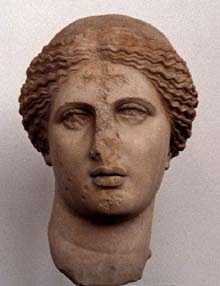
Image: Head of Aphrodite, from the Agora in Athens, defaced with crosses on forehead and chin.


Notes:

1.26: Of the fact that idolatry has been subverted by the name of Christ, and by the faith of Christians, according to the prophets.

Augustine argues that the Christian stance against pagan idolatry was not a new teaching but one that is found in the Old Testament prophets. This Old Testament teaching has been preserved by the Jews, even though they reject Christianity. “Thus,” says Augustine, “the enemy of our faith has been made a witness to our truth.”

The “demolition” of the polytheistic pagan system has come from the God of Israel himself. To prove his point Augustine cites the Shema of Deuteronomy 6:4 and the second commandment against graven images (Exodus 20:4). He further notes that the Christian movement fulfills the promise to Abraham in Genesis 12, that through him and his seed the nations would be blessed. Christ’s virgin birth also fulfilled the prophecy of Isaiah 7:14. The God of the Bible has ordained the overthrow of pagan “superstitions” through Christ.

1.27: An argument urging it upon the remnant of idolaters that they should at length become servants of this true God, who everywhere is subverting idols.

Augustine notes again that the teaching against idolatry is found not only in the books of Christians (the NT) but also in those of the Jews (the OT). He further asks those pagan who have suggested that the Christian God is really Saturn, why, then, they do not worship him. Why also do they not accept his teaching that no other gods are to be worshipped? Augustine also chides the pagans for worshipping their gods in secret for fear that the Christians will take their idols and break them to pieces. He closes by suggesting that the triumph of Christianity over paganism is a fulfillment of Psalm 72:14 that all nations would serve the God of Scripture.

Conclusion:

Augustine continues his relentless attack on paganism. Christian teachings on this topic are not new, but they are found in the Old Testament prophets. Augustine presumes that Christianity has, in fact, already triumphed over pagan idolatry.

JTR

Monday, June 21, 2021

WM 206: Is Hosea 6:2 a prophecy of the third day resurrection?


Some notes for WM 206:

After two days will he revive us: in the third day he will raise us up, and we shall live in his sight (Hosea 6:2).

What is the issue?

As I’ve been preaching through Hosea, I have tried to call attention to places where there are “messianic” prophecies (e.g., Hosea 3:5) and I know there are more of these to come (cf Hosea 11:1//Matt 2:15).

Sunday before last, I was preaching through Hosea 6 and pondered the meaning of v. 2.

Is this a prophecy of an experience of the historical Israel or it is a prophecy of the death, burial, and resurrection of Christ?

As I looked at a couple of commentaries I was struck by a stark difference in interpretation.

One hand, the MacArthur Study Bible comment on v. 2 flatly rejects this verse as relating to the resurrection: “Not a reference to the resurrection of Christ…”

On the other hand, there was Matthew Poole, who distinguishes between the historical and the “mystical” interpretation, but clearly affirms the latter.

This sent me on a survey of Study Bibles and commentaries:

Survey of commentaries:

Orthodox Study Bible: “The Church understands this text as a messianic prophecy regarding Christ’s resurrection….”

Calvin’s commentary: “We must always mind this, that we fly not in the air….”

Matthew Henry: “But this seems to have a further reference to the resurrection of Jesus Christ…”

ESV Study Bible: Acknowledges that this verse is behind the notion of Christ rising on the third day, but it suggests it does not speak of Christ “directly.”

Key NT passages:

Luke 24:46: And said unto them, Thus it is written, and thus it behooved Christ to suffer, and to rise from the dead the third day:

Also:

Luke 9:22 Saying, The Son of man must suffer many things, and be rejected of the elders and chief priests and scribes, and be slain, and be raised the third day.

Cf. Matt 16:21; Mark 8:31; 9:31; 10:34.

Note also the charge of the chief priests and Pharisees to Pilate, “Sir, we remember that that deceiver said, while he was yet alive, After three days I will rise again” (Matt 27:63; cf. Matt 28:6).

1 Corinthians 15:3 And that he was buried, and that he rose again the third day according to the scriptures:

Matthew 12:40: For as Jonas was three days and three nights in the whale's belly; so shall the Son of man be three days and three nights in the heart of the earth.

Citing:

Jonah 1:17 Now the Lord had prepared a great fish to swallow up Jonah. And Jonah was in the belly of the fish three days and three nights.

Hosea 6:2 and Jonah 1:17 would appear to be two of the key prooftexts for the OT prophecy of the third day resurrection of Christ.

This recalls G. K. Beale’s classic 1989 article “Did Jesus and his followers preach the right doctrine from the wrong texts?”

The MacArthur Study Bible note is then potentially dangerous.

We see the start of a more rationalistic interpretation in Calvin, but it is not followed in the Protestant orthodox Poole and Henry, but revived in the modern era.

We might also ask what further implications Hosea 6:2 has for the doctrine of the descent (Note: It is not listed in the Scriptural index for either Matthew Emerson’s He Descended to the Dead or Samuel Renihan’s Crux, Mors, Inferi; both, however, have an entry for Hosea 13:14).

Conclusion:

There is good reason to defend the traditional, pre-critical view that sees Hosea 6:2 as a Scriptural proof text for the third day resurrection of Christ.

We can trace rationalistic interpretation of Hosea 6:2 to the very early modern period (as in Calvin), but it seems that later Protestant Orthodox (like Poole, Henry) continued to defend the pre-critical view.

We should also note that Hosea 6:2, if related to the resurrection, stresses the benefits of the resurrection for believers. Compare:

Romans 4:25 Who was delivered for our offences, and was raised again for our justification.

Romans 6:4 Therefore we are buried with him by baptism into death: that like as Christ was raised up from the dead by the glory of the Father, even so we also should walk in newness of life.

JTR

Friday, January 08, 2021

The Vision (1.8.21): Then was fulfilled that which was spoken


Image: Isaiah, 1838, by Jean Louis Ernest Meissonier (1815-1891)

In preaching on Matthew 2:13-18 last Sunday we took note of two more “fulfillment passages” from the Old Testament Scriptures in the description of the nativity of Christ within the opening two chapters of Matthew.

An ordinary reader likely would not have perceived what was here prophesied, but the apostle Matthew saw it under the guidance of the Spirit.

As I noted in the message, it is striking that the prophetic citations in Matthew 1-2 come from across the body of the Old Testament prophetic writings, from Isaiah, to Micah, to Hosea, to Jeremiah:

Of his virgin birth, from Isaiah: “Behold, a virgin shall be with child, and shall bring forth a son, and they shall call his name Emmanuel…” (Matt 1:23; Isa 7:14).

Of his birth in Bethlehem, from Micah: “And thou Bethlehem in the land of Juda … out of thee shall come a Governor, that shall rule my people Israel” (Matt 2:6; Micah 5:2).

Of his flight into Egypt, from Hosea: “Out of Egypt shall I call my son” (Matt 2:15; Hosea 11:1).

Of Herod’s massacre of the innocents, from Jeremiah: “In Rama there was a voice heard … Rachel weeping for her children…” (Matt 2:18; Jer 31:15).

All these prophecies have a subtle cumulative impact, telling us that all the Scriptures were all pointing toward Christ.

It recalls what the risen Christ will later say to the two befuddled disciples on the way to Emmaus (emphasis added):

Luke 24:25 Then he said unto them, O fools, and slow of heart to believe all that the prophets have spoken:

26 Ought not Christ to have suffered these things, and to enter into his glory?

27 And beginning at Moses and all the prophets, he expounded unto them in all the scriptures the things concerning himself.

It is a striking thing to consider, especially in days like these, that God was providentially at work in history to bring forth his son to “save his people from their sin” (Matt 1:21). He had declared this in the prophets, though men were slow of heart to perceive it.

The comforting thing to know is that he continues to work out his will and purposes in Christ, to the end, “that God may be all in all” (1 Cor 15:28).

Grace and peace, Pastor Jeff Riddle

Friday, November 29, 2019

The Vision (11.29.19): Ahab’s hostility to the Lord’s prophet


Note: Devotion taken from last Sunday's sermon on 1 Kings 22:1-29.

And the king of Israel said unto Jehoshaphat, There is yet one man, Micaiah the son of Imlah, by whom we may inquire of the LORD: but I hate him; for he doth not prophesy good concerning me, but evil. And Jehoshaphat said, Let not the king say so (1 Kings 22:8).

Ahab’s description of Micaiah recalls his interactions with the better-known Elijah (cf. 1 Kings 18:17-18; 21:20).

Some kings only want to surround themselves with “Yes-men.” Ahab only wanted prophets who could give him good news, confirm him in his own desires. He did not want a prophetic minister who would bring the word of the Lord to rebuke him, exhort him, admonish him.

There are parallels between this account of Micaiah son of Imlah and the ministry of Jeremiah which took place in later generations. Jeremiah will say of the false prophets of his day: “They have healed also the hurt of the daughter of my people slightly, saying, Peace, peace; when there is no peace” (Jer 6:14). Paul, likewise, will write to Timothy with a similar warning: “For the time will come when they will not endure sound doctrine; but after their own lusts shall they heap to themselves teachers, having itching ears” (2 Tim 4:3).

Just think of how silly that is? What if you went to your physician to have a physical, but you told him ahead of time, I only want you to give me a good report. If you find a tumor or an irregular heart beat or high blood pressure, just ignore that and tell me I’m fine.

Wouldn’t you want your physician to tell you the truth? What about your spiritual physician?

Grace and peace, Pastor Jeff Riddle

Thursday, August 29, 2019

Dale Ralph Davis in defense of the "predictive element" in OT prophecy


OT scholars steeped in the modern historical-critical method are fond of saying of the prophets that they should be understood as “forthtellers," rather than “fore-tellers.” Though it is true that prophets bring “forth” God’s Word, it also appears that such scholars desire to downplay the ability of the prophet to predict or describe future events. So, when Isaiah mentions the future Persian ruler Cyrus in Isaiah 45:1, the modern scholar is more likely to suggest this as an ex eventu device reflecting compositional authorship of Isaiah than to say that Isaiah “fore-told” the rise of Cyrus. To suggest that Isaiah actually prophesied the suffering of Christ in Isaiah 53 would, of course, be rejected out of hand.

I mention all this is to say that I was struck by a footnote I read last week in Dale Ralph Davis’s 1 Kings: The Wisdom and the Folly (Christian Focus, 2002), while preparing to preach on 1 Kings 11. In his discussion of the prophet Ahijah’s encounter with Jeroboam and his pronouncement of the Lord’s declaration that he would take ten tribes from the house of David and give them to Jeroboam, leaving only one tribe to David’s house (1 Kings 11:29-32).

Davis writes (p. 119, f.n. 13):

One often hears the predictive element of biblical prophecy played down. Introductory lectures on the prophets often stress that the biblical prophets were primarily forthtellers rather than foretellers, perhaps due to a paranoia of encouraging eschatological kooks. But the kooks will always be with us, so why justify distorting the character of prophecy by our panic? Biblical prophecy is primarily not tangentially predictive. Anyone who doesn’t think so should spend an afternoon with Isaiah 40-48.

Davis is one of my favorite modern commentators on the OT historical narrative. His commentaries on Joshua-2 Kings from Christian Focus are great resources for preaching.

I appreciate Davis’s comments on the modern playing down of the “predictive element” of the prophets. I’m not sure the motivation is to avoid encouraging “eschatological kooks” but, more generally, to avoid supernatural interpretations for naturalistic one.

JTR

Saturday, July 13, 2019

Eusebius, EH.3.7: Christ's Prophecies of the Fall of Jerusalem


Image: Destruction of the Temple in Jerusalem, painting, 1867, by Francesco Hayez (1791-1882).

Another episode is posted to the series on Eusebius of Caesarea’s The Ecclesiastical History: book 3, chapter 7. Listen here.

Notes and Commentary:

Eusebius continues to stress the fall of Jerusalem to the Romans in AD 70 as “the reward of the iniquity of the Jews and of their impiety against the Christ of God.”

He also stresses that the fall of Jerusalem had been accurately prophesied by Jesus himself in his teaching ministry.

He cites Josephus’ estimate that 1.1 million died by famine and sword and that 90,000 under age 17 were sold into slavery.

He then recalls again Christ’s prophecies against the city, especially in Luke chapters 19 and 21. Eusebius expresses none of the modern skepticism that sees these as mere ex eventu prophecies. Rather, he sees this an indisputable evidence of Christ’s divine character and of the supernatural character of his words.

He also sees it as especially appalling that a robber and murderer (Barabbas) was released rather than “the author of life.”

Finally, he notes that despite such insults, it is a sign of divine long-suffering that the fall of Jerusalem came only 40 years after Christ’s crucifixion.

JTR