Stylos is the blog of Jeff Riddle, a Reformed Baptist Pastor in North Garden, Virginia. The title "Stylos" is the Greek word for pillar. In 1 Timothy 3:15 Paul urges his readers to consider "how thou oughtest to behave thyself in the house of God, which is the church of the living God, the pillar (stylos) and ground of the truth." Image (left side): Decorative urn with title for the book of Acts in Codex Alexandrinus.
Wednesday, January 31, 2007
Happy Birthday Stylos!
The Patience of the Saints
"Here is the patience of the saints" (Revelation 14:12).
In reading again through Revelation, the last book of the Christian canon, I was reminded of the comfort and assurance God gives to those who follow the Lamb. Though Revelation describes many evil things, both things present and still to come, things like the wickedness of the beast and his false prophet, it also reminds us that God will ultimately triumph in the end. Good will defeat evil; Christ will overcome Satan; death will be swallowed up with life.
At several points, John points to "the patience and faith of the saints." The believer is given patience—rooted in his faith in Jesus Christ—for enduring trials. What trials are you facing? Have you been sick? Do you fear death? Just last week I got an email from a Pastor in South Carolina who has been a close family friend. The email told me how he had just received word that his 33 year old son had died suddenly leaving behind a wife and infant child. Truly, no man knows his time (Ecclesiastes 9:12). Are you frightened by the world’s wars and rumors of war? Are you worried that you might not be able to get your bills paid this month? Do you fear for the waywardness of a son or daughter? Have you lost fellowship with a Christian friend? Are there moments of bewilderment and even despair?
Christian, hear the comfort of Scripture. God’s hands are firmly on the steering wheel of the universe. God will triumph over evil in the end. Nothing can take you out of his hands (John 10:29). Look at how God takes care of birds and plants, and "Are you not of more value than they?" (Matthew 6:26).
"Here is the patience and faith of the saints."
Grace and peace, Pastor Jeff Riddle
Wednesday, January 24, 2007
In Zeus They Trust

An AP story the other day reported that a group of modern pagans reinstituted worship of Zeus in Athens for the first time since the 4th century AD.
The comments of these neo-pagans sound more like those of politically correct moderns than what you might read from Zeus' faithful in Homer.
Reading suggestion: The Swiss Family Robinson
Looking for a good book to read on Christian family or an entertaining book to recommend to an older child? Check out Johann Wyss’ classic, The Swiss Family Robinson (make sure you get hold of an unabridged version!). The Disney movie, only loosely based on the book, of course, eliminated all the spiritual and explicitly Christian elements. Wyss’ tale of a Swiss family (father, mother, and four sons) shipwrecked on a deserted island is really a story about Christian family. The father (a pastor) is a wise spiritual leader who defends the family, teaches his young sons to be resourceful and good, and frequently leads his family in prayer and devotions.
After ten years on the island, the father reflects on their circumstances:
The shade of sadness cast on my mind by retrospect of this kind was dispelled by thoughts full of gratitude to God, for the welfare and happiness of my beloved family during so long a period. I had cause especially to rejoice in seeing our sons to manhood, strengthened by early training for lives of usefulness and activity wherever their lot might fall.
And my great wish is that young people who read this record of our lives and adventures should learn from it how admirably suited is the peaceful, industrious, and pious life of a cheerful, united family to the formation of strong, pure, and manly character.
The Spiritual Discipline of Reading
Let me take this opportunity to urge our church body to take up the discipline of reading through the Bible over the course of the next twelve months. It is not too late to take up this resolution. Begin reading three chapters a day. Or, read five chapters per day at least five of seven days in a week. Bible intake is essential to our growth in Christ.
If reading the whole Bible seems daunting, make it your personal goal to read at least through the entire New Testament. Begin in Matthew and read through to the end of Revelation. Put a book mark in your Bible and register your progress.
Our first priority in reading is the Word of God. There is no substitute for this. In addition (as a supplement and not a replacement!) begin the discipline of reading good Christian literature. In an 1863 sermon on Paul’s exhortation to Timothy to "bring the books, but especially the parchments" (2 Tim 4:13), famed London preacher Charles Spurgeon urged believers to pursue the discipline of reading:
You need to read. Renounce as much as you will all light literature, but study as much as possible sound theological works, especially the Puritanic writers, and expositions of the Bible. We are quite persuaded that the very best way to be spending your leisure is to be either reading or praying. You may get much instruction from books which afterwards you may use as a true weapon in your Lord and Master’s service. Paul cries, "Bring the books"—join in the cry.
Beware of just picking up any book off the shelf at the Christian bookstore. In general, avoid works on the current Christian bestsellers. We have some good books for sale at JPBC by the side entrance. We have also set up a table with various Christian tracts and booklets in the sanctuary offered at no cost. These include evangelistic tracts, devotional, doctrinal, and family works. Next time you are at church, pick up something to read that will feed and grow you in Christ.
Grace and peace, Pastor Jeff Riddle
Thursday, January 18, 2007
Christian meets Ignorance
As Christian leaves the Delectable Mountains on the highway towards the city, he meets with "a brisk lad" whose name is Ignorance. Ignorance is a man who strives to be religious and live a good life, but who is ignorant of the fact that one is only saved through Christ alone (Solus Christus).
Christian learns that Ignorance is heading for the Celestial City, but this man has not begun his journey by passing through the "Wicket-gate."
Christian asks how Ignorance hopes to enter the gates of the Celestial City without the parchment given those who pass through the Wicket-gate:
Christian: "But how do you think to get in at the gate, for you may find some difficulty there?"
Ignorance: "As other good people do."
Christian: "But what have you to show at the gate, that may cause that the gate should be opened to you?"
Ignorance: "I know my Lord’s will, and I have been a good liver; I pay every man his own; I pray, fast, pay tithes, and given alms, and have left my own country for whither I am going."
Christian: "But thou camest not in at the Wicket-gate that is at the head of this way; thou camest in hither through that same crooked lane, and therefore, I fear, however thou mayest think of thyself, when the reckoning day shall come, thou wilt have laid to thy charge that thou art a thief and a robber, instead of getting admittance to that city."
Ignorance: "Gentlemen, ye be utter strangers to me; I know you not: be content to follow the religion of your country and I will follow the religion of mine. I hope all will be well. And as for the gate you talk of, all the world knows that that is a long way off of our country. I cannot think that any man in all our parts doth so much as know the way to it; nor need they matter whether they do or no, since we have, as you see, a fine pleasant green lane, that comes down from our country the next way into the way."
Seeing that Ignorance is "wise in his own conceit" Christian and Hopeful discuss how they are to respond. Hopeful concludes with this verse:
"Let Ignorance a little while now muse
On what is said, and let him not refuse
Good counsel to embrace, lest he remain
Still ignorant of what’s the chiefest gain
God saith, Those that no understanding have,
(Although he made them) them he will not save."
Wednesday, January 17, 2007
Racism is Sin
The passing of another Martin Luther King, Jr. Holiday brings reflection on the Biblical view of the relationship between people of different ethnic groups. The Bible speaks of a person’s nation (ethnos) rather than "race."
When Paul preached on the Areopagus (Mar’s Hill) in ancient Athens, he reminded the cultured Gentiles that the God of the Bible is the God of the nations: "And he has made from one blood every nation (ethnos) of men to dwell on all the face of the earth…."
In his letter to the Galatians, Paul says that for those who have put on Christ, "There is neither Jew nor Greek, there is neither slave nor free, there is neither male nor female; for you are all one in Christ Jesus" (3:28).
What matters is not the ethnos to which you belong in the flesh but whether or not you have been made part of the "holy nation (ethnos)" composed of those called "out of darkness into His marvelous light" (1 Peter 2:9). Have you by grace through faith come to know Christ? This is what matters.
When Southern Baptists revised our confession, the Baptist Faith and Message, in 2000, an article was added that addressed "The Christian and the Social Order." Included was this line: "In the spirit of Christ, Christians should oppose racism, every form of greed, selfishness, and vice, and all forms of sexual immorality, including adultery, homosexuality, and pornography."
Though in this age there remain differences among men in language, cultures, and customs, what matters now is whether or not we are in Christ. Let us put racism behind us and preach the gospel to all nations!
Grace and peace, Pastor Jeff Riddle
Monday, January 15, 2007
Answering a Friendly Challenge: What Do I Have in Common with a Neo-Pagan?
Okay... so we disagree. That's not exactly unexpected. Where do we go from here? Or do we simply abandon dialogue altogether? You've suggested some books, and I might have some suggested books as well, that I'd wish you to read. Knowing how busy I suspect both of us are, I sincerely doubt we have the time to get through each other’s reading lists. I did however go back and reread the Bible verses that you referenced (and I concede that the "rocky ground" metaphor might possibly apply, since I was but a youth when exposed to Christianity). So... instead I offer a friendly challenge. I would ask that you write an entire blog entry about only the points we seem to agree upon. I will then do the same (although I don't currently have a blog, I can make one, or find an appropriate community forum). If this is successful, then maybe we can take things a step further. I have little power over our group (being non-hierarchical and all) but I am willing to take this dialogue further if that's of interest to you. If not, then I wish you well.
Lonnie, I do appreciate and respect the tone in which you have entered this dialogue. I also very much appreciate the fact that you were willing to read the Biblical texts I suggested to you for interpreting your previous spiritual experiences.
So, the challenge is for me to post "the points we seem to agree upon."
From a worldview perspective, I think it will be hard to find things we agree upon. I am a conservative, evangelical Christian who believes in the full authority (inerrancy) of Scripture. You are a self-described Neo-pagan. We do not agree on epistemology (how do we know what is true), theology (who God is), anthropology (who man is), Christology (who Christ is), soteriology (salvation), or ethics (what is just, right, and good).
I would sum up our agreement, however, in this: We both believe that no one should force another person to engage in a religious practice or belief against his or her conscience. I would not, for example, attempt to make you a "Christian" at the point of a sword and hope that you would not attempt to make me a neo-pagan by the same means.
Now, I do believe there is much that we have in common (though perhaps we would not agree about this). Here are the things I believe we have in common:
1. We are both human beings made in the image of God and, therefore, have a God-given dignity and value, merely by virtue of our humanity (see Genesis 1:27).
2. We are both sinners. As Paul put it: "All sin and fall short of the glory of God" (Romans 3:23). We have sinned against a holy and righteous God. We inherited our sin nature from our first parents, Adam and Eve. We are sinners from the moment of conception, even before we commit actual transgressions (see Genesis 3; Psalm 51;3; Psalms 58:3). "We are not sinners because we sin; we sin because we are sinners."
3. Sin has badly tarnished or wounded the image of God in us. On the spiritual level our ability to seek God has been deeply damaged to the point that aside from the grace of God we will not seek the God of the Bible. As Paul put it: "There is none righteous, no, not one. There is none who understands. There is none who seeks after God" (Romans 3:11-12). This is not to say that men are irreligious. We love to create gods and religions that meet our needs. When the Apostle Paul went into ancient Athens, he told the inhabitants, "I perceive that in all things you are very religious" (Acts 17:22). Paul even noted that the Athenians had an idol to "the unknown God," and then declared, "the One whom you worship without knowing, Him I proclaim to you" (v. 23).
4. Despite the impact of sin, all human beings are still capable of doing some good things and some things that are pleasing to God. Christians call this "common grace."
5. No matter how "good" we are in this life, we will both receive the just wrath of God for our sin for all eternity, until and unless, God, by his sovereign grace, saves us and brings us to believe in Jesus alone: "He who believes in the Son has everlasting life; and he who does not believe the Son shall not see life, but the wrath of God abides on him" (John 3:36).
Lonnie, please understand that Christians do not feel that we are superior spiritually or ethically to other people (including people who are neo-pagan). Faith in Christ, rightly understood, should fill one with awe and humility at the grace of God.
One of my favorite passages in the Bible is 1 Corinthians 6:9-11. First Paul describes all those who will not be able to enter into the kingdom of God because of their sin in vv. 9-10:
9 Do you not know that the unrighteous will not inherit the kingdom of God? Do not be deceived. Neither fornicators, nor idolaters, nor adulterers, nor homosexuals, nor sodomites,
10 nor thieves, nor covetous, nor drunkards, nor revilers, nor extortioners will inherit the kingdom of God.
He then adds this final note to the Christians at Corinth in v. 11:
And such were some of you. But you were washed, but you were sanctified, but you were justified in the name of the Lord Jesus and by the Spirit of our God.
Christians know we deserve God’s wrath as much as anyone else. We are not inherently more spiritual than other men, or more kind, or more good. Any good we do we must attribute to God’s grace and given Him glory for all things.
JTR
Wednesday, January 10, 2007
Paul Washer is Coming to JPBC (Again!)
Tuesday, January 09, 2007
Christian meets Atheist
Now after a while they perceived afar off, one coming softly and alone all along the highway to meet them. Then said Christian to his fellow, "Yonder is a man with his back toward Zion, and he is coming to meet us."
HOPEFUL: "I see him; let us take heed to ourselves now lest he should prove a Flatterer also." So he drew nearer and nearer, and at last came up unto them. His name was Atheist, and he asked them wither they were going.
CHRISTIAN: "We are going to Mount Zion."
The Atheist then fell into a very great laughter.
CHRISTIAN: "What is the meaning of your laughter?"
ATHEIST: "I laugh to see what ignorant persons you are, to take upon you so tedious a journey; and yet are like to have nothing for your travel but pains."
CHRISTIAN: "Why, man? Do you think we shall not be received?"
ATHEIST: "Received! There is no such place as you dream of in all the world."
CHRISTIAN: "But there is in the world to come."
ATHEIST: "When I was at home in mine own country, I heard as you now affirm, and, from that hearing went out to see, and have been seeking this city this twenty years: But find no more of it, than I did the first day I set out."
CHRISTIAN: "We have both heard and believe that there is such a place to be found."
ATHEIST: "Had not I, when at home, believed, I had not come thus far to seek: But finding none (and yet I should, had there been such a place to be found, for I have gone to seek it further than you), I am going back again, and will seek to refresh myself with the things that I then cast away, for hopes of which I now see is not."
Then said Christian to Hopeful his fellow, "Is it true which this man hath said?"
HOPEFUL: "Take heed, he is one of the Flatterers; remember what it hath cost us once already for our hearkening to such kind of fellows. What! No Mount Zion! Did we not see from the Delectable Mountains the gate of the city? Also, are we not now to walk by faith? Let us go on, said Hopeful, lest the man with the whip overtake us again. You should have taught me that lesson, which I will round you in the ears withal: ‘Cease, my son, to hear the instruction that causeth to err from words of knowledge.’ I say, my brother, cease to hear him, and let us believe to the saving of the soul."
CHRISTIAN: "My brother, I did not put the question to thee for that I doubted the truth of our belief myself, but to prove thee, and to fetch from thee a fruit of the honesty of the thy heart. As for this man, I know that he is blinded by the god of this world. Let thee and I go on, knowing that we have belief of the truth, and ‘no lie is of the truth.’"
HOPEFUL: "Now do I rejoice in hope of the glory of God." So they turned away from the man; and he, laughing at them, went his way.
JTR
Christian at the cave of Pope and Pagan
In the light therefore he came to the end of the valley. Now I saw in my dream, that at the end of the valley lay blood, bones, ashes and the mangled bodies of men, even of pilgrims who had gone this way formerly: And while I was musing what should be the reason, I espied a little before me a cave where two giants, Pope and Pagan, dwelt in old time, by whose power and tyranny the men whose bones, blood, ashes, etc., lay there, were cruelly put to death. But by this place Christian went without much danger, whereat I somewhat wondered; but I have learnt since, that Pagan has been dead many a day; and as for the other, though he be yet alive, he is, by reason of age, and also of the many shrewd brushes that he met with in his younger days, grown so crazy, and stiff in his joints, that he can now do little more than sit in his cave’s mouth grinning at pilgrims as they go by, and biting his nails, because he cannot come at them.
Sadly, it seems that Christian’s intelligence that Pagan "has been dead many a day" was in error. Apparently, he was only slumbering and has now awakened in these postmodern days. Likewise, his twin Pope does not now seem to be so "stiff in the joints." Many pilgrims passing by their cave are mangled by these brutes and their bones, blood, and ashes added to the pile before they can pass by to the Celestial City. Pilgrims, beware.
JTR
Wednesday, January 03, 2007
Spiritual Inventory for a New Year
Survey minutely your inclinations and thoughts, your words and actions, even from your earliest years. Put to yourself seriously questions such as these: What have I been intending and pursuing all my days? What has been the rule of my conduct? The maxims of men or the Word of God? The customs of the world, or the example of Christ? What has the supreme love of my heart been fixed on? Have I given to Christ, or to the world, my strongest desires and warmest attachments? Has it been my habitual intention to please God, or to please myself? Has it been His glory that I have aimed at in every pursuit, or my own gratification, wealth or honor? Is it in heaven or upon earth that I have been chiefly aiming, to lay up treasures for myself? Has God in Christ been the delightful subject of my frequent meditation and conversation? Or have I regarded religious thoughts and converse as insipid and wearisome? Have I been out of my element when employed in the delightful work of prayer and praise, of reading and hearing the glorious Gospel? And have I found more pleasure in licentious mirth and trifling conversation? Have I kept the Sabbath, and with holy reverence frequented the sanctuary of the Lord? Or have I profaned His Sabbath, and poured contempt on His ordinances? And have I relied for all my right to eternal life on the surety-righteousness of Jesus Christ, and trusted cordially in Him for all His salvation? Or have I relied for a title to life partly on my own works, and trusted in Him for a part only of His salvation? Propose with impartiality these questions to yourself, and suffer conscience to return a faithful answer, in order that you may so discern your self-deformity, as to abhor yourself, and repent in dust and ashes.
Grace and peace in the New Year, Jeff Riddle
Tuesday, January 02, 2007
High housing costs in C-ville and rootlessness
JTR
Wednesday, December 27, 2006
Stark on Slavery: Part 2: What about Pagans and Humanists?
He notes that no philosopher of Sumer, Babylon, or Assyria "ever protested against slavery" or expressed any sympathy for its victims.
Plato saw slaves as "lacking the mental capacity for virtue and culture" p. 326). At his death, Plato’s estate included five slaves.
Aristotle justified slavery since slaves were "more akin to brute beasts than to free men" (p. 327). "Upon his death, Aristotle’s personal property included fourteen slaves" (p. 327).
Opposition to slavery developed only among Jews (the Essene and the Therapeutae sects) and Christians.
What about men of the Enlightenment? Surely these noble humanists opposed slavery! Think again, Stark says (see p. 359-60). Stark notes that "a virtual Who’s Who of ‘Enlightenment figures fully accepted slavery" (p. 359). These included Thomas Hobbes, John Locke (he invested in the African slave trade), and Voltair (who supported the slave trade and believed in the inferiority of Africans). We can add to our list of humanist slavery supporters Baron Montesquieu, Compte de Mirabeau, and Edmund Burke (he saw abolitionists as "religious fanatics").
Stark concludes: "It was not philosophers or secular humanists who assembled the moral indictment of slavery, but the very people they held in such contempt: men and women having intense Christian faith, who opposed slavery because it was sin" (p. 360).
The end of slavery in the West did not come through the efforts of humanists but from Quakers in North America, the preaching of the aged John Wesley, and the efforts of evangelical churchmen like William Wilberforce and the "Clapham Sect" in Great Britain.
Stark on Slavery: Christianity contrasted with Islam
Stark notes, on the contrary, that of all the world’s religions, "only in Christianity did the idea develop that slavery was sinful and must be abolished" (p. 291).
Further, Stark notes that when slavery was introduced in the New World by Europeans, its eventual abolition, "was initiated and achieved by Christian activists" (p. 291).
According to Stark, "the excesses of political correctness have all but erased awareness that slavery was once nearly universal to all societies that could afford it, and that only in the West did significant moral opposition ever arise and lead to abolition" (p. 291).
Stark attempts to "put the record straight" by sketching how "Christian theology was unique in eventually developing the abolitionist perspective" (p. 292).
For those enamoured with pre-Christian and pagan societies and religions, they should note the common practice of human slavery in the ancient world.
Those who see no differences in religions should compare the Christian view of slavery with that of Islam. Stark notes that slavery was not abolished in Saudi Arabia until 1962 and not in Mauritania until 1981 (p. 303)!
Stark also asks those who argue that slavery was less abusive in Islamic areas than in the New World to simply note "how few people of black ancestry one observes in Islamic nations, compared with the New World" (p. 304). Given that there were approximately the same number of African slaves who went to both destinations, Stark says that Islamic nations "ought to have very substantial black populations" (p. 303). Why don’t they? Stark says the answer is not infertility or castration "but because infanticide was routinely practiced on infants having black ancestry" in Islamic dominated areas (p. 304).
Why didn’t an abolition movement develop among the theologians of Islam? Stark notes that "the fundamental problem facing Muslim theologians vis-Ã -vis the morality of slavery is that Muhammed bought, sold, captured, and owned slaved" (p. 338).
Notes from Rodney Stark's "For the Glory of God"
This book is a refutation of Emil Durkheim’s social scientific theory that religion has merely to do with "rites and rituals" and not with what those religions actually believe about who God is. Stark corrects Durkheim by arguing that there are moral implications directly related to what one believe about who God is.
He draws two conclusions: "First, the effects of religiousness on individual morality are contingent on image of Gods as conscious, morally concerned beings; religiousness based on impersonal or amoral Gods will not influence moral choices. Second, participation in religious rites and rituals will have little or no independent effect on morality" (p. 374).
Contrary to the views of many secularists, Stark argues that it was the monotheism of Christianity that gave rise to science, limited the abuses of witch-hunts, and ended slavery (in the West). He concludes:
"Moreover, it was not the ‘wisdom of the East’ that gave rise to science, nor did Zen meditation turn people’s hearts against slavery. By the same token, science was not the work of Western secularists or even deists; it was entirely the work of devout believers in an active, conscious, creator God. And it was faith in the goodness of this same God and in the mission of Jesus that led other devout Christians to end slavery, first in medieval Europe and then again in the new world" (p. 376).
Saturday, December 23, 2006
A Call to Counter-Cultural Christianity
Waldron notes that although Calvinists (and Calvinistic Baptists, in particular) promoted and encouraged religious liberty in America, the rise of the American democratic spirit, in turn, led to the decline of Calvinism in American Churches (Baptists included).
In his closing call for contemporary Reformed Baptist churches to be "counter-cultural" Waldron notes the exposure of "a fundamental tension between the spirit of American democracy and the spirit of Biblical Calvinism" (see pp. 41-43).
He continues:
"Together with much that was good, sound, and even Biblical, there was mixed the little ‘leaven’ of a political philosophy fundamentally the same as that which spawned the French Revolution. Though long restrained and moderated by the vigorously Christian environment, in which it was planted, it blossomed in an increasingly general hostility to biblical Calvinism. Now its fruit is ripening in an America largely dominated by secular humanism and its radical separation of church and state."
Reformed Baptists must face the fact that "they are a counter-culture." Any insistence "on the electing grace and authoritative law of an absolutely sovereign God must seem un-American to their neighbors! In a certain sense it will be!" He adds, "Only sovereign grace can make a 20th century American a Christian."
Waldron concludes:
"Any church, therefore, determined to preach and practice the whole counsel of God in American today must be ready for war. It must be ready to be called many things by those who believe in autonomous freedom and worship at the shrine of individual liberty! Even those who should know better may be alienated by the spirit of the age. Yet the war is not un-winnable…. The secret of winning the war is not compromise with the spirit of this age. It is uncompromising obedience to God which holds the promise of his blessing."
Review: Baptist Roots in America
The booklet has three primary chapters and a conclusion:
I. The Rise of Particular Baptists in America.
His basic thesis is that the early Baptists (pre-1900) were Calvinistic (Reformed), coming out of the English Particular Baptists movement and the Great Awakening. Their guiding confession of faith was the Second London Baptist Confession (1689), a Baptistic revision of the Westminster Confession and the Savoy Declaration. This Confession was adopted (along with two extra articles) by Baptists in America in the influential Philadelphia Baptist Confession of 1742.
II. The Decline of Particular Baptists in America.
Next, Waldron asks, "What happened?" (p. 9). How did early Calvinistic Baptist churches become so doctrinally shallow and Arminian? Waldron traces seven major factors:
1. The American, Democratic Ethos.
"There was something in the political philosophy associated with the American Revolution which was profoundly antithetical to Calvinism. There was something in the Baptist alliance with the likes of Thomas Jefferson which did not bode well for the future" (p. 10).
2. Revivalism.
3. Methodism.
4. Inclusivism.
By this Waldron means an effort to downplay the doctrinal divide between Arminian ("free will") and Reformed Baptists.
5. Hyper-Calvinism.
The "Hard-shell" views of men like Daniel Parker (1781-1844) led to "passivism in the Christian life and the rejection of evangelistic effort" (p. 22), placing the doctrines of grace in a distorted light.
6. Modernism.
Liberalism began to creep in after the Civil War, and by the 20th century "it was a flood of heresy among Baptists" (p. 25).
7. The Fundamentalist movement.
Waldron notes three harmful tendencies here: (1) dangerous reduction of focus to a few "fundamentals" that downplayed doctrines of grace; (2) domination of Dispensational Premillenialism; (3) Kewick focus on "higher life," a modification of Wesleyan perfectionism rooted in "a Pelagianizing view of sin."
Some of the ill byproducts here included "Easy-believism" and the teaching of "Carnal Christian Theory" (p. 28).
III. The Rise of Reformed Baptists in America.
Waldron cites the popularity of the writings of C. H. Spurgeon and A. W. Pink; the founding of Westminster Seminary; and the Banner of Truth’s reprinting of Puritan literature as influences that have led to the contemporary reclamation of the Particular Baptist tradition in America.
IV. Concluding Observations.
Waldron closes by describing "the counter-cultural character of the Reformed Baptist movement in America" (p. 41).
He urges Baptists to beware the dangers of "anti-creedalism" which "opened the door to Arminianism and made it impossible to shut the door against Modernism" (p. 43).
He also warns against falling into "hyper-Calvinism": "The cult of five-pointism must be avoided" (p. 45).
Closing Reflection:
Waldron has given us some keen insights on understanding not just the state of Baptists in America but of evangelicalism in general. Every Virginia Baptist, in particular, should read this booklet. True to Waldron’s thesis, Calvinistic Virginia Baptists (born of the merger of Regular and Separate Baptists in the early 19th century) loosened their doctrinal convictions in the post Civil War era. One can clearly trace this if he goes back and reads the articles in the Religious Herald, the newspaper of Virginia Baptists. J. B. Jeter was the last Calvinistic editor of the Religious Herald. With the transition to R. H. Pitt a period of doctrinal decline was hastened. Pitt used the pages of the Herald, for example, to speak out against the adoption of the Baptist Faith and Message in 1925 (the SBC answer to the fundamentalist-modernist controversy). "Freedom" became more important than "purity." "Anti-creedalism" has led to liberalism.
Thursday, December 21, 2006
Jefferson, Calvinism, and the Roots of American Religious Liberty


Some more thoughts churned up by the comments posted on Pagan Evangelism. In that conversation, I made the following comment: "By the way, how do we think our nation arrived at this position where there is freedom of religious expression? It came through the influence of Christians in the nation's founding." I immediately received a number of reprimands. Here are a few:
- In fact, it has always been my understanding, from my US History studies, that the establishment clause of the 1st amendment was influenced most by the Deistic members of the Continental Congress. Men like Ethan Allen, Thomas Paine, James Madison, and Thomas Jefferson, among others. Okay, it's debatable as to whether Jefferson was really a Deist, but he did coin the term "separation of church and state."
- Sorry, but this statement is contradicted by historical fact. Deists such as Jefferson, Madison, Washington, et al., saw so much violence and intolerance engendered by the various Christian sects in Europe that they realized that a secular nation was the only form in which this country could endure.
- While the majority of individuals in our nation are Christians, this nation wasn't founded upon Christianity, but upon the Enlightenment, which included an explicit rejection of the idea that certain religions should be given special consideration by the government.This is the nation you are living in. It is a secular one, and has been since day one. Much like your hypothetical Christian in India, you are a stranger in a strange land (you just have a rather large expat community here with you.)
- The singular mistake you continue to make is that the founding law of this country was based on Christian principles, bound by Christian law, and answerable to the Christian God -- and this is entirely wrong. The Founders instituted freedom of religion not in the least to ensure freedom from religion, and to ensure that the bloody internecine warfare of the 16th and 17th century did not repeat itself in the New World.
- To say Christianity was behind this is a pretty wild distortion.
- Now, return to the question at hand. It is not "What influenced the Founders?" It's "What's responsible for religious toleration in the US?" And I'll eat my hat if the answer "Christianity is responsible for religious toleration in the US" is anything but a half-truth at best and a lie at worst.I fully grant that early America was super-religious and super-Christian. Now, if you want to show that religious toleration comes from Christianity, from the hyper-Calvinists and Anglicans and Methodists, then go ahead. I'll admit William Penn as a religious defender of toleration, but you can't exactly chalk up the radical social doctrines of Quakers to Christianity. I'll stand by my claim of religious toleration coming from highly unorthodox Christians and Christianity-denying Enlightenment figures.
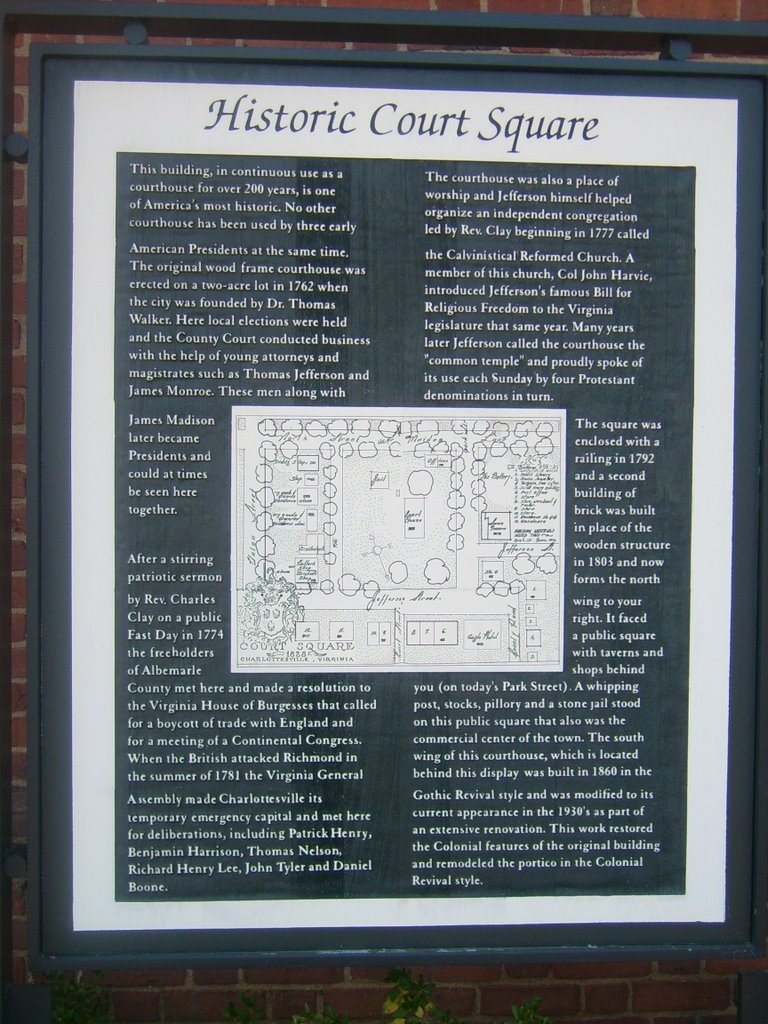
Those who live in Charlottesville might appreciate taking a stroll through Court Square and reading the historic marker there which notes Thomas Jefferson’s role in the 1777 organization of a "Calvinistical Reformed Church" led by Rev. Charles Clay and meeting in the County Courthouse. Notice also that it was a member of this Calvinistic congregation, Col. John Harvie, who introduced Jefferson’s Bill for Religious Freedom in the Virginia Legislature in 1777. Note also how Jefferson referred to the Courthouse as a "common temple" and was proud of its use each Sunday by no less than four Protestant churches in turn.
Why did religious freedom arise in America? Was it because of free-thinking Deists or was it because of committed, Scripture saturated Christians?
For more photos from Charlottesville’s Court Square, check out this photo album.
JTR