Monday, July 31, 2006

Oklahoma church ponders baptism and church membership

Henderson Hills BC of Edmond, OK was set to vote over the weekend on removing the requirement of immersion baptism for church membership. See the BP article. The Elders in this SBC church did generate a lot of theological/exegetical work on the subject. See the HHBC baptism documents. This proposal has met with opposition from their fellow SBCers in OK. See Pastor Rick Thompson's reponse in the Baptist Messenger. See also the satirical piece by Jeff Young on "Mr. and Mrs. Sprinkled Prospect." HHBC has obviously been influenced by John Piper who has made a similar proposal, now in in limbo, to his church. See my audio response to Piper. HHBC also seems influenced by Wayne Grudem and they hold a non-cessationist position on charismatic gifts (see the position paper from their elders).
All the points I made to Piper apply here. How can we separate the requirement of Biblical (for believers and by immersion) baptism from church membership?
JTR

Saturday, July 29, 2006

Oh be careful little mouth what you say... in church!

Last weekend I was at my sister’s wedding in North Carolina. On Sunday morning my family set out to find a place to worship—something we rarely do apart from our beloved JPBC. We turned into a Baptist church off the main road near our hotel in an affluent suburban area near Charlotte. We attended the third of three morning worship service in the "worship center" which also doubles as a gym. According to the bulletin the church has c. 450 in Sunday School and c. 700 in its combined worship services. There were lots of well dressed young adults and families present. The third service was supposed to be the "traditional" one, which meant there was a choir and we sang two hymns along with the praise songs that were projected on the screen. The church children (not ours) abruptly left the service about midway through. The Pastor had a shaved head and wore a sleeveless sport shirt. The guest speaker, a former athlete who now has an evangelism ministry, was also dressed casually and had a shaved head. He was speaking in the morning and then doing evangelism training in the evening. The message was topical. I did appreciate this brother’s zeal for evangelism and his challenge to the worshippers to be more evangelistic.

What struck me were the conversations we heard before and after the service. First, no one spoke to us or greeted us or asked who we were. On one hand the anonymity was nice. On the other hand, my guess is no one was sure whether we were members, visitors, or regular attendees. Before the service one older man greeted another near us with a snide remark about the music chosen for the service. My guess is the older man was not happy with the lack of hymns. After the service, one woman in the line to leave complained to her friend that the preacher spoke so fast that she really could not understand him. The other woman shared that she was not planning to come back to the evening service herself, but she might invite her younger neighbors to attend! I thought of the children’s song: "Oh, be careful little mouth what you say!"

Of course, I began to wonder what guests hear when they visit our church. Mature believers know that everything we do and say is part of our witness. This is particularly true of what we do and say in church. Others are watching and listening. They may be guests visiting our church, or immature Christians, or children, or non-believing attendees. Do our words in church and life edify and bear witness to mature faith in Christ?

Thursday, July 20, 2006

Jefferson Park VBS 2006: "Bethlehem Village"


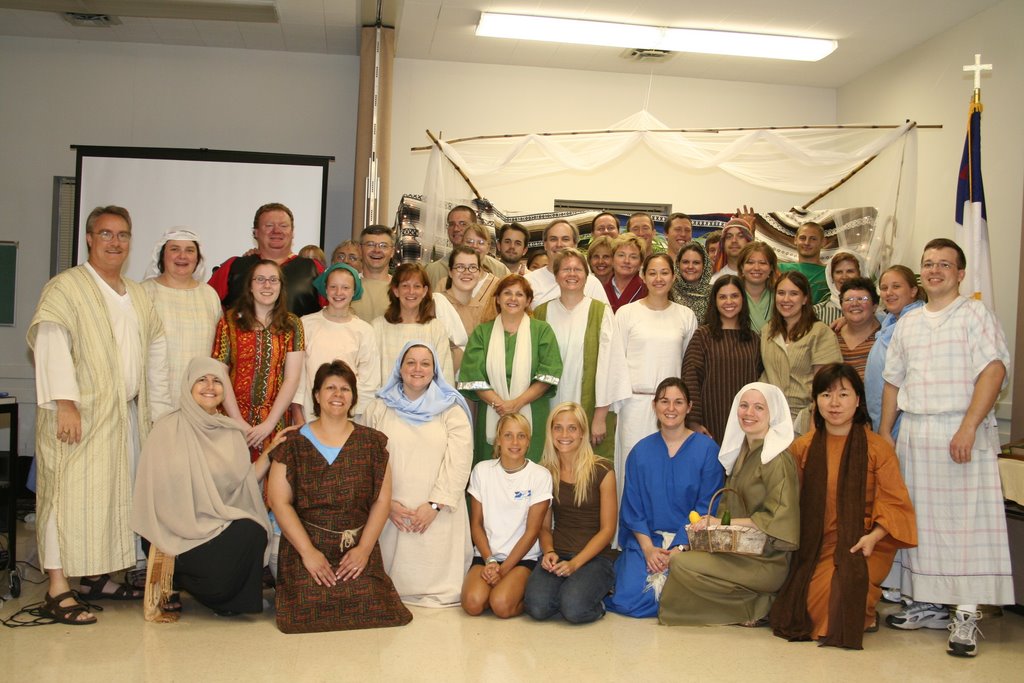
Pictured above is part of the JPBC team of youth, students, and adults who have made our 2006 Vacation Bible School work. Despite extremely hot weather in central Virginia we have had an excellent VBS thus far and have ministered to scores of children from our community. We are using the Group "Bethlehem Village" VBS that centers on telling the Christmas story. The children are divided into the twelve tribes of Israel. Children of various ages (from preschool to grade 6) are in a tribe together with youth and adults leaders. I think this "intergenerational" concept has worked great. It seems when kids are grouped only with children of their same age, they can compete with and pick on each other. This year it has been great to see older children enjoying being with and helping the younger ones. Of course, we have done it all in costume. It is also interesting to see how the children begin to identify with the Israelites and resent the "Roman" characters/leaders. One of the best things about VBS, of course, is just the fellowship and "shared experience" we all enjoy in working together in ministry. Our VBS directors, Melia Hatfield and Stephaine Glass, both elementary school teachers, have done a great job in organizing this event.

Saturday, July 15, 2006

Update

It's been a long time since my last post. I got busy this week with various and sundry things and had little time for writing. Among other things:
  • Monday-Deacons Meeting
  • Getting Together with H Family Tuesday evening (former JPBC-ers and college/seminary friends now living in Mauritania)
  • Church Conference Wednesday Night
  • Working on July Evangelical Forum Newsletter-hope to finish and mail next week
  • Kindergarten Open House Thursday night (Thanks for being "ringers" Chris and Heidi!)
Last night (Friday) I hosted four folk (two father-son combos: John and Sam; Doug and Josh) from Calvary Memorial Church in Roanoke (where our former members the Rawlings family are now connected). Enjoyed the fellowship with these guys. They left my house at 4:45 am for the C-ville airport to fly to Atlanta and rendezvous with the rest of their team (that flew from Roanoke) and then on to Honduras, where they will be doing two VBS ministries and some construction projects for local churches.
Llew and kids have been camping at Chincoteague with Cris Widder and her son David since Wednesday and come home this afternoon.
Another highlight of the week: Yesterday I went out to our garden and picked a mess of grean beans and a squash which I cooked (beans) and fried (squash) and had an all-garden lunch. Gotta love summer!
I did get around to updating my blog template to "minima blue" and finally figuring out how to add a few links.
More later!
JTR

Wednesday, July 05, 2006

Letter to Prisoner of Conscience

Recently I have been reading Garnett Ryland’s book The Baptists of Virginia 1699-1926 (Virginia Baptist Board of Missions and Education, 1955). The history of early Baptists in Virginia is particularly striking reading on the week in which we celebrate our nation’s Independence Day. Early Baptists in Virginia suffered regular persecution. As dissenters, their pastors were arrested for preaching without a license or for meeting in unauthorized gatherings. They suffered the injustice of having their taxes support the Church of England, whose doctrine they opposed. It was no surprise that when the Revolutionary War began Baptists were among the first to enlist to fight against English tyranny. Even after the war for American independence was won, the Baptists continued to petition and send memorials to America’s Founding Fathers urging the safeguarding of religious liberty that American citizens enjoy today.

Here is one example of what early Baptists endured.

On August 21, 1773 Nathaniel Saunders, pastor of Mountain Run Baptist Church in Orange and William McClannahan, assistant pastor of Carter’s Run Baptist Church in Fauquier were arrested in Culpepper County on the charge that they did "Teach & Preach Contrary to the Laws & usages of the Kingdom of Great Britain, raising Sedition & Stirring up Strife amongst his Majestie’s Liege People." Saunders was brought to court on September 20, 1773 and committed to jail, because he refused to give bond that he would "neither teach, preach, nor exhort for one year except in his licensed meeting house."

He soon received this letter from David Thomas his spiritual father in the ministry:

Dear brother,

I hear you are put in prison for preaching the Gospel of Jesus Christ. Perhaps you may think it hard. But O, what honor has the Lord put upon you! I think you may be willing to suffer death now, seeing you are counted worthy to endure a dungeon for your Master’s sake. Hold out, my dear brother! Remember you Master—your royal, heavenly, divine Master—was nailed to a cursed tree for us. O, to suffer for him is glory in the bud! O, let it never be said that a Baptist minister of Virginia ever wronged his conscience to get liberty, not to please God, but himself! O, your imprisonment (which I am satisfied is not from any rash proceedings of your own) is not punishment, but a glory! "If you suffer with him you shall also reign with Him."

Dear brother, the bearer is waiting or I should have enlarged. This is only to let you know that I can pray for you with great freedom. Give my kind love to your fellow-prisoner, though I know him not. I hope he is a dear child of God. Pray for me, for I need it. I remain dear brother,

Yours in our dear Lord Jesus, David Thomas

Fauquier, September 26, 1773

N.B. Let me hear from you the first opportunity.

Note: See Ryland, pp. 80-81. Ryland cites the source as Religious Herald, October 30, 1856, copied from original sent by Nathanile Saunders’ grandson, Francis J. Saunders, to Williams Sands.

May God make us men and women whose consciences are likewise captive to Christ.

Grace and peace, Pastor Jeff Riddle

Monday, July 03, 2006

A Story of Biblical Forgiveness

I am preaching through the parables of Jesus in Matthew 18-25 this summer at JPBC. Yesterday's message was "The True Foundation of Forgiveness," based on the parable of the unmerciful servant (Matthew 18:21-35).
Near the end I included this story of Biblical forgiveness from Eric Wallace's book Uniting Church and Home:

About fifteen years ago, a married man in our church got angry with his wife and shot her in the head. Miraculously the woman survived. Her husband went to jail. Years later, however, the man repented of his sin and asked his wife’s forgiveness. Today they are still married. I know this man fairly well. I remember his telling the congregation about what he had done and how he had given God the glory for reuniting [him] and his wife. This was the most powerful example of God bringing healing and forgiveness I have ever seen. To this day, it serves as a reminder of how great God’s power is, even in the darkest circumstances (p. 181).
JTR

Thursday, June 29, 2006

Are the Daughters of Philip Among the Prophets of Acts?

I have an article just out in the most recent issue (Spring 2006) of the Journal For Biblical Manhood and Womanhood, published by the Council for Biblical Manhood and Womanhood. Jeff Robinson has done a review article on the whole issue.
My article is titled "Are the Daughter of Philip Among the Prophets of Acts?" In it I explore the mention of the prophesying daughters of Philip in Acts 21:9. Many feminists naively jump on this brief mention to argue that these women were filling the public ministry office of prophet in the church, thus justifying egalitarian roles in the contemporary church. I argue for a complementarian perspective on Philip's daughters, noting that though these women prophesy, they do not fill the office of prophet, a role that is singularly reserved for men in Luke and Acts.
Here is a slightly edited excerpt from near the end of my article:
It must be acknowledged, for example, that Luke does not depict women as serving in leadership roles in which they exercise doctrinal or teaching authority over men. Women do not teach or preach in Acts. Like Dorcas, they are known for being "full of good works and almsgiving" (9:36) which might have included skillful sewing for the widows (9:39). Luke presents women who open their homes for the meetings of the church, as did Mary, the mother of John Mark (12:12). Like Lydia, they extend hospitality to the itinerant prophets (16:15, 40). It is true that Priscilla "explained" to Apollos the "way of God more accurately" (18:26), but only alongside her husband Aquila. It should likewise be noted that the four prophesying daughters are clearly "in the household of Philip" (21:8). The implication is that they exercise this ministry under their father’s authority. It is difficult to find any liberationist models of women overtly engaged in leadership within the Christian movement in Acts. Ivoni Richter Reimer’s effort to find a redeeming feminist message within the Ananias and Sapphira story (Acts 5) or in the brief mention of the daughters of Philip reveals how difficult, and indeed futile, the search is. Yet this need not mean that Luke represents a "retrograde movement" in early Christianity with respect to the place of women in early Christianity. The most satisfying conclusion that one may draw upon reviewing Luke’s depiction of women in Acts is the complementarian perspective. Luke affirms women as equal participants in the Christian movement and yet he also clearly affirms that certain offices, like that of prophet, are limited to men only. As for the daughters of Philip, once again, Luke can affirm the fact that they prophesy. This does not mean, however, that they serve as prophets.
Hopefully the whole Spring 2006 will soon be posted online on the CBMW journal page.
JTR

Spurgeon's Catechism Questions on the Lord's Supper

"…do this in remembrance of Me" (1 Corinthians 11:24).

This Sunday morning we will gather again to observe the ordinance of the Lord’s Supper. What is the Lord’s Supper and what is required of those who take part? Consider the teaching offered in Charles Spurgeon’s 1855 Catechism:

Question 80: What is the Lord’s Supper?

Answer: The Lord’s Supper is an ordinance of the New Testament, instituted by Jesus Christ; wherein, by giving and receiving bread and wine, according to His appointment, His death is shown forth, and the worthy receivers are, not after a corporeal and carnal manner, but by faith, made partakers of His body and blood, with all His benefits, to their spiritual nourishment, and growth in grace.

Question 81: What is required to the worthy receiving of the Lord’s Supper?

Answer: It is required of them who would worthily partake of the Lord’s Supper, that they examine themselves of their knowledge to discern the Lord’s body, of their faith to feed upon Him, of their repentance, love, and new obedience, lest coming unworthily, they eat and drink judgement to themselves.

See you this Sunday around the Supper table, Pastor Jeff Riddle

Thursday, June 22, 2006

Links Here and There

  • Gene Bridges has posted my review of Frank Page's booklet "Trouble with the TULIP" at "Strange Baptist Fire" and "Triablogue." One early comment: "Isn't this review longer than the actual book?" Chuckle.
  • Also, the BP article citing my review of Kevin Swanson's "Upgrade" is posted at the Baptist Courier website (SC Baptist paper).
  • I got a very nice email from Nelson Searcy of the Journey Church, NYC after my review of the SBC Pastors' Conference. He pointed out that his church does, in fact, unapologetically use the title "church" in identifying itself, even though the SBC Pastors' Conference program left it out. He also sent me a DVD of a baptismal service in his church that I look forward to watching. I noted on his website that they require two months attendance and a membership class before one can join. Kudos!

Monday, June 19, 2006

Bible Notes: Paul as Prophet Like Samuel (1 Samuel 12:1-5)

While Bible reading the other day, I was struck again by Samuel’s defense of his prophetic ministry at the coronation of King Saul in 1 Samuel 12:1-5 which reads, in part:

3 "Here I am. Witness against me before the LORD and before His anointed: Whose ox have I taken, or whose donkey have I taken, or whom have I cheated? Whom have I oppressed, or from whose hand have I received any bribe with which to blind my eyes? I will restore it to you."
4 And they said, "You have not cheated us or oppressed us, nor have you taken anything from any man's hand."
5 Then he said to them, "The LORD is witness against you, and His anointed is witness this day, that you have not found anything in my hand." And they answered, "He is witness."

Compare Paul’s defense of his ministry in places like Luke’s account of his speech to the Ephesian elders in Acts 20:33-35:

33 I have coveted no one's silver or gold or apparel.
34 Yes, you yourselves know that these hands have provided for my necessities, and for those who were with me.
35 I have shown you in every way, by laboring like this, that you must support the weak. And remember the words of the Lord Jesus, that He said, 'It is more blessed to give than to receive.'

Or in his epistles, at, for example, 2 Corinthians 11:7-9:

7 Did I commit sin in humbling myself that you might be exalted, because I preached the gospel of God to you free of charge?
8 I robbed other churches, taking wages from them to minister to you.
9 And when I was present with you, and in need, I was a burden to no one, for what I lacked the brethren who came from Macedonia supplied. And in everything I kept myself from being burdensome to you, and so I will keep myself.

Did Paul, in his defense of his ministry, see himself as an apostle-prophet like Samuel and the other prophets of old? Did others who knew him, like Luke, also see him as a prophet?

This was the thesis of my 2002 dissertation at UTS, "Paul as Prophet in the Acts of the Apostles."
JTR

Lewis Carroll: Postmodern When Postmodernism Wasn't Cool

My daughter Hannah was in a Blackbox (local children's theater) production of "Alice in Wonderland" last year. She played the middle-sized Alice and did a great job (in my unbiased opinion). Seeing the play made me want to read Lewis Carroll's strange books ["Alice's Adventures in Wonderland" and "Through the Looking Glass"], which I finally finished just this week.

Lewis Carroll was the pen name for Charles Lutwidge Dodgson (1832-98). See the Wikipedia article. He published "Alice" in 1865 and "Through the Looking Glass" in 1872. After reading the books, I was not surprised to find in the Wikipedia article questions raised about Dodgson's departure from the faith of his orthodox Anglican father and his interest in "minority forms of Christianity" and "alternative religions (Theosophy)." More disturbing questions are raised about his character, but this might be the modern tendency to debunk the morals of any figure from the past.
Reading "Alice" makes one think that Dodgson was a postmodern before postmodernism was cool.
Take, for example, this interchange between Alice and Humpty Dumpty:
"When I use a word," Humpty Dumpty said in rather a scornful tone, "it means just what I choose it to mean--neither more nor less."
"The question is," said Alice, "whether you can make words mean so many different things."
"The question is," said Humpty Dumpty, "which is to be master--that's all."
Humpty Dumpty could well be Bill Clinton saying, "That depends on what the meaning of "is" is," or the modern literary professor saying that the text means whatever the reader says it means.
Dodgson's sad life shows what a blind alley this path becomes.

Saturday, June 17, 2006

Paul Washer Preview

Paul Washer is coming on a preaching mission to JPBC November 29-December 3, 2006. For a preview of Paul's preaching, listen to this online message with the provactive description, "Shocking Youth Message Stuns Hearers-So Shocking and Biblical the Preacher Was Never Invited Back."

Church Covenant Series: Part 11 of 11

The final paragraph of the JPBC Membership Covenant is among the most important. It reads:

If we leave this church, we will immediately seek to join another with similar purposes and covenants.

This part of the covenant reminds us that we are always to seek to be vibrant members of a local body of believers. We are convinced that a born-again believer will not be able to go without consistent fellowship in a local church over a long period of time (see Hebrews 10:24-25). If we permanently move out of the geographical area where our church is located, then we need to find a new body of believers where we can transfer our membership as soon as possible. If for doctrinal, spiritual, or personal reasons we are not able to support the local church of which we are members, we should diligently and promptly seek another where we can be joined in good conscience.

This is important for at least three reasons. First, every authentic believer must seek to be a healthy body part (church member). Paul wrote to the Corinthian believers: "Now you are the body of Christ and members individually" (2 Corinthians 12:27). Second, when we transfer our membership to a new church, we relieve our old church of the direct burden of pastoral oversight and concern for us. This is a matter of common courtesy to one’s former church and helps the church avoid an unwieldy list of "inactive" members. Third, when we find a new congregation we desire to join we are able to be a blessing and encouragement to them by becoming a part of their fellowship. Every time a new member joins our church we feel encouraged and affirmed in knowing that someone else wants to become part of our family. Though a new attendee in a church should carefully and prayerfully examine the doctrine and practice of a local church before joining it, he should also beware of avoiding commitment by waiting too long to join. Persons who become long time attendees but who resist making a membership commitment can actually discourage the body through their unwillingness to publicly identify with the church in membership.

You will note that the covenant suggests this should be done "immediately." To avoid legalism, however, no specific time frame is added. Choosing a new church home requires care and patience. In most cases, however, we would encourage anyone who departs from our fellowship to find a new church home within six months. In fact, our church Constitution allows us to remove persons from active membership who have been absent from our fellowship for a period of more than six months, unless there are extenuating circumstances.

Our prayer is that all of our members will be active parts of this body. If a member should leave us, our prayer is that he will, in a timely manner, find a like-minded church family in which he can thrive and grow in Christ.

Grace and peace, Pastor Jeff Riddle

Reflections: SBC Meeting, Part Two, Wednesday

Wednesday (June 14):

SBC Wednesday morning:

The highlight was the resolution report. Before that though, with the convention running ahead (!) Bobby Welch took a moment to "preach" on Matthew 13:24-30 on the Wheat and the Tares (an anticipation of any discussion on church discipline?). After intoning that we should not attack our "enemies" in the SBC, he proceeded to attack Calvinists by saying that if Calvinists are really as hot-hearted about evangelism as they claim and "they know who the elect are" (something no Calvinist says) then they should "put up or shut up" by boldly evangelizing.

In the resolutions discussion, Tom Ascol failed to get his church discipline resolution back on the floor. Resolution chairman T. C. French’s response that (a) we do not know that churches are misrepresenting their numbers and (b) inactive members make a good prospect for "evangelism" was astounding. So, we are now "evangelizing" church members? Whatever happened to regenerate church membership?

Most debate was on Resolution 5 "On Alcohol Use in America." It held a veiled jibe at "antinomian" Calvinists. Several reformed men took the bait and fought it as opposed to inerrancy. Though I agree with them, I do not think it was wise to fight this on the floor. In fact, it was amended to make it even tighter urging the SBC to appoint only tee-totalers to offices. By the way, I do not drink alcohol at all and have seen its sinful abuse as a pastor in my people. Still, I like our JPBC covenant that simply says that we will not "abuse ourselves through addiction or excess."

One of the high points of the whole SBC was Secretary of State Condi Rice’s address c. 10 am. She regally entered to thundering applause and delivered a dignified and powerful speech on America’s moral obligation to protect religious liberty and fight injustice. Most poignant moment: In discussing America’s opposition to international sex-slave traffic, she stated that slavery is not over in the world and America will stand against it. This was met with the most thunderous standing ovation. Wow! The convention begun in 1845 to allow slave owners to be missionaries, standing to applaud an African American woman secretary of state as she denounces slavery. We see God’s gracious providential hand in history.

The South African Donald J. Wilton, Pastor of FBC Spartanburg, SC, preached the most powerful message of the convention on God’s second visitation to Solomon in 1 Kings 9. Though I am not sure we would see eye to eye on all things theological, I liked his statements of love for his local church and for his wife and his bold call for Southern Baptists not to make an idol of our convention.

At the lunch break I attended the Southern Seminary luncheon. It was packed with nearly 900 attendees. Mohler gave a good talk. SBTS is so different than when I was there from 1987-90. It is truly hard to believe.

I left for home after the SBTS lunch, so I missed the evening session and the unveiling of the Graham statue (or as my friend Rob Stovall called it, "the graven image" and "the golden calf"). Got to join my JPBC brothers back home for our Wednesday Bible study to report our SBC observations to our members. It was good to go to the meeting but better to be home.

In my report to our church I listed five key issues in this meeting:

1. Transition in leadership in the post-conservative resurgence era.
2. Stress on need for Cooperative Program support and resentment against churches that give little in percentage.
3. The need to be bold in evangelism.
4. The need for better work and cooperation among trustees.
5. The emergence of doctrinal dialogue. Battle for Bible has been won—we agree on inerrancy. Now the issue is what the Bible says. Among issues: Calvinism (soteriology); Church Discipline; Missiology (emerging church).

JTR

Reflections: SBC Meeting, Part One, Tuesday

Let me get these thoughts down before they cool off.

2006 SBC Reflections:

Tuesday (June 13):

Founders Breakfast:

I was up at 4:30 am! We left our hotel in Reidsville, NC (as close as we could get) at 5:45 am to make the Founders Breakfast at 6:30 am. First, I was surprised that the crowd (c. 300) did not seem as large as last year in Nashville when R. C. Sproul spoke and Steve Camp did music.
We got some good gifts here, including Curtis Vaughan’s paperback commentary on Ephesians and Dever’s new Elders booklet. Got to meet Tom Ascol face to face for a brief moment. Dever’s message was on Romans 9-10. He read it all out loud and pounded home the standard Reformed understanding. Mark can deal with long passages like this. I usually prefer a smaller chunk.

SBC Tuesday morning:

Interesting to be in a business meeting with 12,000 people. The "Everyone Can, And I’m It" slogan hung in larger than life letters from the coliseum ceiling. I get the meaning: "Everyone can share the gospel, and it is my responsibility to do so." But the phrase smacks of such a man-centered overtone that it is hard for me to like it. We kept thinking of alternatives like, "Everyone can’t, but God can."

Motions were introduced including those by ubiquitous SBC Falstaff Wiley Drake and the much anticipated motion by Wade Burleson seeking external investigation of the SBC.

This session also had the first of the convention baptisms. These make my Baptist body cringe. A note in the program read: "Because baptism is an ordinance of the church, all baptisms will be conducted with full approval and support of a sponsoring home church, with members each present to witness." But I have enough Landmark in my bones to be deeply bothered by a local church event being held in an SBC meeting. We are not Jehovah’s Witnesses (they too do their "baptisms" in a convention setting)! It also amazes me that conservatives in the leadership were quiet on this, especially those seeking Landmark-style requirements for IMB mission candidates.

We left a little early to walk across the road and have lunch at Stamey’s Barbecue.

SBC Tuesday afternoon.

Highlight was the presidential election. I have already reviewed Frank Page’s book, so I have already gone on record that I am not sympathetic with his anti-Calvinist stance. I had about decided to vote for the newest candidate, Jerry Sutton, having read his book on the SBC reformation a few years back. But a Pastor friend called me last week and swayed me back to Page. Anyway I met that same brother later at the SBC, and found he had since switched to Sutton!

Oh well, Page won. This has been and will be much analyzed. A protest vote against conservative cronyism and nepotism? A moderation of the convention sans moderates? A statement against "neo-Calvinists"?

I was also thinking about the pros and cons of this variety of Baptist democracy. I later heard Al Mohler say that our Baptist democracy was the thing that saved the SBC from liberalism. Unlike Episcopalians, for example, we have no bishops protected from a grass roots uprising. Yes, that’s good. But is the tendency to reject leadership a not so subtle sign of sin? Isn’t our tendency not to want to submit, to be anti-authoritarian, a sign of our sinfulness? Did the actions of this convention play into that?

SBC Tuesday evening.

Brian, Steve, and Geoff left at the break to head home. Steve Hills (Western Branch BC, Suffolk) and I had supper at the concession stand. We sat with a Roman Catholic priest (he stood out wearing the collar at this SBC gathering) named Frank Ruff (sic). We learned that he is an official Roman Catholic observer at this meeting. When I asked him about his observations he noted that he loved Southern Baptists and thought we were all part of one big family. He thought the biggest thing that divided us was ecclesiology and not theology proper. I pursued by asking about our division on authority (Scripture) and then the doctrine of justification by faith. He contended that we believe the same thing. I differed and noted the significance in this regard of the upsurge in Calvinism. Yes, Arminian evangelicalism and its emphasis on synergism in salvation is close to the Catholic view but not the monergistic view of salvation held by the Reformers. No surprise that neither of us budged on this.

Anyhow Steve and I made it late back into the session and missed casting our vote for Mark Dever in the runoff which he lost by c. 70 votes. What message does this send about neo-Calvinism?

The nomination speech for Wiley Drake was an SBC classic. Just goes to prove how important a nomination speech is in meetings like this. Frank Page likely also had an edge by having the best nomination speech in his race.

The multi-candidate elections set the schedule back very late. But Steve and I stayed till the end. My least favorite message of the entire convention was that of James Walker of Biltmore BC in Arden, NC. He told of his church’s inability to get people who had made "decisions" for Christ to come to the church to get baptized, so they came up with the idea of an outdoor baptism to which they invited their "converts." They even served hamburgers and hot dogs to get people out and baptized over 90. The next year they did it again and baptized over 160. Question: If you cannot get your "converts" to come to church to be baptized unless you serve them refreshments, were they ever really converted?

By the end of this session, there were only a few hundred people left in the cavernous coliseum. That was a shame, because Richard Land gave an excellent report on the Ethics and Religious Liberty Commission. It should have been heard by more.

Thursday, June 15, 2006

Notes: Mohler-Patterson Election Dialogue

Though you can get the audio and listen for yourself, here are my notes from the first session of the Mohler-Patterson Dialogue on Election held June 12, 2006 at the SBC Pastors' Conference in Greensboro:

I. Patterson spoke first:

He first stated that he admires Calvinists for the following reasons:

1. They live pious lives.
2. They think theology is important.
3. They recognize the dangers with the charismatic movement.
4. They see man’s purpose as giving glory to God.
5. They affirm inerrancy.
6. They believe in salvation by grace alone.

He then listed his concerns:

1. Some Calvinists believe all non-Calvinists are Arminians.
2. Some Calvinists believe all non-Calvinists do not accept the doctrines of grace.
3. Some Calvinists say that non-Calvinists do not believe in God’s sovereignty.
4. There are antinomian tendencies among some Calvinists (e.g., in the area of alcohol use).
5. Some Calvinists are not honest with pulpit committees when seeking churches.
6. Calvinism can breed a lack of compassion for the world.

Then he outlined why he is not a "Dortian Calvinist":

1. Irresistible grace makes salvation coercive.
2. Universal atonement is "entirely too compelling."
3. Bible links salvation and foreknowledge.
4. He desires to see God as good and just.
5. Calvinism is the death knell for evangelism.
6. Calvinism is a "system"; Those who embrace part must embrace all (infant baptism; Calvin’s views on church and state, etc.).
7. Cannot accept double predestination (He cited Calvin here as saying God created some for salvation and others for damnation).

In final comments he noted:

1. It is God’s will that every human being will be saved, but not all will. He cited 1 Tim 3:6; 2 Peter 3:9. He rejected Calvinist view of secret and revealed will of God.

Further cited Isa 53:6 and John 1:29 as evidence of atonement that is "potentially universal." He added: 1 Tim 4:10; 2 Peter 2:1; 1 John 2:2; Matt 23:37; John 4:10.

2. The Bible says we are to persuade men. He cited Paul in Acts "persuading" men to believe in Jesus.

He ended by saying that at the Judgement he will stand before God. If Calvinism is right he will hear: At least you made the effort though wrong. But if Calvinism is not right, he will hear: Well done.

II. Mohler spoke next.

He began by noting that were it not for the conservative resurgence, we might be here debating the ordination of homosexuals to ministry.

He asked: "Am I a Calvinist?" and answered, "Yes. I believe in the doctrines of grace, or Calvinistic soteriology."

But he said that no one can be drawn against his will to Christ. He said he does not believe in the fictitious person who is saved against his will.

He referred to those who differing views on salvation working together like Wesley and Whitefield; Spurgeon and Moody.

He cited reasons we are all Calvinists:

1. The analogy with the doctrine of inerrancy. God inspired Biblical authors to write scripture without abusing their will.
2. We affirm the substitutionary atonement.
3. We believe in the unconditional omniscience of God. Some believe more; some less, but all believe.
4. We all affirm the perseverance of the saints. "We are not Nazarenes."
We are inheritors of a common history in which the majority affirmed the doctrines of grace. What binds us together is agreement on the need for the "well meant offer of the gospel."

Next he addressed hyper-Calvinists.
He said that though there are some Calvinists who are hyper, there are not many hyper-Calvinists!

He noted there is a tendency among Calvinists to be argumentative, to have a "debating personality." He said it is not healthy to have people who will drive across the state to debate Calvinism but who will not drive across the street to share the gospel.

He affirms "Whoseover will" but sees it not only as a potentiality but as a reality.
The second fictitious person he cites in this debate is the one who wants to respond to Jesus but who is denied. There is no such person.

We must be eager to "persuade" like Paul. All are Calvinists because we believe in prayer. When we send out evangelistic teams we do not say, "Good Luck!" No. We pray for God to open eyes and hearts, so men will believe.

III. Question and Answer.

Reflections: 2006 SBC Pastors' Conference

Now, on to the SBC meeting in Greensboro. The JPBC contingency (Brian Davis, Geoff Glass, Steve Belcher and I) left Charlottesville for Greensboro Sunday afternoon.

This was my second SBC meeting. Last year in Nashville was my first.

First, some reflections on the Pastors' Conference:

Session I (Sunday evening): This was a disappointment to be honest. We got there at the end of Dick Lincoln’s message. There was a terrible storm outside and the coliseum lost power at the start of Johnny Hunt’s message. The favorite line of our group from Hunt (oft repeated through the week: "I’m about to have a spell!" Rick Warren was supposed to speak but was unable to come for some unexplained family reason. Instead, he sent a video message. I felt like I was in a multi-site church and know now why I do not like them. Impersonal. You have to admire his giving away a large part of his royalties from PDL sales. But it was hard to get over statements like (paraphrase): "God will do as much in your life as you allow him to do."

Session II (Monday morning): Much, much, much better. The highlight of the week and the conference. Hands down. I say this even given the fact that I do not like "break-out" sessions.

Block One: We first attended the Mohler-Patterson dialogue on election. Wow. Two SBC seminary professors sitting in a room with thousands looking on, three deep standing at the back, to hear two SBC theologians discuss election.

Mohler came in wearing dark sunglasses—he had emergency eye surgery Monday at Duke. We suspected he might sit down at a piano at any moment and break into "Georgia on My Mind." He looked to be in pain. But he delivered the goods in the election "discussion." See my notes.
Patterson seemed a bit punchless in the discussion and even helped the other side by making an effort to disabuse the audience of the notion that Calvinism is necessarily anti-evangelism.
Mohler bettered the folksy, populist Patterson by delivering the best zingers. His most poignant observation at the get-go: "If not for the conservative resurgence in the SBC we might be sitting here today debating the ordination of homosexuals into ministry."

Block two: Next we went to Dever’s presentation on Church Discipline. Not much new if you’ve read Dever, but you got the sense his pounding on Matthew 18 and 1 Corinthians 5 was new to many in the standing room only crowd. His co-presenter was an associate at Johnson Ferry BC. His comments were more along the lines of: "We would really like to start doing discipline in our 7,000 member church and we have an organizational flow chart but we haven’t really done it." How stark was the contrast to Mark who held up his church list of c. 500, each of which is known by the Elders.

Block three: "Reaching Today’s World Through Apologetics." This was led by Phil Roberts, president at MWBTS and William Lane Craig of Talbot. I have always admired Roberts’ work at NAMB ("Mormon Puzzle" done while he was there is the best evangelical resource on Mormonism out there). William Lane Craig was dynamite. Clear, articulate, and very practical. He is a member at Johnson Ferry BC and teaches a SS class called "Defenders" on apologetics. He noted that mainly men have been drawn to the class. He also made an aside observation that much of our modern praise music drives men away, because it is so effeminate. Hymns are manly!!! This was a great session.

Session III (Monday afternoon): This was the "contemporary" service. The music, led by Jonathan Munson, was not as bad as I had feared it might. The three speakers were: Nelson Searcy (The Journey, NYC); Kerry Shook (Fellowship of the Woodlands, Texas); and Erwin McManus (Mosaic, LA). Notice none use the name "church." Of the three I liked Searcy’s message best. He actually exposited a text from Colossians! I liked Shook’s least. He played a video clip of a service in which a motorcycle jumped over his head and used minimal scripture in his talk. It seemed to be the worst kind of appeal to the flesh. And what do you say about McManus? His was the most engaging presentation. It was filled with energy and passion. Best line: "I know I live in LA, but I’m not a vegetarian. I don’t believe we should eat anything that isn’t able to run away from us. I can’t help it if cows are not highly motivated." He played a clip of a Mosaic convert. A troubled young woman who found Jesus. Lingering question: How has coming to Jesus changed her dress, speech, and lifestyle (including even her appearance)?

Of all these, I can say I appreciate their zeal for sharing Christ. It challenges me to want to reach out more to the lost. But is some of this zeal without knowledge (Rom 10:2)? Question: Does the rejection of traditional exterior forms (the name "church"; traditional sacred music and orderly worship; etc.) also subtly play into a modern anti-authoritarian attitude that will not lend itself to "traditional," orthodox Christianity?

Session IV (Monday evening): This was the "traditional" worship. "New" Southern Baptist David Jeremiah started the evening off. He made note of his broadcasts on TBN as a mere delivery system and expressed no love for Paul Crouch. The best part of his presentation was a video of baptism testimonies (as we also do here at JPBC). It was powerful to hear the testimonies and see the baptisms of these adults from all backgrounds (men, women, blind, Hispanic, former Muslim, etc.).

Joyce Rogers, widow of SBC colossus Adrian Rogers, also gave a very dignified and God-centered testimony. The thought ran through my mind: Why did God choose to use Adrian Rogers as an instrument for reform in SBC life? Maybe it was because of Joyce’s godly character and maturity. She also stunned many when she made the first overtly political statement of the Greensboro Convention by saying that Adrian would not be pleased with attempts to narrow the participation of fellow conservatives.

Tony Evans preached next. He stacked up a series of stories in a sandwich sermon, but it was hard to follow Joyce. We decided to leave early and so we missed Ed Young’s sermon, which as I hear followed up on the themes Joyce Rogers introduced.

Thus ended the Pastor’s Conference in which we had heard 13 sermons/testimonies/messages in 1.5 days!

Conference Reflections: HEAV 2006

I really do not attend a lot of conferences through the year, but it just so happens that this past week I attended two back to back. First, last Friday-Saturday (June 9-10) I was at the Home Educators Association of Virginia (HEAV) meeting in Richmond and then the SBC meeting Sunday-Wednesday (June 11-14) in Greensboro, NC.

First, some HEAV reflections (I’ll do a separate SBC posting). Llewellyn and I went to this one together. Her Mom and Dad came up and kept the kids, so in addition to this being a conference it was also a good occasion for us to spend time together.

This was our second year at HEAV. It provides numerous seminars on homeschooling and a large exhibition area with curriculum providers, book-sellers, and conservative Christian ministries. Mostly, it is just encouraging to be with others who are doing homeschooling.

It is very interesting to see the people who are there. They are a counter-cultural group. There are people who are choosing to live separately from modern culture by varying degrees, from the conservative Mennonites and Brethren to more mainstream evangelicals. All are passionate about homeschooling. There is also a great love evident for good literature, for history that takes into account America’s Christian roots, and a passion for godly families.

The keynote session on Friday (June 9) morning was by Richard "Little Bear" Wheeler of Mantle Ministries on "George Washington: First in His Class." He retold some stories of George Washington’s providential escapes from death in battle during the French-Indian War. His point: homeschool education allows parents to teach children a providential view of history.

I next went to the session by Jeff Myers titled, "What Happened When We Kissed Dating Goodbye" in which he told how he courted and married his wife, foregoing the modern dating ritual.

I also attended the session titled "Making Brothers and Sisters Best Friends" by the Mally family of Marion, Iowa.

At the exhibit hall, I got to meet and talk with PCA minister Eric Wallace. He signed my copy of his book Uniting Church and Home, which I am now reading.

Saturday (June 10) the keynote was Jeff Myers again on "Generations of Influence: How to Start a Legacy of Four Generations." I also attended a session presented by Memoria Press (the publisher of the Latin curriculum we use with our kids).

In the afternoon Llewellyn went to a session on teaching writing with Susan Wise Bauer. We are using her "History of the World" material with our children.

We went together to hear Rick Boyer’s session "Some things we’ve learned: lessons from 22 years of homeschooling." Boyer’s presentation was the most engaging. He and his wife live in Lynchburg and have 14 children, from ages 31 to 7. He said he loves to go out with c. 6 of his children and have someone ask, "Are they all yours?" "No," he answers to their temporary relief, "I have eight more at home!" The Boyer family were homeschool pioneers in Virginia. Rick is awfully proud of the fact that his son, Rick, Jr, is now a member of the Board of Supervisors in Campbell County, the same local government that took him to court for truancy in the early 1980s!

The final session I went to was Richard Wheeler’s "Martin Luther had a Wife: Making the Decision of No Return" on guiding your children into good marriages.

We got home late on Saturday and I was up Sunday to teach Kairos class and preach a doctrinal message on 2 Corinthians 13:14 ("Why does the doctrine of the Trinity matter?"), bringing to a close the 2 Corinthians series we began in September 2005. After church we had a farewell lunch for the Browns and then we were off to the SBC. More later.

JTR

Thursday, June 08, 2006

Church Covenant Series: Part 10 of 11

We are nearing the end of our exposition of the eleven paragraphs of the JPBC Church Membership Covenant. Paragraph ten reads:

We know that we do not stand alone and that cooperation and mutual effort are necessary among Christians. We will therefore support the church of Jesus Christ throughout the world in whatever ways God leads us.

This part of the covenant reminds us that although we are an autonomous congregation of believers who govern ourselves independently, we are also connected and accountable to the larger kingdom family throughout the world. We seek cooperation in mission and ministry and share in fellowship and encouragement with other like-minded churches.

We see this as the New Testament pattern. In Acts 11 we learn how the church in Antioch responded to the needs of the believers in Judea during a time of famine: "Then the disciples, each according to his ability, determined to send relief to the brethren dwelling in Judea" (v. 29). In 2 Corinthians Paul urges the church at Corinth also to take part in this offering, praising "the churches of Macedonia" for their generosity in this effort (8:1-2). In fact, Paul says, "that according to their ability, yes, and beyond their ability, they were freely willing, imploring us with much urgency that we would receive the gift and the fellowship of the ministering to the saints" (8:3-4). There was rich cooperation and fellowship among the early churches. This is the pattern we wish to follow.

Jefferson Park has traditionally pursued this part of the covenant through our participation in the Southern Baptist Convention, the largest non-Catholic religious body in the United States. We regularly and generously contribute to the mission causes of the Southern Baptist Convention. These churches share a common confessional statement as expressed in the Baptist Faith and Message 2000. We have also shared fellowship with other Baptist churches in Virginia and in our local area through various associations.

Our covenant makes clear, however, that we are also free to pursue cooperation and encouragement with other evangelical churches, outside our denominational structure, as the Lord leads us.

May God continue to bless us with stirring fellowship with like-minded believers and congregations!

Grace and peace, Pastor Jeff Riddle

Tuesday, June 06, 2006

Review of Frank Page's "Trouble with the TULIP"

An extended book review of Frank Page's out-of-print Trouble With The TULIP is now posted on our website. The Page booklet is only 80 pages long, but it deserves scrutiny, especially since its author is standing for election as SBC President next week in Greensboro. Tom Ascol beat me to the punch in posting his briefer review on his blog yesterday.

JTR